AQA · GCSE · Physics
Course version: 8463 · Version from Sept 2016
Contact and non-contact forces: Force is a vector quantity.
Force is a vector, so it has a magnitude in newtons and a direction, and both are needed for a complete answer.
Checked against the AQA 8463 specification (opens in a new tab) on .
- Point 4 of 5
- 3 key terms
Study notes
From the checked teaching notes for this specification point.
The idea
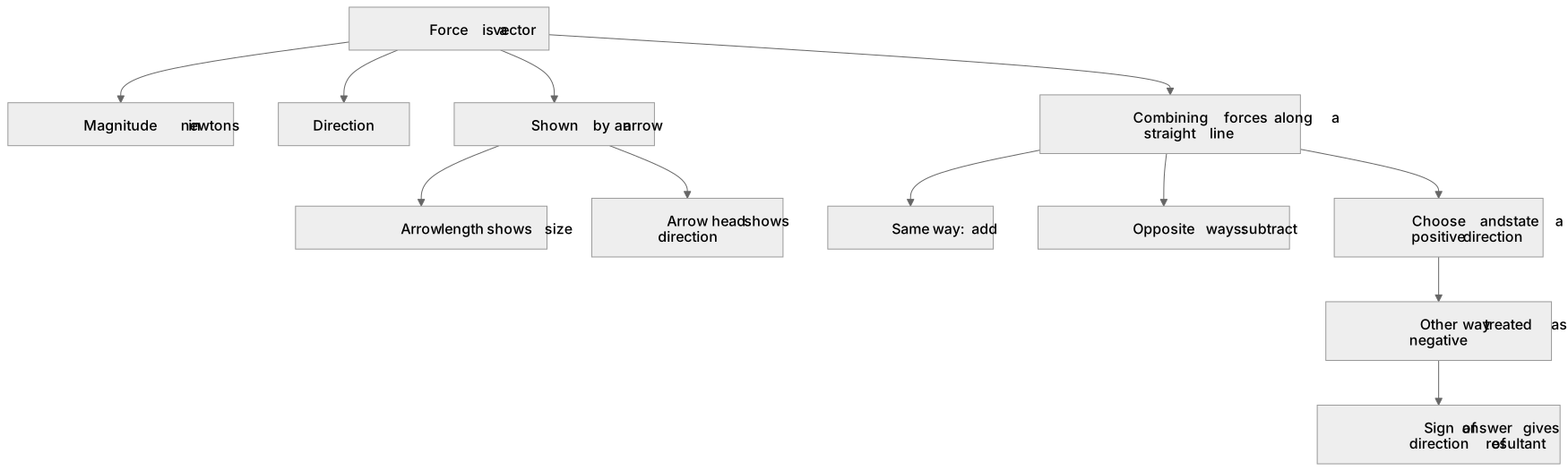
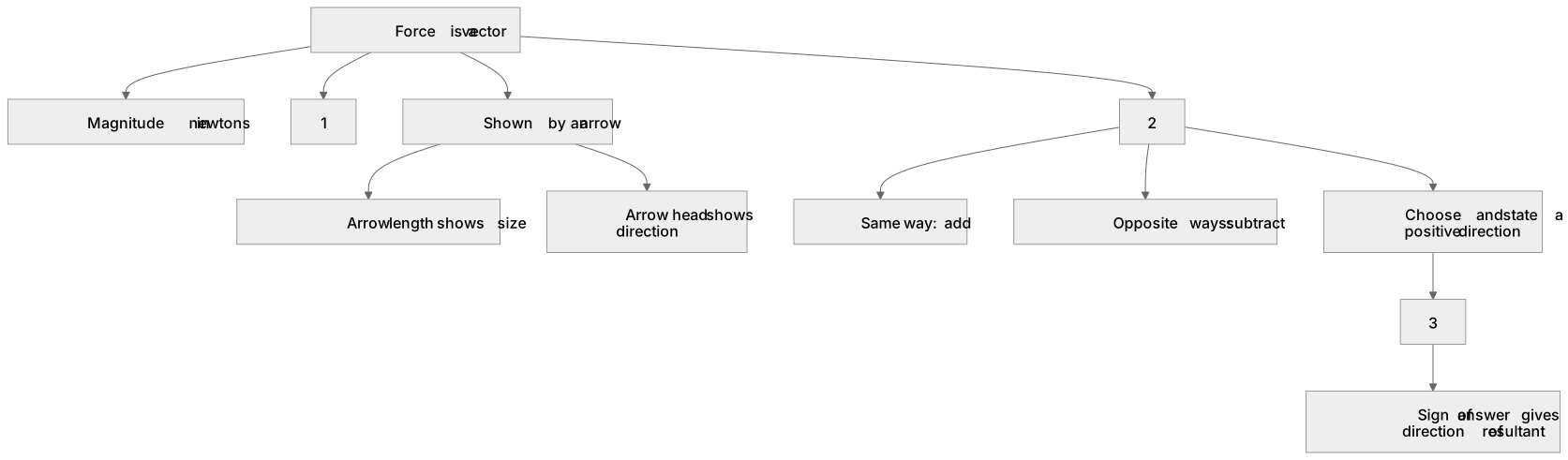
Force is a vector, so it has a magnitude in newtons and a direction, and both are needed for a complete answer. On a diagram it is shown by an arrow whose length represents the size and whose head shows the direction. The vector nature controls how forces combine: along a straight line, forces pointing the same way add and forces pointing opposite ways subtract. A 400 N driving force with 250 N of drag gives a resultant of 150 N forwards, not 650 N. Equal and opposite forces give a resultant of zero. Choose a positive direction first, state it, and treat forces the other way as negative; then the sign of the answer tells you the direction of the resultant.
What earns the marks
- A force having both a magnitude in newtons and a direction.
- Representing a force by an arrow whose length shows the size.
- Adding forces acting in the same direction and subtracting those acting in opposite directions.
- Giving the direction of the resultant as well as its magnitude.
Common mistakes and how to put them right
Adding a 5 N force to the left and a 3 N force to the right to get 8 N.
Giving the size of a resultant with no direction.
Arguing that force is a scalar because newtons are just numbers.
Changing the positive direction part-way through a calculation.
Drawing all force arrows the same length regardless of size.
Exam tips
- Write down which direction you are treating as positive before you start adding.
- Give the direction in words as well as by sign, so there is no doubt what a negative answer means.
- Match arrow lengths to force sizes on any diagram you draw, even a rough one.
Try the lesson
The start of the Contact and non-contact forces: Force is a vector quantity. lesson, made from checked teaching notes for this specification point.
Have a go first
What is meant by saying that force is a vector quantity?
Listen
Force is a vector, so it has a magnitude in newtons and a direction, and both are needed for a complete answer. On a diagram it is shown by an arrow whose length represents the size and whose head shows the direction. The vector nature controls how forces combine: along a straight line, forces pointing the same way add and forces pointing opposite ways subtract. A 400 N driving force with 250 N of drag gives a resultant of 150 N forwards, not 650 N. Equal and opposite forces give a resultant of zero. Choose a positive direction first, state it, and treat forces the other way as negative; then the sign of the answer tells you the direction of the resultant. A strong answer earns marks for these points. a force having both a magnitude in newtons and a direction. representing a force by an arrow whose length shows the size. adding forces acting in the same direction and subtracting those acting in opposite directions. giving the direction of the resultant as well as its magnitude. Exam tip: Write down which direction you are treating as positive before you start adding.
See it
Key words
Say what each word means before you turn the card.
arrow representation
Try answering aloud or in your head before turning the card.
resultant
Try answering aloud or in your head before turning the card.
positive direction
Try answering aloud or in your head before turning the card.
See every definition
- arrow representation
- A way of showing a force on a diagram, where the length represents the size and the head shows the direction.
- resultant
- What forces combine to give; along a straight line, forces pointing the same way add and forces pointing opposite ways subtract.
- positive direction
- A direction chosen and stated first, so that forces the other way are treated as negative and the sign of the answer tells you the direction of the resultant.
Label the diagram
Some boxes have lost their names. Pick the right name for each number.
1Box 1
2Box 2
3Box 3
There is more to this lesson
The full lesson goes on to check your understanding and help you earn the marks. Create a free account to carry on, with your progress saved.
A week of Premium from your first lesson · Then the free plan continues · No card, no charge
Test your understanding of Contact and non-contact forces: Force is a vector quantity.
Active recall beats re-reading. Take an instant quiz now to test what you’ve learned and lock it into long-term memory.
A week of Premium from your first lesson · Then the free plan continues · No card, no charge