AQA · GCSE · Physics
Course version: 8463 · Version from Sept 2016
Students should be able to recognise/draw simple diagrams to model the…
Full specification wording
Density of materials: Students should be able to recognise/draw simple diagrams to model the difference between solids, liquids and gases.
The particle model is drawn as circles, and the marks come from arrangement and spacing rather than artistry.
Checked against the AQA 8463 specification (opens in a new tab) on .
- Point 1 of 3
- 4 key terms
Study notes
From the checked teaching notes for this specification point.
The idea
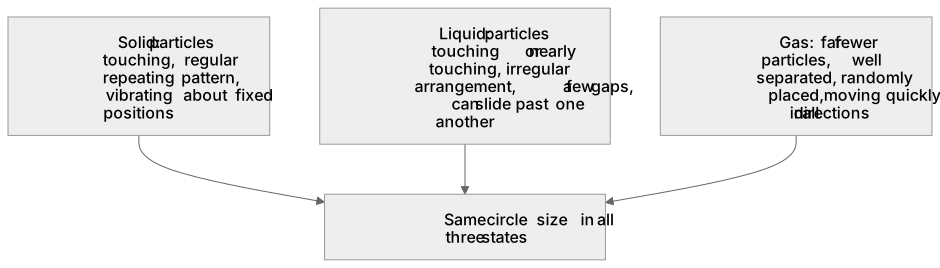
The particle model is drawn as circles, and the marks come from arrangement and spacing rather than artistry. In a solid, draw the particles touching, in a regular repeating pattern, filling the box; they vibrate about fixed positions. In a liquid, draw them still touching or nearly touching but irregularly arranged, with a few gaps, so they can slide past one another. In a gas, draw far fewer particles, well separated and randomly placed, moving quickly in all directions. Keep every circle the same size across all three diagrams, because the particles themselves do not shrink or swell when a substance changes state; only their spacing and arrangement change. Use the same number of particles in the solid and liquid boxes so the comparison is fair.
What earns the marks
- Solid particles drawn touching in a regular arrangement.
- Liquid particles drawn touching or close but irregularly arranged.
- Gas particles drawn far apart and randomly arranged.
- Particles drawn the same size in all three states.
Common mistakes and how to put them right
Drawing gas particles larger than solid particles to show that they have expanded.
Drawing a solid with gaps between its particles.
Drawing a liquid identical to a gas, with widely separated particles.
Describing the arrangement in words while leaving the drawing itself ambiguous.
Exam tips
- Draw particles as identical circles and keep the same circle size in all three boxes.
- Add a short label under each diagram naming the state, so no mark hangs on the drawing alone.
- Use the same number of particles in the solid and liquid boxes to show that only the spacing changed.
Try the lesson
The start of the Density of materials: Students should be able to recognise/draw simple diagrams to model the difference between solids, liquids and gases. lesson, made from checked teaching notes for this specification point.
Have a go first
A student is asked to draw simple particle diagrams to model a solid, a liquid and a gas. Which set of features correctly describes the arrangement of particles in all three models?
Listen
The particle model is drawn as circles, and the marks come from arrangement and spacing rather than artistry. In a solid, draw the particles touching, in a regular repeating pattern, filling the box; they vibrate about fixed positions. In a liquid, draw them still touching or nearly touching but irregularly arranged, with a few gaps, so they can slide past one another. In a gas, draw far fewer particles, well separated and randomly placed, moving quickly in all directions. Keep every circle the same size across all three diagrams, because the particles themselves do not shrink or swell when a substance changes state; only their spacing and arrangement change. Use the same number of particles in the solid and liquid boxes so the comparison is fair. A strong answer earns marks for these points. solid particles drawn touching in a regular arrangement. liquid particles drawn touching or close but irregularly arranged. gas particles drawn far apart and randomly arranged. particles drawn the same size in all three states. Exam tip: Draw particles as identical circles and keep the same circle size in all three boxes.
See it
Key words
Say what each word means before you turn the card.
particle model
Try answering aloud or in your head before turning the card.
arrangement of particles
Try answering aloud or in your head before turning the card.
spacing in solids liquids gases
Try answering aloud or in your head before turning the card.
constant particle size
Try answering aloud or in your head before turning the card.
See every definition
- particle model
- A way of modelling matter by drawing particles as circles, where the marks come from arrangement and spacing rather than artistry.
- arrangement of particles
- In a solid the particles are in a regular repeating pattern, in a liquid irregularly arranged, and in a gas randomly placed.
- spacing in solids liquids gases
- In a solid the particles are touching, in a liquid touching or nearly touching with a few gaps, and in a gas well separated.
- constant particle size
- Every circle is kept the same size across all three diagrams because the particles themselves do not shrink or swell when a substance changes state.
Label the diagram
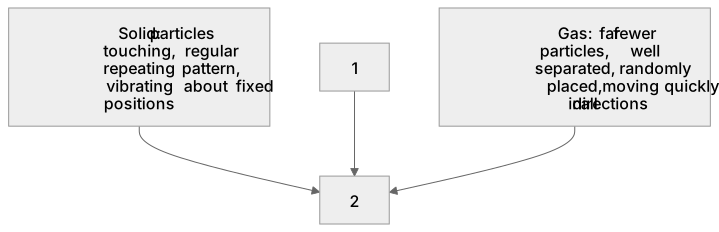
Some boxes have lost their names. Pick the right name for each number.
1Box 1
2Box 2
There is more to this lesson
The full lesson goes on to check your understanding and help you earn the marks. Create a free account to carry on, with your progress saved.
A week of Premium from your first lesson · Then the free plan continues · No card, no charge
Test your understanding of Density of materials: Students should be able to recognise/draw simple diagrams to model the difference between solids, liquids and gases.
Active recall beats re-reading. Take an instant quiz now to test what you’ve learned and lock it into long-term memory.
A week of Premium from your first lesson · Then the free plan continues · No card, no charge