AQA · GCSE · Physics
Course version: 8463 · Version from Sept 2016
Radioactive isotopes have a very wide range of half-life values.
Full specification wording
Different half-lives of radioactive isotopes: Radioactive isotopes have a very wide range of half-life values.
Half-life values span an extraordinary range, from tiny fractions of a second to billions of years.
Checked against the AQA 8463 specification (opens in a new tab) on .
- Point 1 of 2
- 4 key terms
Study notes
From the checked teaching notes for this specification point.
The idea
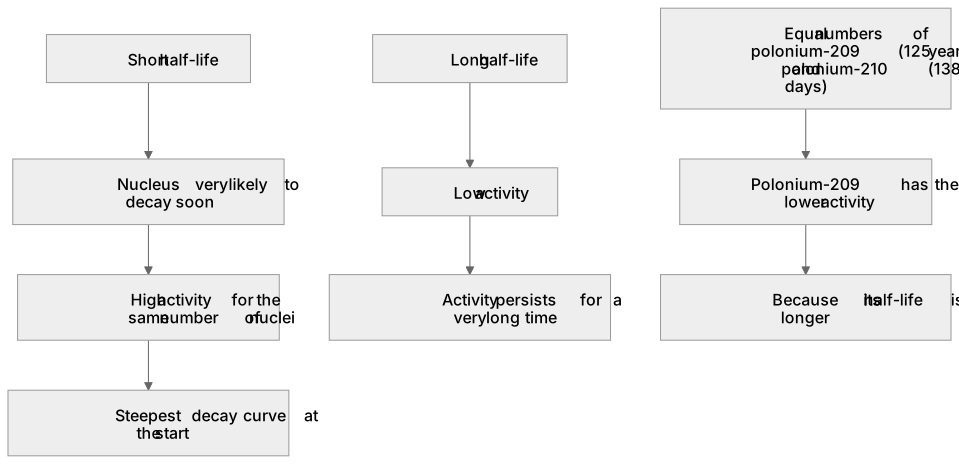
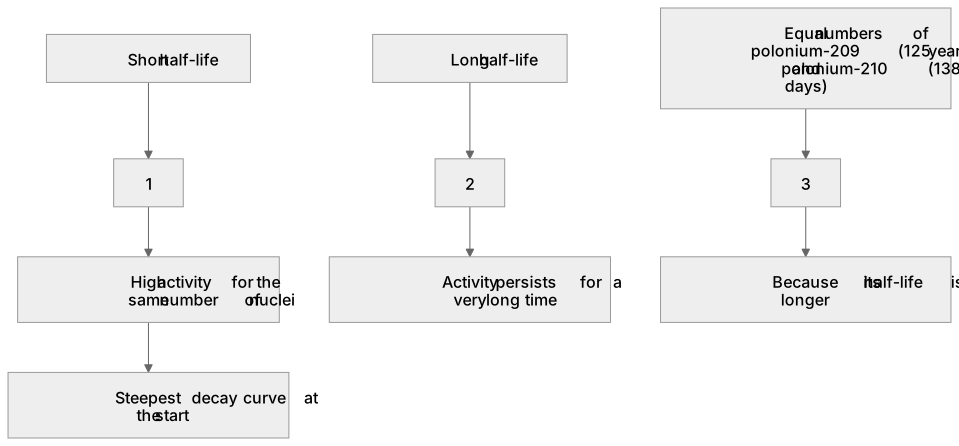
Half-life values span an extraordinary range, from tiny fractions of a second to billions of years. Uranium-238 has a half-life of about 4.5 billion years, carbon-14 about 5730 years, technetium-99m about 6 hours and some isotopes decay in microseconds. The consequence matters more than the numbers: a short half-life means each nucleus is very likely to decay soon, so for the same number of nuclei the activity is high and the decay curve is steepest at the start. A long half-life means a low activity that persists for a very long time. In a sample holding equal numbers of polonium-209, half-life 125 years, and polonium-210, half-life 138 days, the polonium-209 has the lower activity precisely because its half-life is longer.
What earns the marks
- The range running from fractions of a second to millions or billions of years.
- A short half-life giving a high activity from the same number of nuclei.
- The isotope with the shortest half-life having the steepest curve at the start.
- A comparison in the correct direction, such as polonium-209 having a lower activity than polonium-210 in the same sample.
Common mistakes and how to put them right
Assuming a long half-life automatically means a more dangerous source.
Comparing half-lives given in different units, such as 125 years and 138 days, without converting.
Reading a steeper decay curve as a longer half-life.
Saying an isotope with more nuclei remaining later must be decaying faster.
Stating the comparison of activities without giving the half-life as the reason, when the reason mark depends on it.
Exam tips
- Convert to a common unit before comparing two half-lives; days against years catches people out.
- State the activity comparison first and then the half-life reason, matching the order the mark scheme expects.
- Remember that comparisons of activity only work directly when the numbers of atoms are equal, which the question will usually tell you.
Try the lesson
The start of the Different half-lives of radioactive isotopes: Radioactive isotopes have a very wide range of half-life values. lesson, made from checked teaching notes for this specification point.
Have a go first
Which statement correctly describes the range of half-life values for different radioactive isotopes?
Listen
Half-life values span an extraordinary range, from tiny fractions of a second to billions of years. Uranium-238 has a half-life of about 4.5 billion years, carbon-14 about 5730 years, technetium-99m about 6 hours and some isotopes decay in microseconds. The consequence matters more than the numbers: a short half-life means each nucleus is very likely to decay soon, so for the same number of nuclei the activity is high and the decay curve is steepest at the start. A long half-life means a low activity that persists for a very long time. In a sample holding equal numbers of polonium-209, half-life 125 years, and polonium-210, half-life 138 days, the polonium-209 has the lower activity precisely because its half-life is longer. A strong answer earns marks for these points. the range running from fractions of a second to millions or billions of years. a short half-life giving a high activity from the same number of nuclei. the isotope with the shortest half-life having the steepest curve at the start. a comparison in the correct direction, such as polonium-209 having a lower activity than polonium-210 in the same sample. Exam tip: Convert to a common unit before comparing two half-lives; days against years catches people out.
See it
Key words
Say what each word means before you turn the card.
range of half-lives
Try answering aloud or in your head before turning the card.
activity and half-life
Try answering aloud or in your head before turning the card.
steepness of decay curve
Try answering aloud or in your head before turning the card.
unit conversion
Try answering aloud or in your head before turning the card.
See every definition
- range of half-lives
- Half-life values span an extraordinary range, from tiny fractions of a second to billions of years.
- activity and half-life
- A short half-life means each nucleus is very likely to decay soon, so for the same number of nuclei the activity is high.
- steepness of decay curve
- For the same number of nuclei, the isotope with the shortest half-life has the steepest curve at the start.
- unit conversion
- Half-lives given in different units, such as days against years, must be converted to a common unit before comparing two half-lives.
Label the diagram
Some boxes have lost their names. Pick the right name for each number.
1Box 1
2Box 2
3Box 3
There is more to this lesson
The full lesson goes on to check your understanding and help you earn the marks. Create a free account to carry on, with your progress saved.
A week of Premium from your first lesson · Then the free plan continues · No card, no charge
Test your understanding of Different half-lives of radioactive isotopes: Radioactive isotopes have a very wide range of half-life values.
Active recall beats re-reading. Take an instant quiz now to test what you’ve learned and lock it into long-term memory.
A week of Premium from your first lesson · Then the free plan continues · No card, no charge