AQA · GCSE · Physics
Course version: 8463 · Version from Sept 2016
Distance and displacement: Displacement is a vector quantity.
Calling displacement a vector means it needs both a size and a direction before it is fully described, and that it combines by geometry rather than by simple addition.
Checked against the AQA 8463 specification (opens in a new tab) on .
- Point 3 of 4
- 4 key terms
Study notes
From the checked teaching notes for this specification point.
The idea
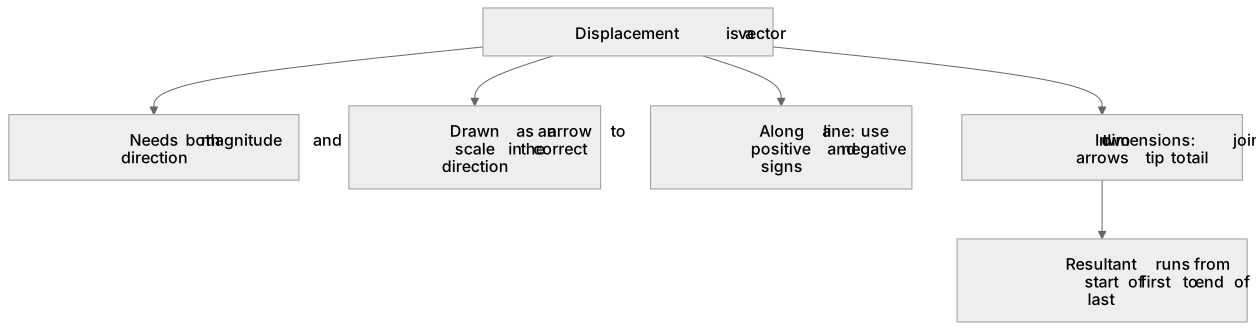
Calling displacement a vector means it needs both a size and a direction before it is fully described, and that it combines by geometry rather than by simple addition. On a diagram a vector is drawn as an arrow whose length is drawn to scale and whose direction is the direction of the quantity. Along a single line, direction can be handled with signs: taking east as positive, a displacement of five metres west is written as negative five metres, and adding eight metres east to that gives three metres east. In two dimensions the arrows are joined tip to tail and the resultant runs from the start of the first to the end of the last. The other vectors on this course are force, velocity, acceleration, momentum and weight.
What earns the marks
- A vector having both magnitude and direction.
- Representing a vector as an arrow drawn to scale in the correct direction.
- Using positive and negative signs for opposite directions along a line.
- Combining displacements tip to tail to find a resultant.
Common mistakes and how to put them right
Stating the magnitude and treating the answer as complete.
Adding vectors that point in different directions arithmetically.
Drawing an arrow with no scale and no stated direction.
Treating a negative displacement as a negative distance.
Exam tips
- State your positive direction before using signs; examiners accept either choice if it is declared.
- Draw the arrow, because a labelled diagram often carries the mark on its own.
Try the lesson
The start of the Distance and displacement: Displacement is a vector quantity. lesson, made from checked teaching notes for this specification point.
Have a go first
Which statement correctly describes displacement?
Listen
Calling displacement a vector means it needs both a size and a direction before it is fully described, and that it combines by geometry rather than by simple addition. On a diagram a vector is drawn as an arrow whose length is drawn to scale and whose direction is the direction of the quantity. Along a single line, direction can be handled with signs: taking east as positive, a displacement of five metres west is written as negative five metres, and adding eight metres east to that gives three metres east. In two dimensions the arrows are joined tip to tail and the resultant runs from the start of the first to the end of the last. The other vectors on this course are force, velocity, acceleration, momentum and weight. A strong answer earns marks for these points. a vector having both magnitude and direction. representing a vector as an arrow drawn to scale in the correct direction. using positive and negative signs for opposite directions along a line. combining displacements tip to tail to find a resultant. Exam tip: State your positive direction before using signs; examiners accept either choice if it is declared.
See it
Key words
Say what each word means before you turn the card.
vectors
Try answering aloud or in your head before turning the card.
magnitude and direction
Try answering aloud or in your head before turning the card.
scaled arrows
Try answering aloud or in your head before turning the card.
sign conventions
Try answering aloud or in your head before turning the card.
See every definition
- vectors
- Quantities that need both a size and a direction before they are fully described, and that combine by geometry rather than by simple addition.
- magnitude and direction
- The two things a vector needs before it is fully described.
- scaled arrows
- How a vector is drawn on a diagram, with length drawn to scale and direction being the direction of the quantity.
- sign conventions
- Handling direction along a single line with positive and negative signs, for example taking east as positive.
Label the diagram
Some boxes have lost their names. Pick the right name for each number.
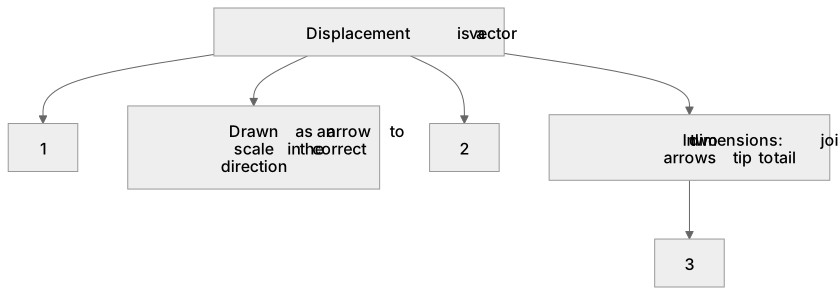
1Box 1
2Box 2
3Box 3
There is more to this lesson
The full lesson goes on to check your understanding and help you earn the marks. Create a free account to carry on, with your progress saved.
A week of Premium from your first lesson · Then the free plan continues · No card, no charge
Test your understanding of Distance and displacement: Displacement is a vector quantity.
Active recall beats re-reading. Take an instant quiz now to test what you’ve learned and lock it into long-term memory.
A week of Premium from your first lesson · Then the free plan continues · No card, no charge