AQA · GCSE · Physics
Course version: 8463 · Version from Sept 2016
(HT only) Students should be able to describe ways to increase the…
Full specification wording
Efficiency: (HT only) Students should be able to describe ways to increase the efficiency of an intended energy transfer.
Efficiency compares useful output energy with total input energy.
Checked against the AQA 8463 specification (opens in a new tab) on .
- Point 7 of 7
- 4 key terms
Study notes
From the checked teaching notes for this specification point.
The idea
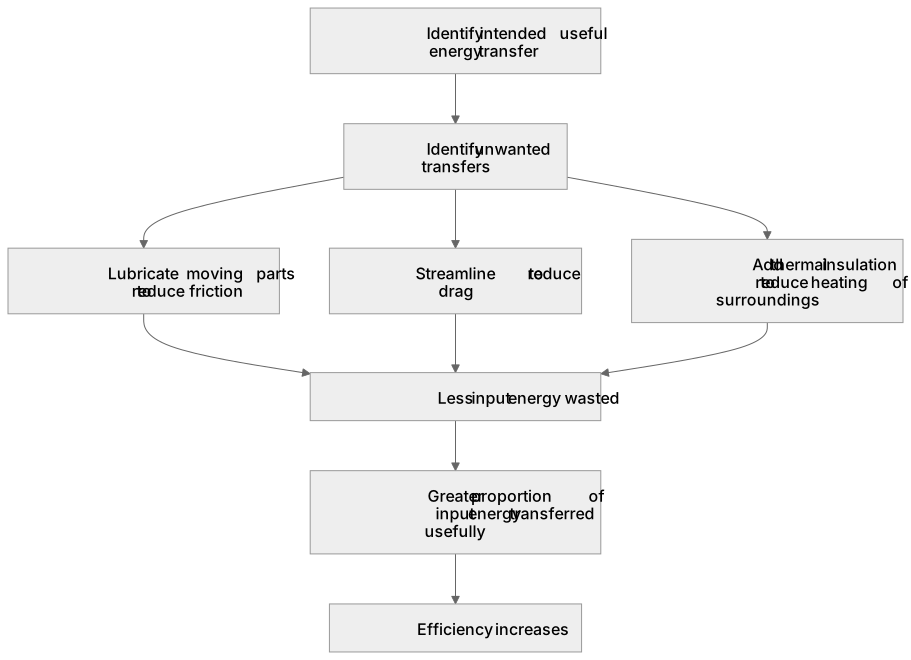
Efficiency compares useful output energy with total input energy. To improve it, reduce unwanted transfers, mainly by heating, friction and sound. For a filament lamp, only a small fraction of input energy becomes light; most is wasted by heating. Replacing it with an LED increases the useful light output for the same input, so efficiency rises. For a moving machine, lubricating surfaces reduces friction, so less input energy becomes thermal energy in the surroundings. Streamlining a vehicle lowers drag, so less energy is transferred to the air. Insulating a hot water tank reduces heating of the surroundings. In each case, identify the intended useful store or pathway, then reduce the unwanted transfers without reducing the useful output.
What earns the marks
- Identify the intended useful energy transfer and the unwanted transfers in the device or system.
- Describe a specific change that reduces unwanted energy transfer, such as lubrication to reduce friction between moving parts.
- Describe a specific change that reduces unwanted energy transfer, such as streamlining to reduce drag from the surrounding fluid.
- Describe a specific change that reduces unwanted energy transfer, such as thermal insulation to reduce heating of the surroundings.
- Explain that reducing wasted energy increases the proportion of input energy transferred usefully, so efficiency increases.
- Use the efficiency relationship to support the description, for example efficiency = useful output energy transfer ÷ total input energy transfer.
- Compare two designs and state which is more efficient, referring to the useful and wasted transfers.
Common mistakes and how to put them right
Thinking that efficiency can exceed 100%.
Put it right by stating that useful output energy is always less than total input energy in any real energy transfer.
Confusing efficiency with power.
Put it right by explaining that efficiency is a ratio of energies or powers, while power is the rate of energy transfer.
Suggesting that adding more energy increases efficiency.
Put it right by explaining that efficiency improves when a greater proportion of the input energy is transferred usefully, not when more energy is supplied.
Ignoring the intended useful transfer and describing only a reduction in total energy use.
Put it right by identifying the useful output first, then reducing the unwanted transfers.
Exam tips
- Name the device and the useful energy transfer before describing the improvement, so your answer is focused on the intended transfer.
- Use the phrase 'reduces unwanted energy transfer by heating to the surroundings' or 'reduces energy transferred by friction' to make the mechanism clear.
- If a calculation is required, write the efficiency equation, substitute the energy values with units, and give the answer as a decimal or percentage as appropriate.
- For a 'describe' question, give a sequence of changes and their effects rather than a single vague statement such as 'make it better'.
Try the lesson
The start of the Efficiency: (HT only) Students should be able to describe ways to increase the efficiency of an intended energy transfer. lesson, made from checked teaching notes for this specification point.
Have a go first
A student uses a pan to heat water on a gas stove. Some energy is wasted heating the surrounding air. Which change would increase the efficiency of this energy transfer?
Listen
Efficiency compares useful output energy with total input energy. To improve it, reduce unwanted transfers, mainly by heating, friction and sound. For a filament lamp, only a small fraction of input energy becomes light; most is wasted by heating. Replacing it with an LED increases the useful light output for the same input, so efficiency rises. For a moving machine, lubricating surfaces reduces friction, so less input energy becomes thermal energy in the surroundings. Streamlining a vehicle lowers drag, so less energy is transferred to the air. Insulating a hot water tank reduces heating of the surroundings. In each case, identify the intended useful store or pathway, then reduce the unwanted transfers without reducing the useful output. A strong answer earns marks for these points. Identify the intended useful energy transfer and the unwanted transfers in the device or system. Describe a specific change that reduces unwanted energy transfer, such as lubrication to reduce friction between moving parts. Describe a specific change that reduces unwanted energy transfer, such as streamlining to reduce drag from the surrounding fluid. Describe a specific change that reduces unwanted energy transfer, such as thermal insulation to reduce heating of the surroundings. A common slip: Thinking that efficiency can exceed 100%. Instead, stating that useful output energy is always less than total input energy in any real energy transfer. Exam tip: Name the device and the useful energy transfer before describing the improvement, so your answer is focused on the intended transfer.
See it
Key words
Say what each word means before you turn the card.
Efficiency
Try answering aloud or in your head before turning the card.
Unwanted energy transfers
Try answering aloud or in your head before turning the card.
Lubrication
Try answering aloud or in your head before turning the card.
Streamlining
Try answering aloud or in your head before turning the card.
See every definition
- Efficiency
- A comparison of useful output energy with total input energy, which increases when a greater proportion of the input energy is transferred usefully.
- Unwanted energy transfers
- Transfers that waste input energy, mainly by heating, friction and sound, which can be reduced without reducing the useful output.
- Lubrication
- A change that reduces friction between moving parts, so less input energy becomes thermal energy in the surroundings.
- Streamlining
- A change that lowers drag, so less energy is transferred to the air.
Label the diagram
Some boxes have lost their names. Pick the right name for each number.
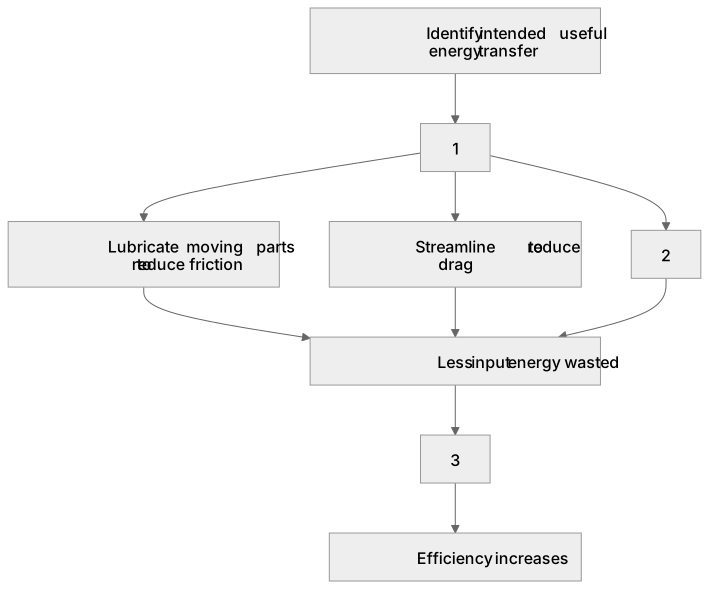
1Box 1
2Box 2
3Box 3
There is more to this lesson
The full lesson goes on to check your understanding and help you earn the marks. Create a free account to carry on, with your progress saved.
A week of Premium from your first lesson · Then the free plan continues · No card, no charge
Test your understanding of Efficiency: (HT only) Students should be able to describe ways to increase the efficiency of an intended energy transfer.
Active recall beats re-reading. Take an instant quiz now to test what you’ve learned and lock it into long-term memory.
A week of Premium from your first lesson · Then the free plan continues · No card, no charge