AQA · GCSE · Physics
Course version: 8463 · Version from Sept 2016
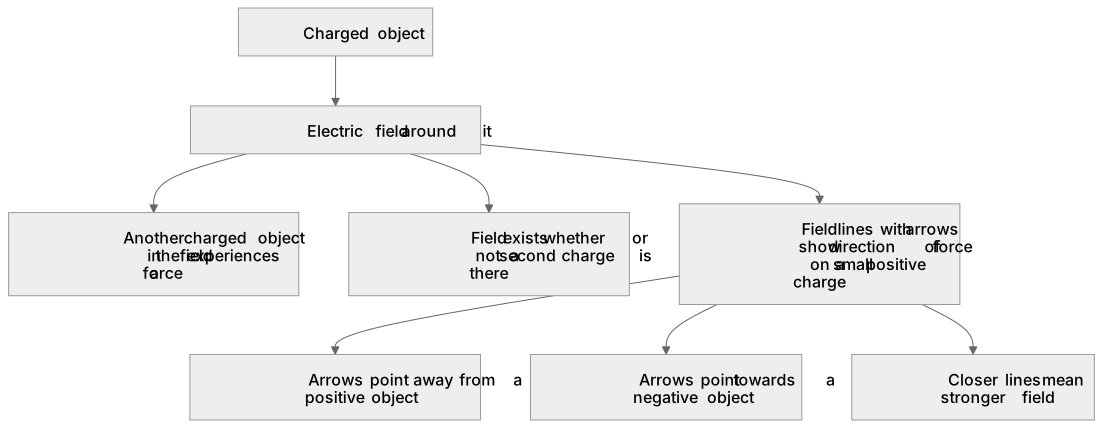
Electric fields: A charged object creates an electric field around itself.
An electric field is the region around a charged object in which another charged object experiences a force, and that exact wording is what mark schemes want.
Checked against the AQA 8463 specification (opens in a new tab) on .
- Point 1 of 6
Study notes
From the checked teaching notes for this specification point.
The idea
An electric field is the region around a charged object in which another charged object experiences a force, and that exact wording is what mark schemes want. The field is not something you can see, but it is how the force is carried across the gap, so it exists whether or not a second charge is there to feel it. It is drawn as field lines with arrows showing the direction of the force on a small positive charge, so the lines point away from a positive object and towards a negative one. For an isolated charged sphere the lines are straight and radial, evenly spaced all the way round, starting at right angles to the surface. The closer together the lines are drawn, the stronger the field at that point.
What earns the marks
- The electric field as the region around a charged object where another charged object experiences a force.
- The field existing whether or not a second charge is placed in it.
- Field lines drawn radially and at right angles to the surface of a charged sphere.
- Arrows pointing away from a positive object and towards a negative object.
Common mistakes and how to put them right
Defining the field as the force itself rather than the region in which a force acts.
Drawing field lines that cross one another.
Drawing arrows pointing towards a positive sphere.
Leaving the arrows off the field lines entirely.
Exam tips
- Learn the definition word for word: the region around a charged object where another charged object experiences a force.
- Put an arrow on every field line you draw, because a line without one may score nothing.
- Start every line on the surface of the sphere and draw it at right angles to that surface.
Try the lesson
The start of the Electric fields: A charged object creates an electric field around itself. lesson, made from checked teaching notes for this specification point.
Have a go first
Which type of field is created around an object specifically because it has an electrical charge?
Listen
An electric field is the region around a charged object in which another charged object experiences a force, and that exact wording is what mark schemes want. The field is not something you can see, but it is how the force is carried across the gap, so it exists whether or not a second charge is there to feel it. It is drawn as field lines with arrows showing the direction of the force on a small positive charge, so the lines point away from a positive object and towards a negative one. For an isolated charged sphere the lines are straight and radial, evenly spaced all the way round, starting at right angles to the surface. The closer together the lines are drawn, the stronger the field at that point. A strong answer earns marks for these points. the electric field as the region around a charged object where another charged object experiences a force. the field existing whether or not a second charge is placed in it. field lines drawn radially and at right angles to the surface of a charged sphere. arrows pointing away from a positive object and towards a negative object. Exam tip: Learn the definition word for word: the region around a charged object where another charged object experiences a force.
See it
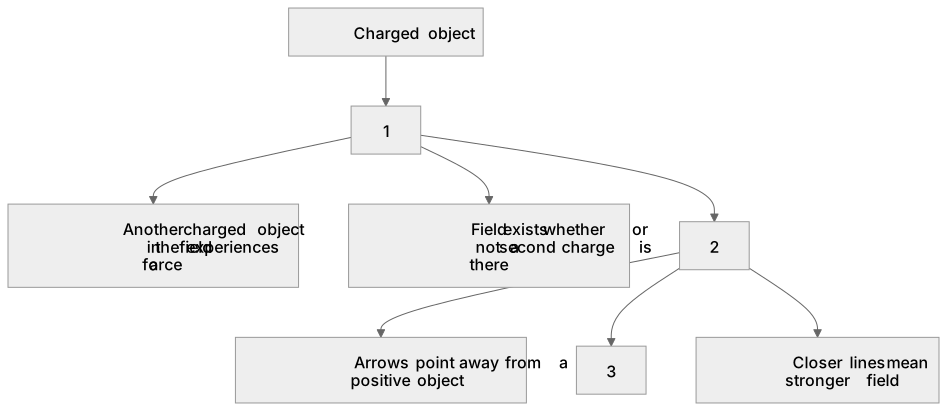
Label the diagram
Some boxes have lost their names. Pick the right name for each number.
1Box 1
2Box 2
3Box 3
There is more to this lesson
The full lesson goes on to check your understanding and help you earn the marks. Create a free account to carry on, with your progress saved.
A week of Premium from your first lesson · Then the free plan continues · No card, no charge
Test your understanding of Electric fields: A charged object creates an electric field around itself.
Active recall beats re-reading. Take an instant quiz now to test what you’ve learned and lock it into long-term memory.
A week of Premium from your first lesson · Then the free plan continues · No card, no charge