AQA · GCSE · Physics
Course version: 8463 · Version from Sept 2016
A second charged object placed in the field experiences a force.
Full specification wording
Electric fields: A second charged object placed in the field experiences a force.
The field is only detectable through what it does to another charge.
Checked against the AQA 8463 specification (opens in a new tab) on .
- Point 4 of 6
- 4 key terms
Study notes
From the checked teaching notes for this specification point.
The idea
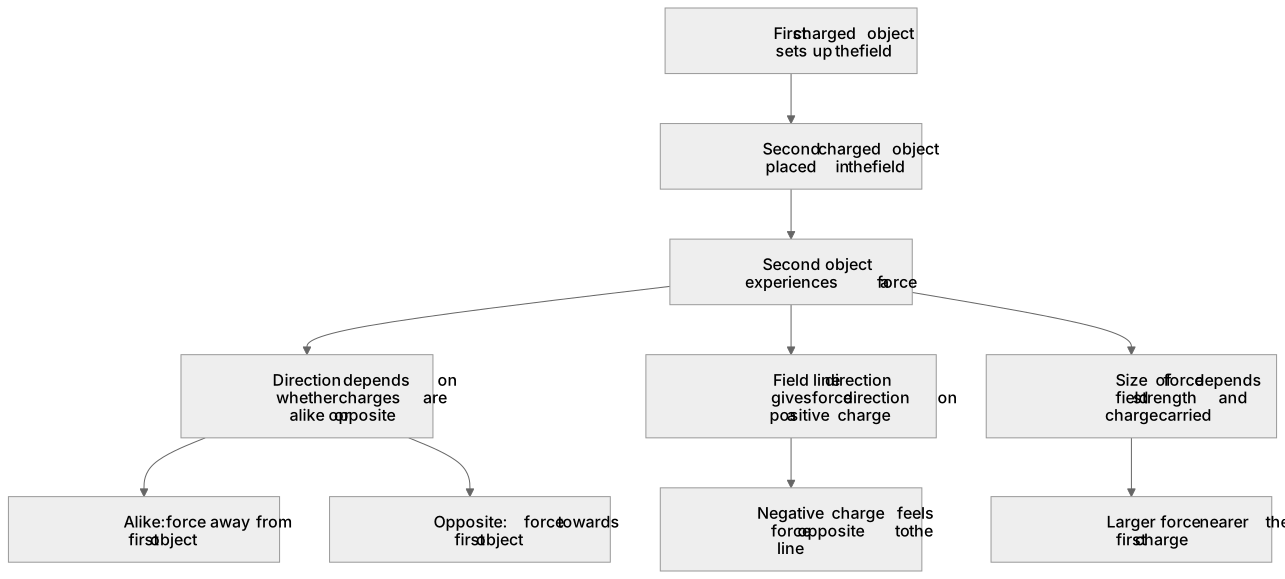
The field is only detectable through what it does to another charge. Place a second charged object in the field and it feels a force: away from the first object if the two charges are alike, towards it if they are opposite. The direction of the field line at that point gives the direction of the force on a positive charge, and a negative charge feels a force in the opposite direction to the line. The size of the force depends on how strong the field is at that point and on how much charge the second object carries, so the same object feels a larger force nearer the first charge. This is what non-contact force means in practice: the first object sets up the field, and the second responds to the field where it sits.
What earns the marks
- The second charged object experiencing a force when placed in the field.
- The direction of that force depending on whether the charges are alike or opposite.
- The force being larger where the field is stronger.
- The field line direction giving the direction of the force on a positive charge.
Common mistakes and how to put them right
Saying the second object must touch a field line before a force can act.
Giving the force on a negative charge in the same direction as the field line.
Assuming the force is the same size everywhere in the field.
Describing the second object as attracted in all cases, whatever its charge.
Exam tips
- Note the sign of the test charge before deciding the direction of the force.
- Quote both factors when asked what the force depends on: field strength and the charge placed in it.
- Use the field-line arrow for a positive charge, then reverse it for a negative one.
Try the lesson
The start of the Electric fields: A second charged object placed in the field experiences a force. lesson, made from checked teaching notes for this specification point.
Have a go first
What happens to a second charged object when it is placed in the electric field of another charged object?
Listen
The field is only detectable through what it does to another charge. Place a second charged object in the field and it feels a force: away from the first object if the two charges are alike, towards it if they are opposite. The direction of the field line at that point gives the direction of the force on a positive charge, and a negative charge feels a force in the opposite direction to the line. The size of the force depends on how strong the field is at that point and on how much charge the second object carries, so the same object feels a larger force nearer the first charge. This is what non-contact force means in practice: the first object sets up the field, and the second responds to the field where it sits. A strong answer earns marks for these points. the second charged object experiencing a force when placed in the field. the direction of that force depending on whether the charges are alike or opposite. the force being larger where the field is stronger. the field line direction giving the direction of the force on a positive charge. Exam tip: Note the sign of the test charge before deciding the direction of the force.
See it
Key words
Say what each word means before you turn the card.
test charge
Try answering aloud or in your head before turning the card.
direction of force
Try answering aloud or in your head before turning the card.
field strength
Try answering aloud or in your head before turning the card.
non-contact interaction
Try answering aloud or in your head before turning the card.
See every definition
- test charge
- A second charged object placed in the field, which experiences a force and is used to detect the field.
- direction of force
- Given by the field line at that point for a positive charge, while a negative charge feels a force in the opposite direction to the line.
- field strength
- How strong the field is at that point, which together with the charge the second object carries determines the size of the force.
- non-contact interaction
- The first object sets up the field, and the second responds to the field where it sits, so a force acts across a gap between two objects.
Label the diagram
Some boxes have lost their names. Pick the right name for each number.
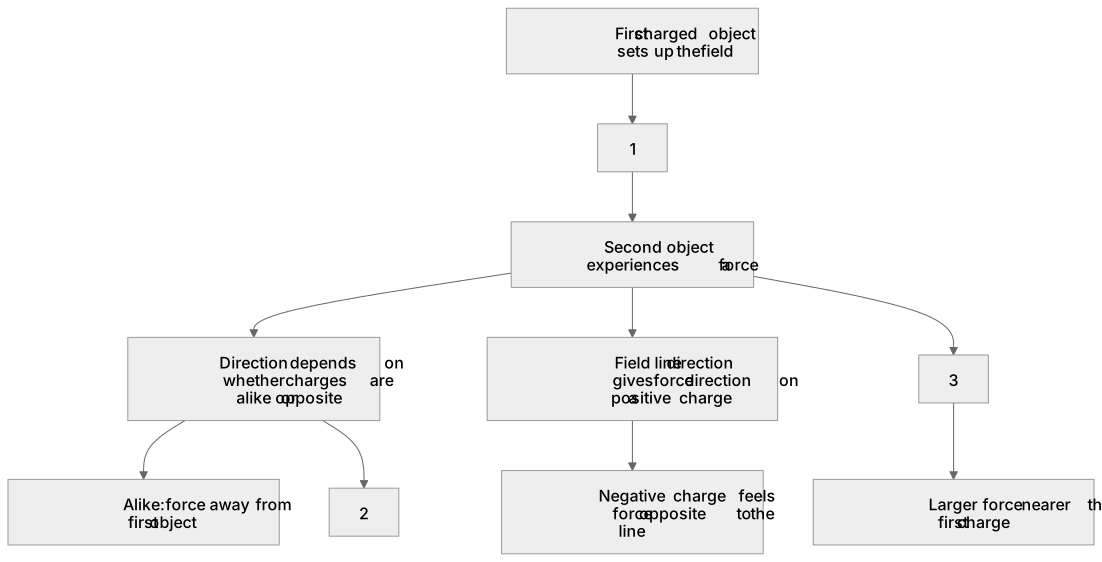
1Box 1
2Box 2
3Box 3
There is more to this lesson
The full lesson goes on to check your understanding and help you earn the marks. Create a free account to carry on, with your progress saved.
A week of Premium from your first lesson · Then the free plan continues · No card, no charge
Test your understanding of Electric fields: A second charged object placed in the field experiences a force.
Active recall beats re-reading. Take an instant quiz now to test what you’ve learned and lock it into long-term memory.
A week of Premium from your first lesson · Then the free plan continues · No card, no charge