AQA · GCSE · Physics
Course version: 8463 · Version from Sept 2016
Electric motors (HT only): This is the basis of an electric motor.
A practical direct current motor turns that idea into hardware: a coil on an axle between the poles of a permanent magnet, fed through a split-ring commutator and two carbon brushes.
Checked against the AQA 8463 specification (opens in a new tab) on .
- Point 2 of 3
- 3 key terms
Study notes
From the checked teaching notes for this specification point.
The idea
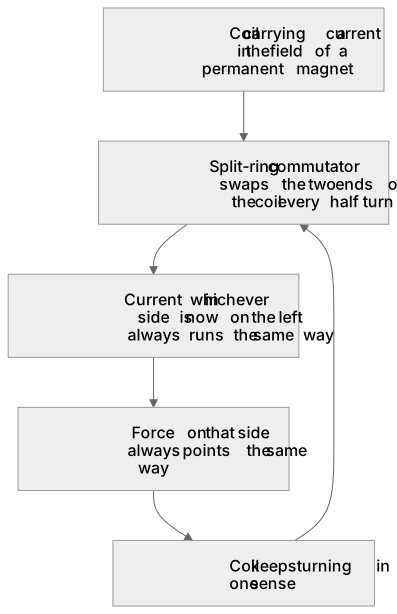
A practical direct current motor turns that idea into hardware: a coil on an axle between the poles of a permanent magnet, fed through a split-ring commutator and two carbon brushes. Without the commutator the coil would swing round to the vertical and stop, because beyond that point the same forces would push it back again. The split ring swaps the two ends of the coil over every half turn, so the current in whichever side is now on the left always runs the same way, the force on that side always points the same way, and the coil keeps turning in one sense. Making the current larger, using a stronger magnet, or winding on more turns all increase the turning effect. Reversing the current, or swapping the magnetic poles over, reverses the rotation, but doing both together changes nothing.
What earns the marks
- A coil carrying a current in the field of a permanent magnet.
- The split-ring commutator reversing the current in the coil every half turn.
- Explaining that this keeps the force on each side acting the same way, so rotation continues.
- A named way of increasing the speed, such as a larger current, more turns or a stronger magnet.
Common mistakes and how to put them right
Describing a slip ring rather than a split ring, which would let the coil come to rest after half a turn.
Saying the commutator reverses the magnetic field, when it reverses the current in the coil.
Reversing both the current and the magnets and then predicting reversed rotation, when the two changes cancel.
Calling the coil an electromagnet that is attracted to the magnet, instead of using the motor effect force.
Exam tips
- Learn the parts list, coil, permanent magnet, split-ring commutator and brushes, and name them in any explanation.
- If asked how to make the motor turn faster, change one thing at a time and say why it increases the force.
- A question asking why the coil does not stop is always about the commutator; say what it swaps and how often.
Try the lesson
The start of the Electric motors (HT only): This is the basis of an electric motor. lesson, made from checked teaching notes for this specification point.
Have a go first
The tendency of a current-carrying coil in a magnetic field to rotate is the basis of which device?
Listen
A practical direct current motor turns that idea into hardware: a coil on an axle between the poles of a permanent magnet, fed through a split-ring commutator and two carbon brushes. Without the commutator the coil would swing round to the vertical and stop, because beyond that point the same forces would push it back again. The split ring swaps the two ends of the coil over every half turn, so the current in whichever side is now on the left always runs the same way, the force on that side always points the same way, and the coil keeps turning in one sense. Making the current larger, using a stronger magnet, or winding on more turns all increase the turning effect. Reversing the current, or swapping the magnetic poles over, reverses the rotation, but doing both together changes nothing. A strong answer earns marks for these points. a coil carrying a current in the field of a permanent magnet. the split-ring commutator reversing the current in the coil every half turn. explaining that this keeps the force on each side acting the same way, so rotation continues. a named way of increasing the speed, such as a larger current, more turns or a stronger magnet. Exam tip: Learn the parts list, coil, permanent magnet, split-ring commutator and brushes, and name them in any explanation.
See it
Key words
Say what each word means before you turn the card.
split-ring commutator
Try answering aloud or in your head before turning the card.
brushes
Try answering aloud or in your head before turning the card.
direction of rotation
Try answering aloud or in your head before turning the card.
See every definition
- split-ring commutator
- It swaps the two ends of the coil over every half turn, so the current in whichever side is now on the left always runs the same way.
- brushes
- Two carbon brushes feed the current to the coil through the split-ring commutator.
- direction of rotation
- Reversing the current, or swapping the magnetic poles over, reverses it, but doing both together changes nothing.
Label the diagram
Some boxes have lost their names. Pick the right name for each number.
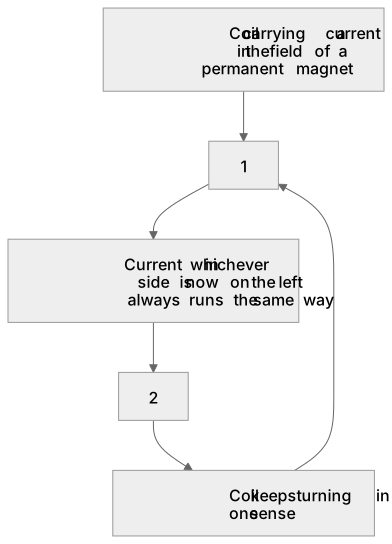
1Box 1
2Box 2
There is more to this lesson
The full lesson goes on to check your understanding and help you earn the marks. Create a free account to carry on, with your progress saved.
A week of Premium from your first lesson · Then the free plan continues · No card, no charge
Test your understanding of Electric motors (HT only): This is the basis of an electric motor.
Active recall beats re-reading. Take an instant quiz now to test what you’ve learned and lock it into long-term memory.
A week of Premium from your first lesson · Then the free plan continues · No card, no charge