AQA · GCSE · Physics
Course version: 8463 · Version from Sept 2016
Electric current is a flow of electrical charge. The size of the electric…
Full specification wording
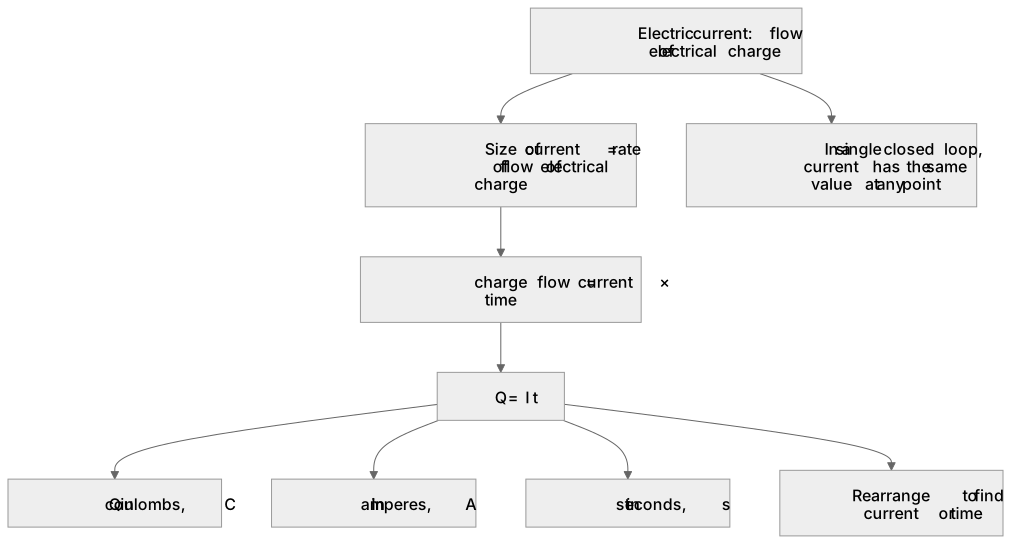
Electrical charge and current: Electric current is a flow of electrical charge. The size of the electric current is the rate of flow of electrical charge. Charge flow, current and time are linked by the equation: charge f low = current × time Q = I t charge flow, Q, in coulombs, C current, I, in amperes, A (amp is acceptable for ampere) time, t, in seconds, s A current has the same value at any point in a single closed loop.
An electric current is a flow of electrical charge, and its size is the rate of that flow: how much charge passes a point each second.
Checked against the AQA 8463 specification (opens in a new tab) on .
- Point 2 of 2
- 4 key terms
Study notes
From the checked teaching notes for this specification point.
The idea
An electric current is a flow of electrical charge, and its size is the rate of that flow: how much charge passes a point each second. That is written Q = I t, with charge flow Q in coulombs, current I in amperes and time t in seconds, so a current of 3 A for 20 s moves 60 C. Rearranged, I = Q ÷ t and t = Q ÷ I. The other half of this statement is just as heavily examined: in a single closed loop the current has the same value at every point, because charge is not created or used up on the way round. So an ammeter placed anywhere in a series loop reads the same, and a lamp nearer the battery does not take a bigger share. It also explains why one blown lamp in a series loop stops the current everywhere at once.
What earns the marks
- Writing charge flow = current × time, or Q = I t.
- A correct substitution with the time converted to seconds.
- The answer in coulombs, or in amperes when current is the unknown.
- Stating that the current is the same at every point in a single closed loop.
Common mistakes and how to put them right
Leaving the time in minutes or hours, so the charge is 60 or 3600 times too small.
Writing the unit of charge as amperes rather than coulombs.
Claiming current is used up by each component, so less returns to the battery.
Confusing charge flow with potential difference when both are given in a question.
Exam tips
- Where the question says write down the equation, give it in words or symbols; both are accepted.
- Convert minutes to seconds on the first line of working so the conversion is visible for method marks.
- In a series circuit question, state that the current is the same everywhere before doing any calculation.
Try the lesson
The start of the Electrical charge and current: Electric current is a flow of electrical charge. The size of the electric current is the rate of flow of electrical charge. Charge flow, current and time are linked by the equation: charge f low = current × time Q = I t charge flow, Q, in coulombs, C current, I, in amperes, A (amp is acceptable for ampere) time, t, in seconds, s A current has the same value at any point in a single closed loop. lesson, made from checked teaching notes for this specification point.
Have a go first
A current of 2 A flows through a lamp for 5 s. Using Q = I t, what is the charge flow through the lamp?
Listen
An electric current is a flow of electrical charge, and its size is the rate of that flow: how much charge passes a point each second. That is written Q = I t, with charge flow Q in coulombs, current I in amperes and time t in seconds, so a current of 3 A for 20 s moves 60 C. Rearranged, I = Q ÷ t and t = Q ÷ I. The other half of this statement is just as heavily examined: in a single closed loop the current has the same value at every point, because charge is not created or used up on the way round. So an ammeter placed anywhere in a series loop reads the same, and a lamp nearer the battery does not take a bigger share. It also explains why one blown lamp in a series loop stops the current everywhere at once. A strong answer earns marks for these points. writing charge flow = current × time, or Q = I t. a correct substitution with the time converted to seconds. the answer in coulombs, or in amperes when current is the unknown. stating that the current is the same at every point in a single closed loop. Exam tip: Where the question says write down the equation, give it in words or symbols; both are accepted.
See it
Key words
Say what each word means before you turn the card.
current as rate of flow of charge
Try answering aloud or in your head before turning the card.
charge flow equation
Try answering aloud or in your head before turning the card.
coulombs
Try answering aloud or in your head before turning the card.
series loop current
Try answering aloud or in your head before turning the card.
See every definition
- current as rate of flow of charge
- The size of the electric current is the rate of flow of electrical charge.
- charge flow equation
- Charge flow, current and time are linked by the equation charge flow = current × time, or Q = I t.
- coulombs
- Charge flow, Q, is measured in coulombs, C.
- series loop current
- A current has the same value at any point in a single closed loop.
Label the diagram
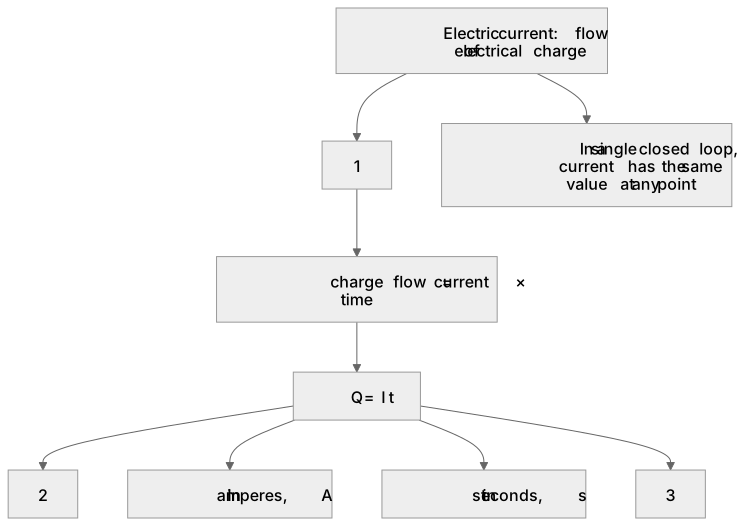
Some boxes have lost their names. Pick the right name for each number.
1Box 1
2Box 2
3Box 3
There is more to this lesson
The full lesson goes on to check your understanding and help you earn the marks. Create a free account to carry on, with your progress saved.
A week of Premium from your first lesson · Then the free plan continues · No card, no charge
Test your understanding of Electrical charge and current: Electric current is a flow of electrical charge. The size of the electric current is the rate of flow of electrical charge. Charge flow, current and time are linked by the equation: charge f low = current × time Q = I t charge flow, Q, in coulombs, C current, I, in amperes, A (amp is acceptable for ampere) time, t, in seconds, s A current has the same value at any point in a single closed loop.
Active recall beats re-reading. Take an instant quiz now to test what you’ve learned and lock it into long-term memory.
A week of Premium from your first lesson · Then the free plan continues · No card, no charge