AQA · GCSE · Physics
Course version: 8463 · Version from Sept 2016
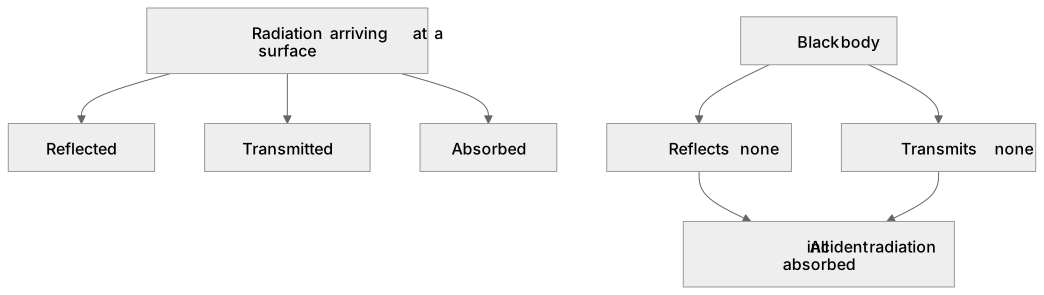
A black body does not reflect or transmit any radiation.
Full specification wording
Emission and absorption of infrared radiation: A black body does not reflect or transmit any radiation.
Radiation arriving at a surface can only do three things: be reflected, be transmitted, or be absorbed.
Checked against the AQA 8463 specification (opens in a new tab) on .
- Point 4 of 5
- 4 key terms
Study notes
From the checked teaching notes for this specification point.
The idea
Radiation arriving at a surface can only do three things: be reflected, be transmitted, or be absorbed. A perfect black body does neither of the first two, so the whole of the incident radiation must be absorbed, and that is what makes the model so simple to work with. Real surfaces fall short in one of those two ways: shiny silver reflects most of the infrared that reaches it, which is why a vacuum flask is silvered, while clear glass transmits most of the visible light that reaches it. The shiny white cube rose only 2.0 °C in the AQA experiment because so much was reflected. It is the absence of reflection that makes a cold black body look black in the first place.
What earns the marks
- Stating that a black body reflects none of the incident radiation.
- Stating that a black body transmits none of the incident radiation.
- Concluding that all of the incident radiation is therefore absorbed.
- Identifying a shiny or transparent surface as a poor approximation to a black body and saying why.
Common mistakes and how to put them right
Selecting 'they are good reflectors of radiation' or 'they easily transmit radiation' in a multiple choice item.
Allowing a perfect black body to reflect a small amount.
Concluding that a black body emits nothing, when it is in fact the best emitter.
Assuming the definition means the body can never reach a steady temperature.
Exam tips
- In tick-one questions, rule out the reflection and transmission options straight away.
- Use a silvered vacuum flask as the worked counter-example of a poor absorber.
- Say 'radiation' not 'heat' when writing about what the body does or does not do.
Try the lesson
The start of the Emission and absorption of infrared radiation: A black body does not reflect or transmit any radiation. lesson, made from checked teaching notes for this specification point.
Have a go first
What happens to radiation that reaches the surface of a black body?
Listen
Radiation arriving at a surface can only do three things: be reflected, be transmitted, or be absorbed. A perfect black body does neither of the first two, so the whole of the incident radiation must be absorbed, and that is what makes the model so simple to work with. Real surfaces fall short in one of those two ways: shiny silver reflects most of the infrared that reaches it, which is why a vacuum flask is silvered, while clear glass transmits most of the visible light that reaches it. The shiny white cube rose only 2.0 °C in the AQA experiment because so much was reflected. It is the absence of reflection that makes a cold black body look black in the first place. A strong answer earns marks for these points. stating that a black body reflects none of the incident radiation. stating that a black body transmits none of the incident radiation. concluding that all of the incident radiation is therefore absorbed. identifying a shiny or transparent surface as a poor approximation to a black body and saying why. Exam tip: In tick-one questions, rule out the reflection and transmission options straight away.
See it
Key words
Say what each word means before you turn the card.
black body
Try answering aloud or in your head before turning the card.
no reflection
Try answering aloud or in your head before turning the card.
no transmission
Try answering aloud or in your head before turning the card.
complete absorption
Try answering aloud or in your head before turning the card.
See every definition
- black body
- A body that does not reflect or transmit any radiation, so the whole of the incident radiation must be absorbed.
- no reflection
- A black body reflects none of the incident radiation, and it is the absence of reflection that makes a cold black body look black.
- no transmission
- A black body transmits none of the incident radiation that reaches it.
- complete absorption
- Because a black body neither reflects nor transmits incident radiation, all of that radiation is absorbed.
Label the diagram
Some boxes have lost their names. Pick the right name for each number.
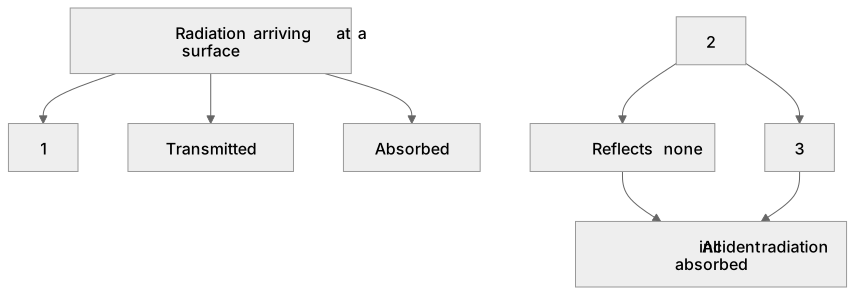
1Box 1
2Box 2
3Box 3
There is more to this lesson
The full lesson goes on to check your understanding and help you earn the marks. Create a free account to carry on, with your progress saved.
A week of Premium from your first lesson · Then the free plan continues · No card, no charge
Test your understanding of Emission and absorption of infrared radiation: A black body does not reflect or transmit any radiation.
Active recall beats re-reading. Take an instant quiz now to test what you’ve learned and lock it into long-term memory.
A week of Premium from your first lesson · Then the free plan continues · No card, no charge