AQA · GCSE · Physics
Course version: 8463 · Version from Sept 2016
The hotter the body, the more infrared radiation it radiates in a given…
Full specification wording
Emission and absorption of infrared radiation: The hotter the body, the more infrared radiation it radiates in a given time.
The rate at which a body radiates infrared rises steeply as its temperature rises, so a hot object loses energy by radiation quickly at first and more slowly as it cools.
Checked against the AQA 8463 specification (opens in a new tab) on .
- Point 2 of 5
- 3 key terms
Study notes
From the checked teaching notes for this specification point.
The idea
The rate at which a body radiates infrared rises steeply as its temperature rises, so a hot object loses energy by radiation quickly at first and more slowly as it cools. That is why a cooling curve is steepest at the start and flattens off towards room temperature. In the flask experiment the flasks emit at the greatest rate during the first minute, because that is when the water is hottest and the temperature difference between the flask and its surroundings is greatest. Cooling never stops abruptly; once the flask reaches the temperature of its surroundings it is still emitting, but at the same rate as it absorbs. Rate of emission is not the same as total energy emitted over the whole experiment.
What earns the marks
- Identifying the earliest time interval as the one with the greatest rate of emission.
- The reason that the water is hottest then, so the temperature difference with the surroundings is greatest.
- Stating that the rate of energy transfer by radiation increases as temperature increases.
- Linking a steeper section of a cooling curve to a greater rate of emission.
Common mistakes and how to put them right
Choosing the last minute because the flask has been emitting for longest.
Giving the temperature alone as the reason rather than the difference from the surroundings.
Saying the flask stops emitting once it reaches room temperature.
Confusing the rate of emission with the total energy emitted during the experiment.
Exam tips
- Get the tick right first: the reason mark usually depends on choosing the correct interval.
- Use the phrase 'temperature difference between the object and its surroundings'.
- On a cooling graph, read the gradient, not the temperature, when a question asks about rate.
Try the lesson
The start of the Emission and absorption of infrared radiation: The hotter the body, the more infrared radiation it radiates in a given time. lesson, made from checked teaching notes for this specification point.
Have a go first
A metal block is heated so that its temperature rises. What happens to the amount of infrared radiation it radiates in a given time?
Listen
The rate at which a body radiates infrared rises steeply as its temperature rises, so a hot object loses energy by radiation quickly at first and more slowly as it cools. That is why a cooling curve is steepest at the start and flattens off towards room temperature. In the flask experiment the flasks emit at the greatest rate during the first minute, because that is when the water is hottest and the temperature difference between the flask and its surroundings is greatest. Cooling never stops abruptly; once the flask reaches the temperature of its surroundings it is still emitting, but at the same rate as it absorbs. Rate of emission is not the same as total energy emitted over the whole experiment. A strong answer earns marks for these points. identifying the earliest time interval as the one with the greatest rate of emission. the reason that the water is hottest then, so the temperature difference with the surroundings is greatest. stating that the rate of energy transfer by radiation increases as temperature increases. linking a steeper section of a cooling curve to a greater rate of emission. Exam tip: Get the tick right first: the reason mark usually depends on choosing the correct interval.
See it
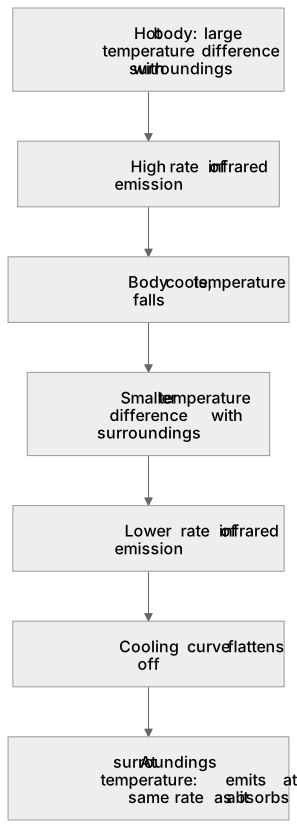
Put it in order
Put these steps in the order they happen.
- 1. At surroundings temperature: emits at same rate as it absorbs
- 2. Cooling curve flattens off
- 3. Body cools, temperature falls
- 4. Lower rate of infrared emission
- 5. Hot body: large temperature difference with surroundings
- 6. High rate of infrared emission
- 7. Smaller temperature difference with surroundings
Key words
Say what each word means before you turn the card.
rate of emission
Try answering aloud or in your head before turning the card.
cooling curves
Try answering aloud or in your head before turning the card.
infrared radiation
Try answering aloud or in your head before turning the card.
See every definition
- rate of emission
- How much infrared radiation a body radiates in a given time, which is not the same as the total energy emitted over the whole experiment.
- cooling curves
- A graph on which a steeper section is linked to a greater rate of emission and which is steepest at the start and flattens off towards room temperature.
- infrared radiation
- The radiation that a body radiates more of in a given time the hotter the body is.
Label the diagram
Some boxes have lost their names. Pick the right name for each number.
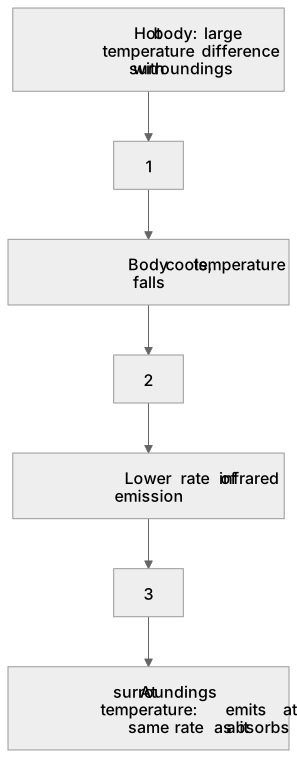
1Box 1
2Box 2
3Box 3
There is more to this lesson
The full lesson goes on to check your understanding and help you earn the marks. Create a free account to carry on, with your progress saved.
A week of Premium from your first lesson · Then the free plan continues · No card, no charge
Test your understanding of Emission and absorption of infrared radiation: The hotter the body, the more infrared radiation it radiates in a given time.
Active recall beats re-reading. Take an instant quiz now to test what you’ve learned and lock it into long-term memory.
A week of Premium from your first lesson · Then the free plan continues · No card, no charge