AQA · GCSE · Physics
Course version: 8463 · Version from Sept 2016
The amount of energy stored in or released from a system as its…
Full specification wording
Energy changes in systems: The amount of energy stored in or released from a system as its temperature changes can be calculated using the equation:
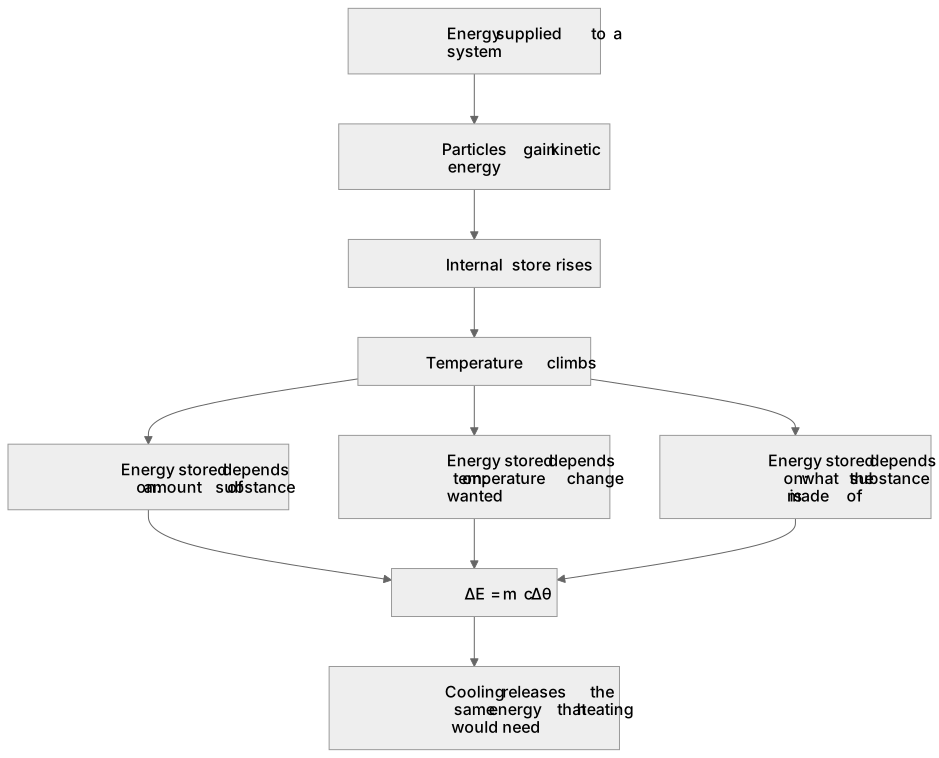
Heat a substance and its particles gain kinetic energy, so its internal store rises and its temperature climbs.
Checked against the AQA 8463 specification (opens in a new tab) on .
- Point 1 of 2
- 4 key terms
Study notes
From the checked teaching notes for this specification point.
The idea
Heat a substance and its particles gain kinetic energy, so its internal store rises and its temperature climbs. How much energy that takes depends on three things: how much substance there is, how many degrees you want, and what the substance is made of. Those three appear in ΔE = m c Δθ. Water has a specific heat capacity of 4200 J/kg °C, so it takes 4200 J to warm one kilogram by one degree; the same energy would raise a kilogram of copper, at 385 J/kg °C, by about 11 °C. The equation works both ways, so a cooling object releases the same energy that heating it would need, which is why a high specific heat capacity material makes a good store and a good coolant.
What earns the marks
- Selecting ΔE = m c Δθ and identifying the three quantities from the question.
- Using the temperature change rather than the final temperature.
- A correct substitution with mass in kilograms.
- The energy in joules, or for the correct rearrangement when c or Δθ is the unknown.
Common mistakes and how to put them right
Putting the final temperature into the equation instead of the difference between start and finish.
Using grams for mass with a specific heat capacity quoted per kilogram.
Assuming a material that heats quickly must be storing more energy, when it has a low specific heat capacity.
Using ΔE = m c Δθ for the part of a process where the substance is changing state, when that part needs the specific latent heat equation E = m L instead.
Exam tips
- Write Δθ as final minus initial in its own line before substituting, so the sign and size are both clear.
- A temperature change of 1 °C and of 1 K are the same size, so no conversion is needed.
- If the answer comes out in the millions, check whether the mass should have been in kilograms.
Try the lesson
The start of the Energy changes in systems: The amount of energy stored in or released from a system as its temperature changes can be calculated using the equation: lesson, made from checked teaching notes for this specification point.
Have a go first
A 2 kg block of aluminium is heated and its temperature rises by 5 °C. The specific heat capacity of aluminium is 900 J/kg °C. Which calculation gives the change in thermal energy of the block in joules?
Listen
Heat a substance and its particles gain kinetic energy, so its internal store rises and its temperature climbs. How much energy that takes depends on three things: how much substance there is, how many degrees you want, and what the substance is made of. Those three appear in ΔE = m c Δθ. Water has a specific heat capacity of 4200 J/kg °C, so it takes 4200 J to warm one kilogram by one degree; the same energy would raise a kilogram of copper, at 385 J/kg °C, by about 11 °C. The equation works both ways, so a cooling object releases the same energy that heating it would need, which is why a high specific heat capacity material makes a good store and a good coolant. A strong answer earns marks for these points. selecting ΔE = m c Δθ and identifying the three quantities from the question. using the temperature change rather than the final temperature. a correct substitution with mass in kilograms. the energy in joules, or for the correct rearrangement when c or Δθ is the unknown. Exam tip: Write Δθ as final minus initial in its own line before substituting, so the sign and size are both clear.
See it
Key words
Say what each word means before you turn the card.
internal energy
Try answering aloud or in your head before turning the card.
specific heat capacity
Try answering aloud or in your head before turning the card.
temperature change
Try answering aloud or in your head before turning the card.
energy released on cooling
Try answering aloud or in your head before turning the card.
See every definition
- internal energy
- The energy stored in a system, which rises as its particles gain kinetic energy when the substance is heated.
- specific heat capacity
- The energy needed to warm one kilogram of a substance by one degree, quoted per kilogram.
- temperature change
- The difference between the start and finish temperatures, written as final minus initial and used rather than the final temperature.
- energy released on cooling
- The same energy that heating the object would need, because the equation works both ways.
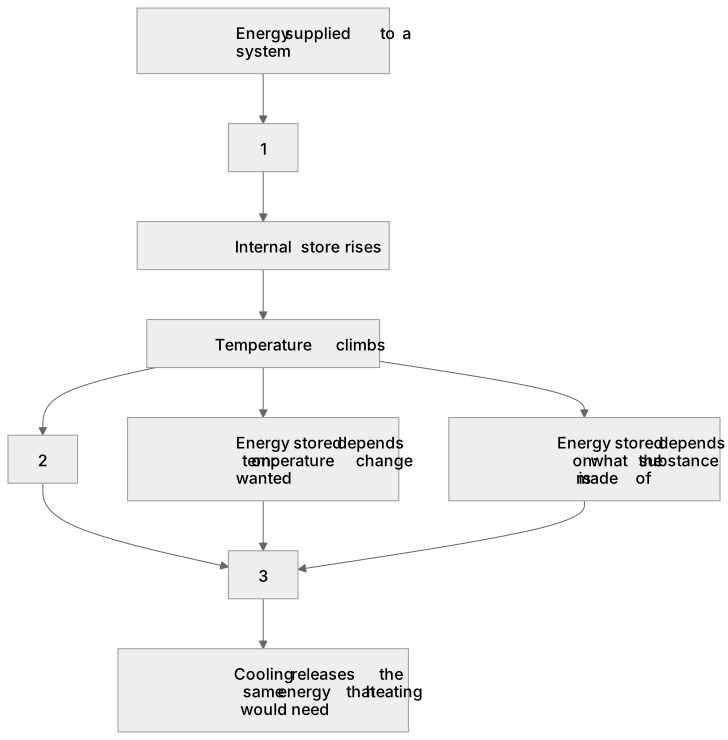
Label the diagram
Some boxes have lost their names. Pick the right name for each number.
1Box 1
2Box 2
3Box 3
There is more to this lesson
The full lesson goes on to check your understanding and help you earn the marks. Create a free account to carry on, with your progress saved.
A week of Premium from your first lesson · Then the free plan continues · No card, no charge
Test your understanding of Energy changes in systems: The amount of energy stored in or released from a system as its temperature changes can be calculated using the equation:
Active recall beats re-reading. Take an instant quiz now to test what you’ve learned and lock it into long-term memory.
A week of Premium from your first lesson · Then the free plan continues · No card, no charge