AQA · GCSE · Physics
Course version: 8463 · Version from Sept 2016
Energy stores and systems: A system is an object or group of objects.
A system in physics is whatever you choose to draw a boundary around: one object, such as a stretched spring, or a group of objects, such as a bumper car and the barrier it hits.
Checked against the AQA 8463 specification (opens in a new tab) on .
- Point 1 of 4
- 4 key terms
Study notes
From the checked teaching notes for this specification point.
The idea
A system in physics is whatever you choose to draw a boundary around: one object, such as a stretched spring, or a group of objects, such as a bumper car and the barrier it hits. The boundary matters because energy is only counted inside it. Energy sits in stores - kinetic, gravitational potential, elastic potential, thermal, chemical, magnetic, electrostatic and nuclear - and moves between them by mechanical working, electrical working, heating or radiation. A closed system is one that nothing crosses, so the total energy inside stays constant however it is shuffled between stores. Name the objects in the system before describing any change, or a transfer to the surroundings looks like energy vanishing.
What earns the marks
- Naming the objects that make up the system in the situation described.
- Stating that the total energy of a closed system stays constant.
- Saying that no energy is transferred to or from the surroundings.
- Identifying which store fills and which store empties inside the system.
Common mistakes and how to put them right
Treating the system as one object only, leaving out the barrier, spring or surroundings that the question named.
Listing electrical, light or sound as energy stores when they are pathways between stores.
Writing that energy is lost or used up when it has been transferred to the thermal store of the surroundings.
Exam tips
- Open the answer by saying what is inside the system; the boundary has to be clear before the energy argument means anything.
- For a closed system, the examiner credits stating that there is no net energy transfer to or from the surroundings, which means the total energy remains constant.
Try the lesson
The start of the Energy stores and systems: A system is an object or group of objects. lesson, made from checked teaching notes for this specification point.
Have a go first
A student is analysing the energy transfers that occur when a car brakes. They decide to study the car and the road together. In physics, what term is used to describe the object or group of objects chosen for analysis?
Listen
A system in physics is whatever you choose to draw a boundary around: one object, such as a stretched spring, or a group of objects, such as a bumper car and the barrier it hits. The boundary matters because energy is only counted inside it. Energy sits in stores - kinetic, gravitational potential, elastic potential, thermal, chemical, magnetic, electrostatic and nuclear - and moves between them by mechanical working, electrical working, heating or radiation. A closed system is one that nothing crosses, so the total energy inside stays constant however it is shuffled between stores. Name the objects in the system before describing any change, or a transfer to the surroundings looks like energy vanishing. A strong answer earns marks for these points. naming the objects that make up the system in the situation described. stating that the total energy of a closed system stays constant. saying that no energy is transferred to or from the surroundings. identifying which store fills and which store empties inside the system. Exam tip: Open the answer by saying what is inside the system; the boundary has to be clear before the energy argument means anything.
See it
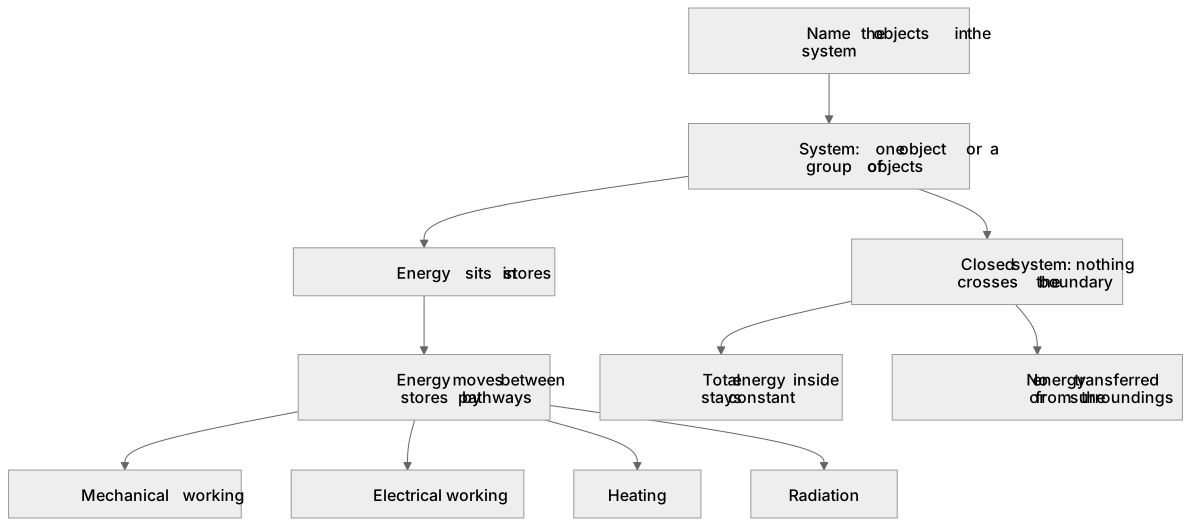
Watch it explained
A stretched spring is chosen as the system. Explain the boundary and what happens to energy in a closed system.
Read the described scene instead
Welcome to this GCSE AQA Physics breakdown on energy stores and systems. A system is simply whatever you choose to draw a boundary around: it can be one object, such as a stretched spring, or a group of objects, such as a bumper car and the barrier it hits. The boundary matters because energy is only counted inside it. In this video we will build the vocabulary of stores and pathways, see why closed systems conserve total energy, and practise the exact points examiners reward. Let's map the core idea. Inside a system, energy sits in stores: kinetic, gravitational potential, elastic potential, thermal, chemical, magnetic, electrostatic and nuclear. Energy moves between these stores by pathways: mechanical working, electrical working, heating or radiation. Keep stores and pathways separate. Electrical, light and sound are not stores in this guide; they are pathways between stores. If you can name the store and the pathway, you can describe an energy change clearly instead of saying energy has vanished. Our core study notes start with the boundary. A system is an object or a group of objects, and you must name the objects that make up the system in the situation described. For example, do not treat the system as one object only if the question also names a barrier, a spring or surroundings. A closed system is one that nothing crosses, so the total energy inside stays constant however it is shuffled between stores. That is why exam answers credit stating that no energy is transferred to or from the surroundings. Use this sequence in an exam answer. First, define the system by saying what is inside the boundary. Second, name the objects in that system before describing any change. Third, identify the energy store that fills and the store that empties inside the system. Fourth, if the system is closed, state that nothing crosses the boundary and that no energy is transferred to or from the surroundings. Fifth, conclude that the total energy of the closed system stays constant. This order keeps the boundary clear before the energy argument. Let's apply it. Question: A stretched spring is chosen as the system. Explain the boundary and what happens to energy in a closed system. Step one: name the object inside the system — the stretched spring. Step two: identify the relevant store — the elastic potential store. Step three: state that a closed system is one that nothing crosses. Step four: state that no energy is transferred to or from the surroundings. Answer: the system is the stretched spring; its energy is in the elastic potential store. In a closed system the total energy inside stays constant, so any change is described as energy moving between stores inside the system, not as energy being lost. Now avoid the common pitfalls. Do not treat the system as one object only and leave out the barrier, spring or surroundings that the question named. Do not list electrical, light or sound as energy stores; in this guide they are pathways between stores. Do not write that energy is lost or used up when it has been transferred to the thermal store of the surroundings. Instead, name the objects in the system, state whether it is closed, and say clearly which store fills and which store empties inside the boundary. Recap. A system is whatever you draw a boundary around: one object or a group of objects. Energy sits in stores — kinetic, gravitational potential, elastic potential, thermal, chemical, magnetic, electrostatic and nuclear — and moves by mechanical working, electrical working, heating or radiation. A closed system has nothing crossing it, so total energy stays constant. For full marks: name the objects, state no net transfer to or from surroundings, and identify which store fills and which store empties inside the system.
Key words
Say what each word means before you turn the card.
system
Try answering aloud or in your head before turning the card.
closed system
Try answering aloud or in your head before turning the card.
energy stores
Try answering aloud or in your head before turning the card.
energy pathways
Try answering aloud or in your head before turning the card.
See every definition
- system
- An object or group of objects, whatever you choose to draw a boundary around.
- closed system
- One that nothing crosses, so the total energy inside stays constant however it is shuffled between stores.
- energy stores
- Kinetic, gravitational potential, elastic potential, thermal, chemical, magnetic, electrostatic and nuclear, between which energy moves.
- energy pathways
- Mechanical working, electrical working, heating or radiation, by which energy moves between stores.
Label the diagram
Some boxes have lost their names. Pick the right name for each number.
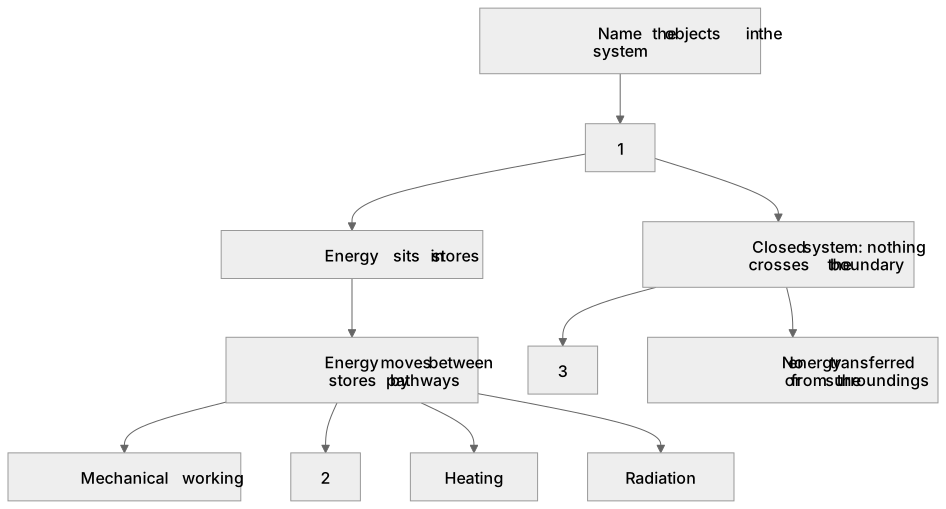
1Box 1
2Box 2
3Box 3
There is more to this lesson
The full lesson goes on to check your understanding and help you earn the marks. Create a free account to carry on, with your progress saved.
A week of Premium from your first lesson · Then the free plan continues · No card, no charge
Test your understanding of Energy stores and systems: A system is an object or group of objects.
Active recall beats re-reading. Take an instant quiz now to test what you’ve learned and lock it into long-term memory.
A week of Premium from your first lesson · Then the free plan continues · No card, no charge