AQA · GCSE · Physics
Course version: 8463 · Version from Sept 2016
Required practical activity 2 (physics only): investigate the…
Full specification wording
Energy transfers in a system: Required practical activity 2 (physics only): investigate the effectiveness of different materials as thermal insulators and the factors that may affect the thermal insulation properties of a material.
In this required practical you compare insulating materials.
Checked against the AQA 8463 specification (opens in a new tab) on .
- Point 8 of 8
Study notes
From the checked teaching notes for this specification point.
The idea
In this required practical you compare insulating materials. Pour a fixed volume of hot water into a beaker, wrap it in the material being tested, fit a lid with a thermometer through it, and record the temperature every minute for ten minutes, or time how long it takes to fall by a set amount. The independent variable is the type of material, or its thickness if that is what you change; the dependent variable is the temperature drop in a set time, or the time for a set drop. Control the starting temperature, the volume of water, the beaker and the room. The material that keeps the water hottest has the lowest thermal conductivity. Repeat and average, because a single run hides how much readings scatter.
What earns the marks
- Identifying the independent variable as the type of insulating material.
- Identifying the dependent variable, the temperature reached or the time taken.
- Two named control variables such as the volume and starting temperature of the water.
- A conclusion linking the slowest cooling to the best insulator or lowest thermal conductivity.
Common mistakes and how to put them right
Giving thickness of material as the independent variable when the investigation compared different materials.
Changing the volume of water between trials so the comparison is invalid.
Leaving the beaker without a lid, so evaporation and convection swamp the effect being tested.
Concluding the material is best without referring to the cooling data that shows it.
Exam tips
- Read the stem carefully before naming variables; the mark scheme rejects thickness where material was the variable.
- Say how long the readings were taken for, because a method without a time span is incomplete.
- Offer a conclusion in the form water wrapped in X cooled more slowly, then add the conductivity comparison.
Try the lesson
The start of the Energy transfers in a system: Required practical activity 2 (physics only): investigate the effectiveness of different materials as thermal insulators and the factors that may affect the thermal insulation properties of a material. lesson, made from checked teaching notes for this specification point.
Have a go first
In an experiment on thermal insulation, a beaker of hot water is wrapped in a material. What measurement shows how effective the material is as an insulator?
Listen
In this required practical you compare insulating materials. Pour a fixed volume of hot water into a beaker, wrap it in the material being tested, fit a lid with a thermometer through it, and record the temperature every minute for ten minutes, or time how long it takes to fall by a set amount. The independent variable is the type of material, or its thickness if that is what you change; the dependent variable is the temperature drop in a set time, or the time for a set drop. Control the starting temperature, the volume of water, the beaker and the room. The material that keeps the water hottest has the lowest thermal conductivity. Repeat and average, because a single run hides how much readings scatter. A strong answer earns marks for these points. identifying the independent variable as the type of insulating material. identifying the dependent variable, the temperature reached or the time taken. two named control variables such as the volume and starting temperature of the water. a conclusion linking the slowest cooling to the best insulator or lowest thermal conductivity. Exam tip: Read the stem carefully before naming variables; the mark scheme rejects thickness where material was the variable.
See it
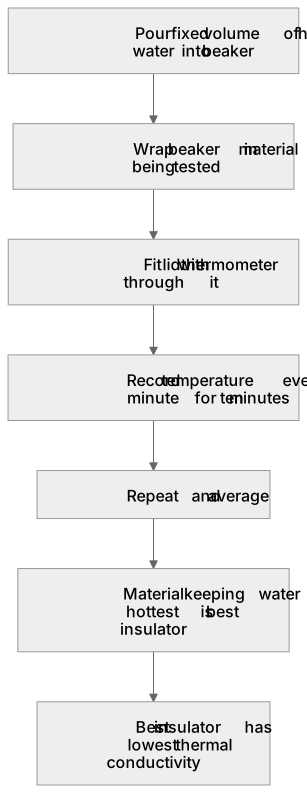
Put it in order
Put these steps in the order they happen.
- 1. Best insulator has lowest thermal conductivity
- 2. Material keeping water hottest is best insulator
- 3. Fit lid with thermometer through it
- 4. Repeat and average
- 5. Pour fixed volume of hot water into beaker
- 6. Wrap beaker in material being tested
- 7. Record temperature every minute for ten minutes
Label the diagram
Some boxes have lost their names. Pick the right name for each number.
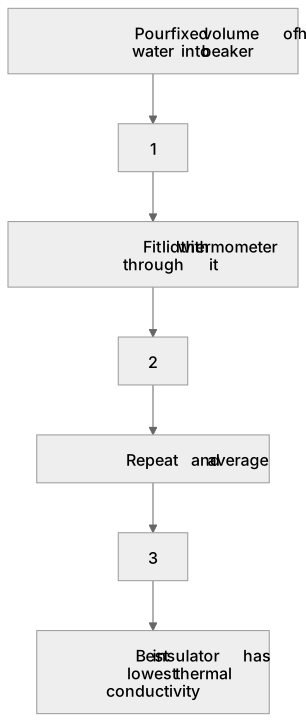
1Box 1
2Box 2
3Box 3
There is more to this lesson
The full lesson goes on to check your understanding and help you earn the marks. Create a free account to carry on, with your progress saved.
A week of Premium from your first lesson · Then the free plan continues · No card, no charge
Test your understanding of Energy transfers in a system: Required practical activity 2 (physics only): investigate the effectiveness of different materials as thermal insulators and the factors that may affect the thermal insulation properties of a material.
Active recall beats re-reading. Take an instant quiz now to test what you’ve learned and lock it into long-term memory.
A week of Premium from your first lesson · Then the free plan continues · No card, no charge