AQA · GCSE · Physics
Course version: 8463 · Version from Sept 2016
Students should be able to describe, with examples, the relationship…
Full specification wording
Energy transfers in everyday appliances: Students should be able to describe, with examples, the relationship between the power ratings for domestic electrical appliances and the changes in stored energy when they are in use.
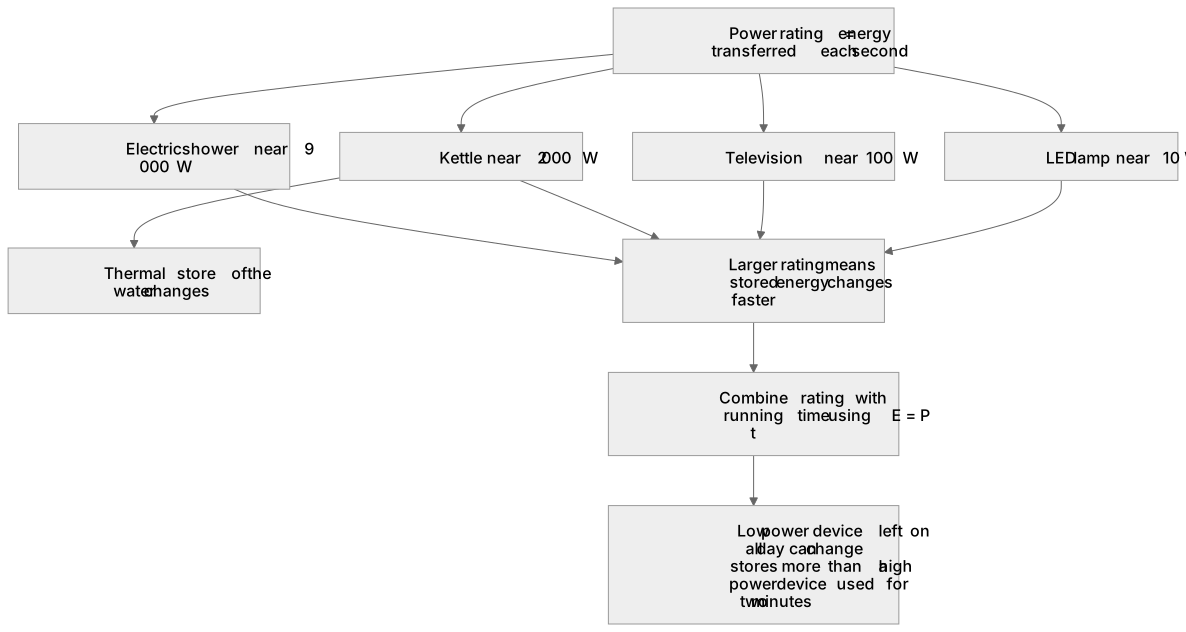
The power rating printed on an appliance is the energy it transfers each second, in joules per second.
Checked against the AQA 8463 specification (opens in a new tab) on .
- Point 6 of 6
- 3 key terms
Study notes
From the checked teaching notes for this specification point.
The idea
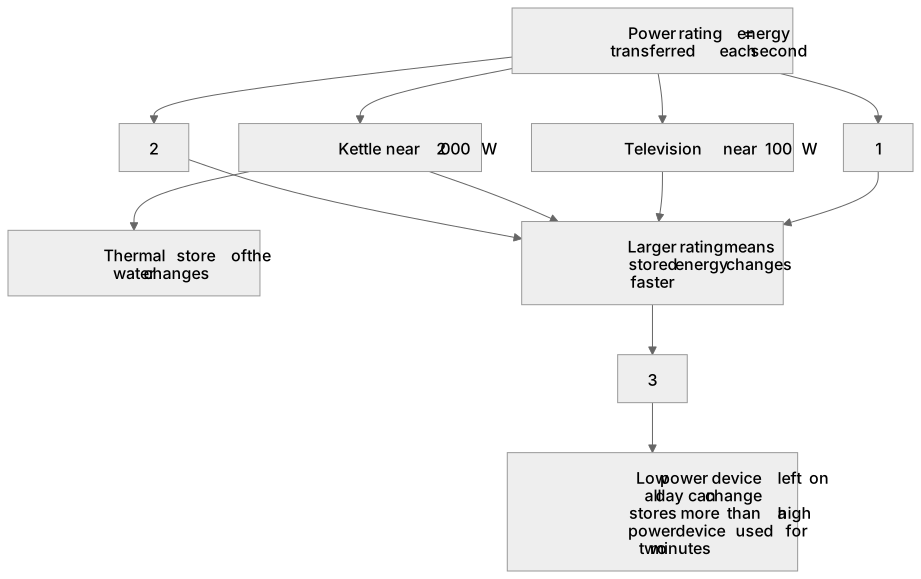
The power rating printed on an appliance is the energy it transfers each second, in joules per second. An LED lamp near 10 W, a television near 100 W, a kettle near 2 000 W and an electric shower near 9 000 W are the numbers worth carrying into the exam. A larger rating means the stored energy changes faster: a 2 000 W kettle raises the thermal store of the water two hundred times faster than a 10 W lamp lights a room. To compare appliances properly you must combine the rating with the running time using E = P t, because a low power device left on all day can change stores by more than a high power device used for two minutes. Heating appliances carry the highest ratings, because raising temperature needs a great deal of energy.
What earns the marks
- The power rating stated as the energy transferred each second.
- A sensible power rating quoted for a named appliance.
- Naming the store that changes, such as the thermal store of the water in a kettle.
- Combining the rating with a running time using E = P t to compare two appliances.
Common mistakes and how to put them right
Describing a power rating as the total energy an appliance uses.
Quoting a kettle as 2 W or an LED lamp as 2 000 W because the magnitudes have not been learned.
Comparing appliances by power rating alone when their running times differ.
Saying the energy of the appliance increases rather than naming the store that changes.
Exam tips
- Learn one plausible rating for a lamp, a television, a kettle and a shower so you can always quote an example.
- 'With examples' in a question means at least one named appliance with a number attached.
- Say which store changes and in which direction, because 'energy increases' alone is not enough.
Try the lesson
The start of the Energy transfers in everyday appliances: Students should be able to describe, with examples, the relationship between the power ratings for domestic electrical appliances and the changes in stored energy when they are in use. lesson, made from checked teaching notes for this specification point.
Have a go first
A 2000 W kettle and a 700 W microwave are each switched on for the same length of time. Which appliance transfers more energy from the mains electricity supply in that time?
Listen
The power rating printed on an appliance is the energy it transfers each second, in joules per second. An LED lamp near 10 W, a television near 100 W, a kettle near 2 000 W and an electric shower near 9 000 W are the numbers worth carrying into the exam. A larger rating means the stored energy changes faster: a 2 000 W kettle raises the thermal store of the water two hundred times faster than a 10 W lamp lights a room. To compare appliances properly you must combine the rating with the running time using E = P t, because a low power device left on all day can change stores by more than a high power device used for two minutes. Heating appliances carry the highest ratings, because raising temperature needs a great deal of energy. A strong answer earns marks for these points. the power rating stated as the energy transferred each second. a sensible power rating quoted for a named appliance. naming the store that changes, such as the thermal store of the water in a kettle. combining the rating with a running time using E = P t to compare two appliances. Exam tip: Learn one plausible rating for a lamp, a television, a kettle and a shower so you can always quote an example.
See it
Key words
Say what each word means before you turn the card.
power rating
Try answering aloud or in your head before turning the card.
typical appliance powers
Try answering aloud or in your head before turning the card.
running time
Try answering aloud or in your head before turning the card.
See every definition
- power rating
- The energy an appliance transfers each second, in joules per second, as printed on the appliance.
- typical appliance powers
- Plausible ratings worth learning for a lamp, a television, a kettle and a shower, so an example can always be quoted.
- running time
- The time an appliance is used for, which must be combined with the rating using E = P t to compare appliances properly.
Label the diagram
Some boxes have lost their names. Pick the right name for each number.
1Box 1
2Box 2
3Box 3
There is more to this lesson
The full lesson goes on to check your understanding and help you earn the marks. Create a free account to carry on, with your progress saved.
A week of Premium from your first lesson · Then the free plan continues · No card, no charge
Test your understanding of Energy transfers in everyday appliances: Students should be able to describe, with examples, the relationship between the power ratings for domestic electrical appliances and the changes in stored energy when they are in use.
Active recall beats re-reading. Take an instant quiz now to test what you’ve learned and lock it into long-term memory.
A week of Premium from your first lesson · Then the free plan continues · No card, no charge