AQA · GCSE · Physics
Course version: 8463 · Version from Sept 2016
Students should be able to apply the principles of the generator effect in…
Full specification wording
Induced potential (HT only): Students should be able to apply the principles of the generator effect in a given context.
Unfamiliar contexts are the same physics in new clothes, so answer them with the same four moves: find the conductor, find the magnetic field, say what is changing, then say what is induced.
Checked against the AQA 8463 specification (opens in a new tab) on .
- Point 7 of 7
- 4 key terms
Study notes
From the checked teaching notes for this specification point.
The idea
Unfamiliar contexts are the same physics in new clothes, so answer them with the same four moves: find the conductor, find the magnetic field, say what is changing, then say what is induced. A shake torch has a magnet sliding through a coil, so the field through the coil changes and a potential difference is induced that lights the lamp. An electric guitar pickup has a steel string vibrating above a magnet and a coil, so the field through the coil changes at the frequency of the string. A roller coaster brake drags metal fins between magnets, and the induced currents produce fields that oppose the motion and slow the car. That last one is the opposition rule doing useful work, and none of these devices needs a battery.
What earns the marks
- Identifying the conductor and the magnetic field in the unfamiliar arrangement.
- Stating what is changing, either the relative position or the strength of the field.
- A potential difference, and where the circuit is complete a current, being induced.
- Applying the opposition rule where the question asks about a force or a braking effect.
Common mistakes and how to put them right
Answering with a memorised dynamo description that never mentions the apparatus in the question.
Saying the device creates electricity rather than naming the induced potential difference.
Missing that a vibrating steel object near a magnet changes the field, so no cause for the induction is identified.
Leaving out the need for a complete circuit before claiming that a current flows.
Exam tips
- Underline the moving part in the stem; that is almost always where the induction happens.
- Write your answer using the nouns the question uses, so the fins rather than the coil.
- Two marks usually means cause then effect, so do not give two versions of the effect.
Try the lesson
The start of the Induced potential (HT only): Students should be able to apply the principles of the generator effect in a given context. lesson, made from checked teaching notes for this specification point.
Have a go first
A coil of wire is rotated between the poles of a magnet while it is connected to a lamp. Why does the lamp light up?
Listen
Unfamiliar contexts are the same physics in new clothes, so answer them with the same four moves: find the conductor, find the magnetic field, say what is changing, then say what is induced. A shake torch has a magnet sliding through a coil, so the field through the coil changes and a potential difference is induced that lights the lamp. An electric guitar pickup has a steel string vibrating above a magnet and a coil, so the field through the coil changes at the frequency of the string. A roller coaster brake drags metal fins between magnets, and the induced currents produce fields that oppose the motion and slow the car. That last one is the opposition rule doing useful work, and none of these devices needs a battery. A strong answer earns marks for these points. identifying the conductor and the magnetic field in the unfamiliar arrangement. stating what is changing, either the relative position or the strength of the field. a potential difference, and where the circuit is complete a current, being induced. applying the opposition rule where the question asks about a force or a braking effect. Exam tip: Underline the moving part in the stem; that is almost always where the induction happens.
See it
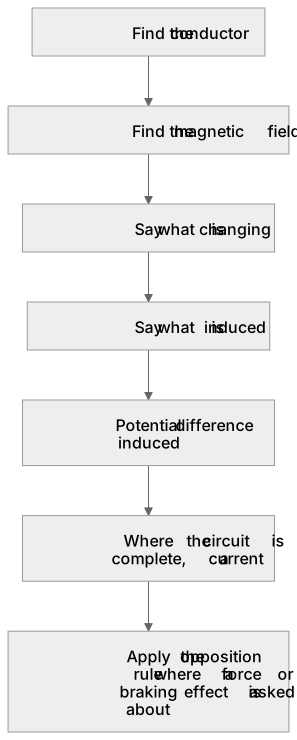
Put it in order
Put these steps in the order they happen.
- 1. Apply the opposition rule where a force or braking effect is asked about
- 2. Where the circuit is complete, a current
- 3. Say what is changing
- 4. Potential difference induced
- 5. Find the conductor
- 6. Find the magnetic field
- 7. Say what is induced
Key words
Say what each word means before you turn the card.
unfamiliar contexts
Try answering aloud or in your head before turning the card.
changing field
Try answering aloud or in your head before turning the card.
induced potential difference
Try answering aloud or in your head before turning the card.
opposition and braking
Try answering aloud or in your head before turning the card.
See every definition
- unfamiliar contexts
- Situations that are the same physics in new clothes, answered with the same four moves: find the conductor, find the magnetic field, say what is changing, then say what is induced.
- changing field
- A change in the field through the coil, caused for example by a magnet sliding through a coil or a steel string vibrating above a magnet and a coil.
- induced potential difference
- What is produced when the field through the coil changes, lighting the lamp in a shake torch, and where the circuit is complete a current is induced.
- opposition and braking
- The opposition rule doing useful work, where induced currents produce fields that oppose the motion and slow the car, as in a roller coaster brake.
Label the diagram
Some boxes have lost their names. Pick the right name for each number.
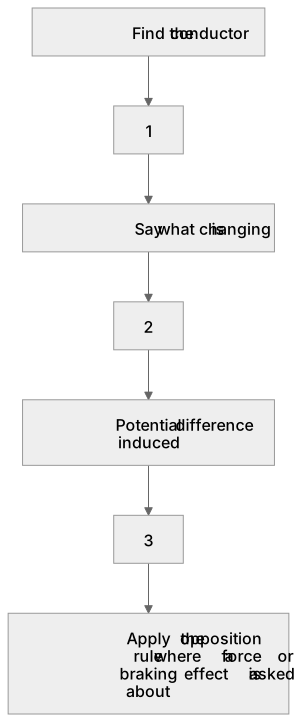
1Box 1
2Box 2
3Box 3
There is more to this lesson
The full lesson goes on to check your understanding and help you earn the marks. Create a free account to carry on, with your progress saved.
A week of Premium from your first lesson · Then the free plan continues · No card, no charge
Test your understanding of Induced potential (HT only): Students should be able to apply the principles of the generator effect in a given context.
Active recall beats re-reading. Take an instant quiz now to test what you’ve learned and lock it into long-term memory.
A week of Premium from your first lesson · Then the free plan continues · No card, no charge