AQA · GCSE · Physics
Course version: 8463 · Version from Sept 2016
Heating changes the energy stored within the system by increasing the…
Full specification wording
Internal energy: Heating changes the energy stored within the system by increasing the energy of the particles that make up the system.
Heating transfers energy into a system, and that energy ends up with the particles.
Checked against the AQA 8463 specification (opens in a new tab) on .
- Point 3 of 4
- 4 key terms
Study notes
From the checked teaching notes for this specification point.
The idea
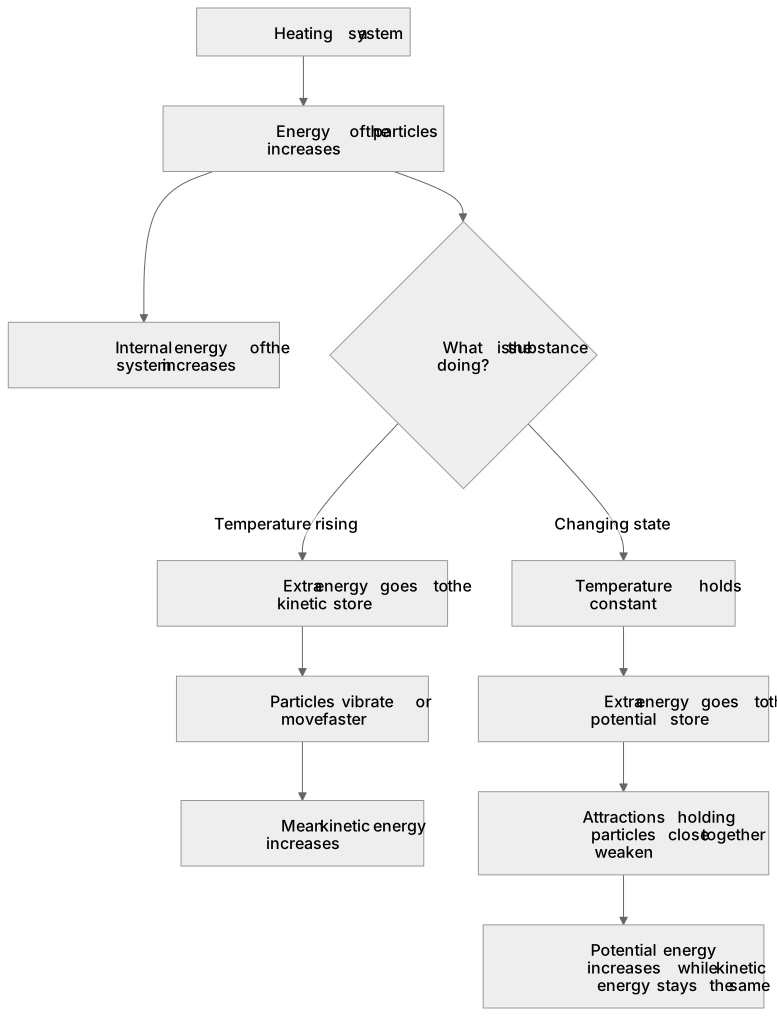
Heating transfers energy into a system, and that energy ends up with the particles. Which part of their energy rises depends on what the substance is doing. While the temperature is rising, the extra energy goes to the kinetic store, so the particles vibrate or move faster and their mean kinetic energy increases. While the substance is changing state, the temperature holds constant and the extra energy goes to the potential store instead, weakening the attractions that hold the particles close together, so their potential energy increases while their kinetic energy stays the same. Either way the internal energy of the system increases, because the energy is not lost, only stored differently.
What earns the marks
- Heating increasing the energy of the particles in the system.
- The mean kinetic energy of the particles increasing while the temperature rises.
- The potential energy of the particles increasing during a change of state.
- The kinetic energy of the particles staying the same while a substance melts at constant temperature.
Common mistakes and how to put them right
Saying the particles move faster while a substance melts, even though the temperature is constant.
Stating that the potential energy of the particles decreases as a solid melts.
Claiming the particles expand or gain mass when they are heated.
Treating a constant temperature as evidence that no energy is being transferred in.
Exam tips
- Check the temperature first, because constant temperature means potential energy and rising temperature means kinetic energy.
- In tick-box questions with a row for kinetic and a row for potential, give one tick per row only.
- Write 'mean kinetic energy' rather than 'speed' when describing a whole system of particles.
Try the lesson
The start of the Internal energy: Heating changes the energy stored within the system by increasing the energy of the particles that make up the system. lesson, made from checked teaching notes for this specification point.
Have a go first
What happens to the energy of the particles in a system when the system is heated?
Listen
Heating transfers energy into a system, and that energy ends up with the particles. Which part of their energy rises depends on what the substance is doing. While the temperature is rising, the extra energy goes to the kinetic store, so the particles vibrate or move faster and their mean kinetic energy increases. While the substance is changing state, the temperature holds constant and the extra energy goes to the potential store instead, weakening the attractions that hold the particles close together, so their potential energy increases while their kinetic energy stays the same. Either way the internal energy of the system increases, because the energy is not lost, only stored differently. A strong answer earns marks for these points. heating increasing the energy of the particles in the system. the mean kinetic energy of the particles increasing while the temperature rises. the potential energy of the particles increasing during a change of state. the kinetic energy of the particles staying the same while a substance melts at constant temperature. Exam tip: Check the temperature first, because constant temperature means potential energy and rising temperature means kinetic energy.
See it
Key words
Say what each word means before you turn the card.
heating a system
Try answering aloud or in your head before turning the card.
kinetic energy of particles
Try answering aloud or in your head before turning the card.
potential energy of particles
Try answering aloud or in your head before turning the card.
constant temperature during melting
Try answering aloud or in your head before turning the card.
See every definition
- heating a system
- Changes the energy stored within the system by increasing the energy of the particles that make up the system.
- kinetic energy of particles
- Increases while the temperature is rising, so the particles vibrate or move faster and their mean kinetic energy increases.
- potential energy of particles
- Increases during a change of state, weakening the attractions that hold the particles close together while their kinetic energy stays the same.
- constant temperature during melting
- While the substance is changing state the temperature holds constant and the extra energy goes to the potential store instead.
Label the diagram
Some boxes have lost their names. Pick the right name for each number.
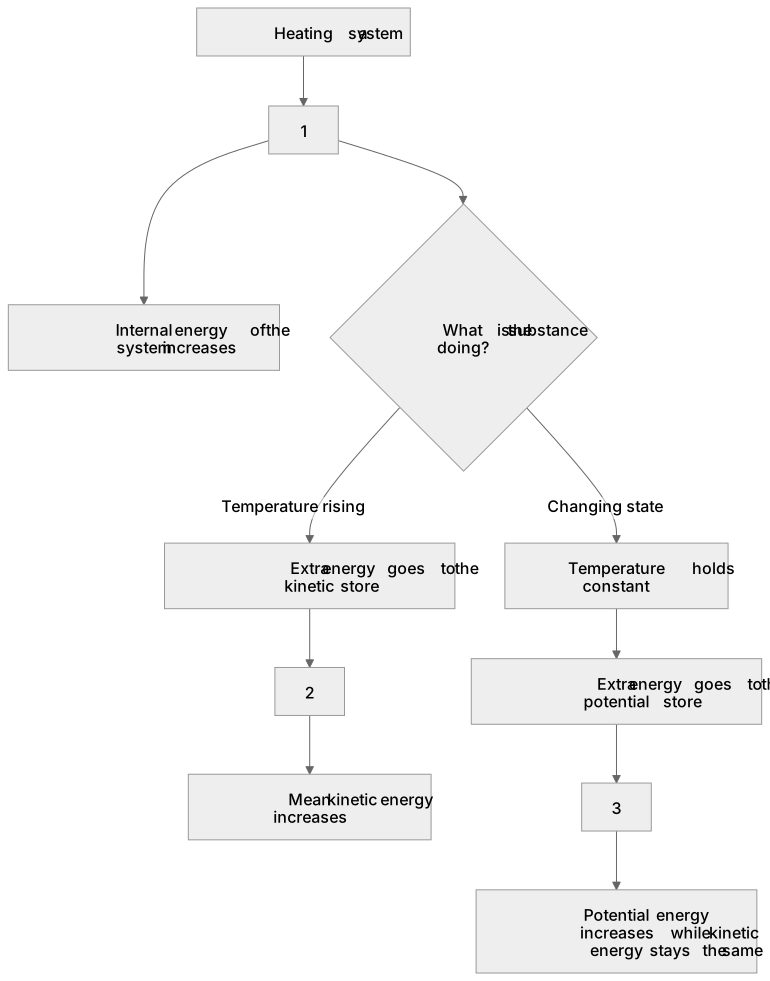
1Box 1
2Box 2
3Box 3
There is more to this lesson
The full lesson goes on to check your understanding and help you earn the marks. Create a free account to carry on, with your progress saved.
A week of Premium from your first lesson · Then the free plan continues · No card, no charge
Test your understanding of Internal energy: Heating changes the energy stored within the system by increasing the energy of the particles that make up the system.
Active recall beats re-reading. Take an instant quiz now to test what you’ve learned and lock it into long-term memory.
A week of Premium from your first lesson · Then the free plan continues · No card, no charge