AQA · GCSE · Physics
Course version: 8463 · Version from Sept 2016
The image produced by a convex lens can be either real or virtual.
Full specification wording
Lenses (physics only): The image produced by a convex lens can be either real or virtual.
Which kind of image you get depends on where the object is.
Checked against the AQA 8463 specification (opens in a new tab) on .
- Point 5 of 9
- 3 key terms
Study notes
From the checked teaching notes for this specification point.
The idea
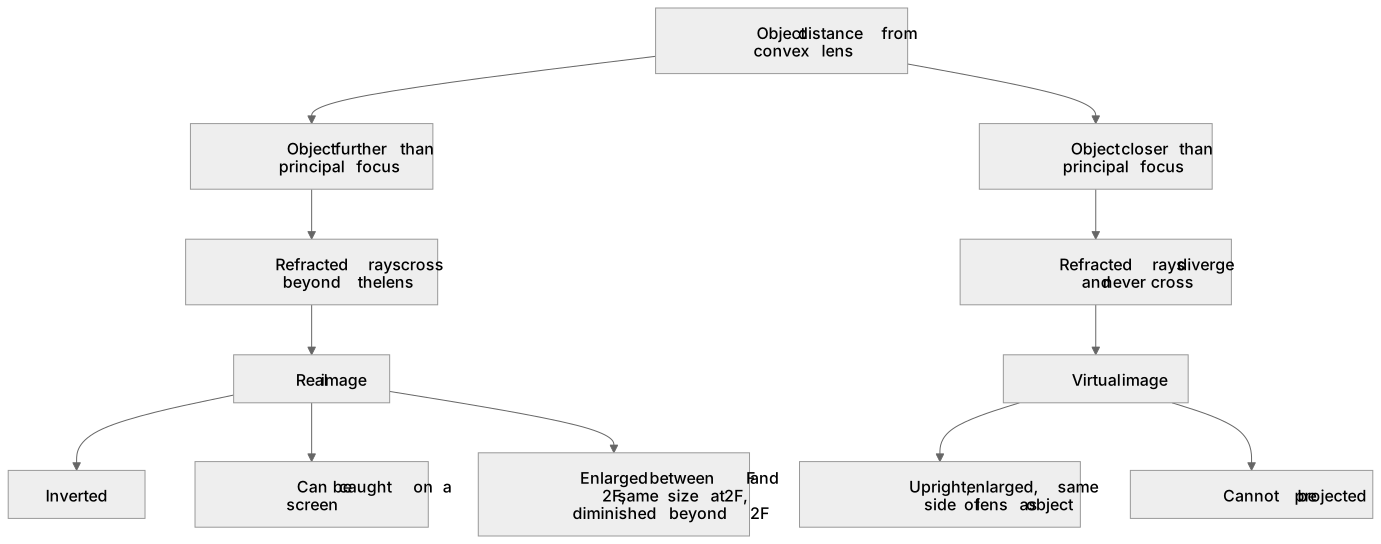
Which kind of image you get depends on where the object is. If the object is further from the lens than the principal focus, the refracted rays actually cross beyond the lens and form a real image: it is inverted, it can be caught on a screen, and it is enlarged when the object lies between F and 2F, the same size at 2F and diminished beyond 2F. If the object is closer to the lens than the principal focus, the refracted rays diverge and never cross, so you trace them back to where they appear to come from; that is a virtual image, upright, enlarged and on the same side of the lens as the object. That is the magnifying glass arrangement. A real image can be projected, a virtual image cannot.
What earns the marks
- Stating that the object must be further from the lens than the principal focus for a real image.
- Stating that an object closer to the lens than the principal focus gives a virtual image.
- Describing a real image as inverted and able to be formed on a screen.
- Describing a virtual image as upright and on the same side of the lens as the object.
Common mistakes and how to put them right
Saying a convex lens always magnifies, when it can also produce a diminished image.
Claiming a virtual image can be projected onto a screen.
Drawing a real image upright.
Deciding the image type from the lens alone without checking the object distance.
Exam tips
- Mark F and 2F on both sides before deciding what kind of image to expect.
- Describe an image in three parts: real or virtual, upright or inverted, enlarged or diminished.
- If the ray diagram shows the rays diverging after the lens, the image must be virtual.
Try the lesson
The start of the Lenses (physics only): The image produced by a convex lens can be either real or virtual. lesson, made from checked teaching notes for this specification point.
Have a go first
Which type of image can a convex lens produce?
Listen
Which kind of image you get depends on where the object is. If the object is further from the lens than the principal focus, the refracted rays actually cross beyond the lens and form a real image: it is inverted, it can be caught on a screen, and it is enlarged when the object lies between F and 2F, the same size at 2F and diminished beyond 2F. If the object is closer to the lens than the principal focus, the refracted rays diverge and never cross, so you trace them back to where they appear to come from; that is a virtual image, upright, enlarged and on the same side of the lens as the object. That is the magnifying glass arrangement. A real image can be projected, a virtual image cannot. A strong answer earns marks for these points. stating that the object must be further from the lens than the principal focus for a real image. stating that an object closer to the lens than the principal focus gives a virtual image. describing a real image as inverted and able to be formed on a screen. describing a virtual image as upright and on the same side of the lens as the object. Exam tip: Mark F and 2F on both sides before deciding what kind of image to expect.
See it
Key words
Say what each word means before you turn the card.
real image
Try answering aloud or in your head before turning the card.
magnifying glass
Try answering aloud or in your head before turning the card.
object distance
Try answering aloud or in your head before turning the card.
See every definition
- real image
- Formed when the object is further from the lens than the principal focus, so the refracted rays actually cross beyond the lens; it is inverted and can be caught on a screen.
- magnifying glass
- The arrangement in which the object is closer to the lens than the principal focus, giving a virtual image that is upright and enlarged.
- object distance
- How far the object is from the lens, which decides whether the image is real or virtual.
Label the diagram
Some boxes have lost their names. Pick the right name for each number.
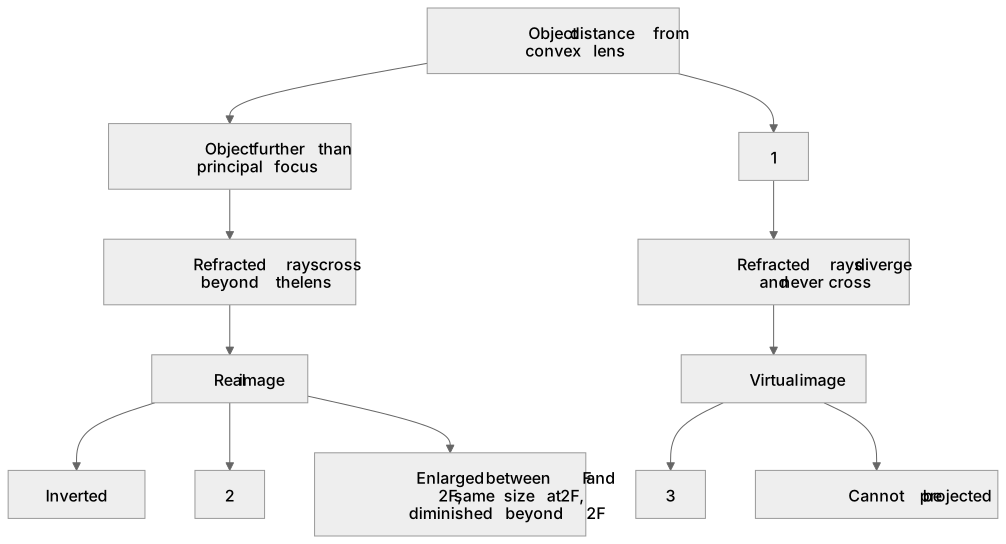
1Box 1
2Box 2
3Box 3
There is more to this lesson
The full lesson goes on to check your understanding and help you earn the marks. Create a free account to carry on, with your progress saved.
A week of Premium from your first lesson · Then the free plan continues · No card, no charge
Test your understanding of Lenses (physics only): The image produced by a convex lens can be either real or virtual.
Active recall beats re-reading. Take an instant quiz now to test what you’ve learned and lock it into long-term memory.
A week of Premium from your first lesson · Then the free plan continues · No card, no charge