AQA · GCSE · Physics
Course version: 8463 · Version from Sept 2016
Loudspeakers and headphones use the motor effect to convert variations in…
Full specification wording
Loudspeakers (physics only) (HT only): Loudspeakers and headphones use the motor effect to convert variations in current in electrical circuits to the pressure variations in sound waves.
A moving-coil loudspeaker turns an electrical signal into sound using the motor effect.
Checked against the AQA 8463 specification (opens in a new tab) on .
- Point 1 of 2
Study notes
From the checked teaching notes for this specification point.
The idea
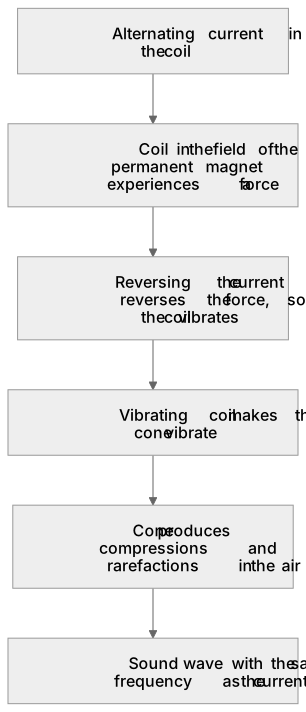
A moving-coil loudspeaker turns an electrical signal into sound using the motor effect. A coil is wound on a former sitting in the gap of a cylindrical permanent magnet, so the field runs straight across the wire. An alternating current in the coil puts a force on it, and because of the way the field is arranged that force pushes the coil in or out along the axis. Reverse the current and the force reverses, so an alternating signal makes the coil move in and out at the frequency of the signal, and a larger current gives a larger force and a bigger movement. The coil is fixed to a paper cone, the cone pushes on the air next to it, and the air is squashed into compressions and pulled apart into rarefactions. That is a sound wave with the same frequency as the current.
What earns the marks
- A varying or alternating current passing through the coil.
- The coil experiencing a force because it is in the field of the permanent magnet.
- Reversing the current reversing the force, so the coil vibrates.
- The vibrating coil making the cone vibrate.
- The cone producing compressions and rarefactions, the pressure variations of a sound wave.
Common mistakes and how to put them right
Saying the coil is attracted and repelled as a magnet, instead of naming the force on a current-carrying wire.
Stopping at the cone vibrating, with no mention of pressure variations in the air.
Describing the sound produced as a transverse wave, when sound in air is longitudinal.
Explaining the generator effect, which is the microphone, rather than the motor effect.
Saying that a bigger current gives a higher note, when it gives a louder one.
Exam tips
- This is usually a six mark levels question; write the chain in order, current, force, coil, cone, air, sound.
- Use the words compression and rarefaction, which turn the cone moves into a description of a sound wave.
- If the question changes the signal, say what happens to both the loudness and the pitch.
Try the lesson
The start of the Loudspeakers (physics only) (HT only): Loudspeakers and headphones use the motor effect to convert variations in current in electrical circuits to the pressure variations in sound waves. lesson, made from checked teaching notes for this specification point.
Have a go first
A loudspeaker contains a coil of wire attached to a cone. The coil is placed in a magnetic field. When an alternating current flows through the coil, the cone vibrates and produces sound. Which statement explains why the cone vibrates?
Listen
A moving-coil loudspeaker turns an electrical signal into sound using the motor effect. A coil is wound on a former sitting in the gap of a cylindrical permanent magnet, so the field runs straight across the wire. An alternating current in the coil puts a force on it, and because of the way the field is arranged that force pushes the coil in or out along the axis. Reverse the current and the force reverses, so an alternating signal makes the coil move in and out at the frequency of the signal, and a larger current gives a larger force and a bigger movement. The coil is fixed to a paper cone, the cone pushes on the air next to it, and the air is squashed into compressions and pulled apart into rarefactions. That is a sound wave with the same frequency as the current. A strong answer earns marks for these points. a varying or alternating current passing through the coil. the coil experiencing a force because it is in the field of the permanent magnet. reversing the current reversing the force, so the coil vibrates. the vibrating coil making the cone vibrate. Exam tip: This is usually a six mark levels question; write the chain in order, current, force, coil, cone, air, sound.
See it
Put it in order
Put these steps in the order they happen.
- 1. Reversing the current reverses the force, so the coil vibrates
- 2. Coil in the field of the permanent magnet experiences a force
- 3. Alternating current in the coil
- 4. Sound wave with the same frequency as the current
- 5. Cone produces compressions and rarefactions in the air
- 6. Vibrating coil makes the cone vibrate
Label the diagram
Some boxes have lost their names. Pick the right name for each number.
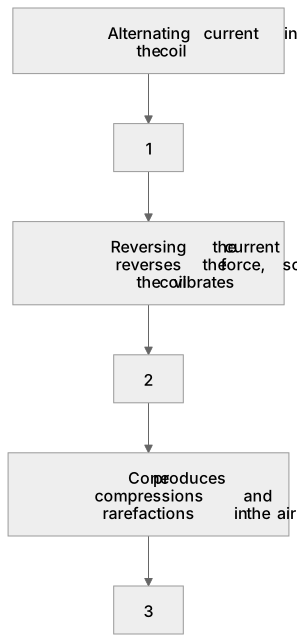
1Box 1
2Box 2
3Box 3
There is more to this lesson
The full lesson goes on to check your understanding and help you earn the marks. Create a free account to carry on, with your progress saved.
A week of Premium from your first lesson · Then the free plan continues · No card, no charge
Test your understanding of Loudspeakers (physics only) (HT only): Loudspeakers and headphones use the motor effect to convert variations in current in electrical circuits to the pressure variations in sound waves.
Active recall beats re-reading. Take an instant quiz now to test what you’ve learned and lock it into long-term memory.
A week of Premium from your first lesson · Then the free plan continues · No card, no charge