AQA · GCSE · Physics
Course version: 8463 · Version from Sept 2016
The insulation covering each wire is colour coded for easy identification:…
Full specification wording
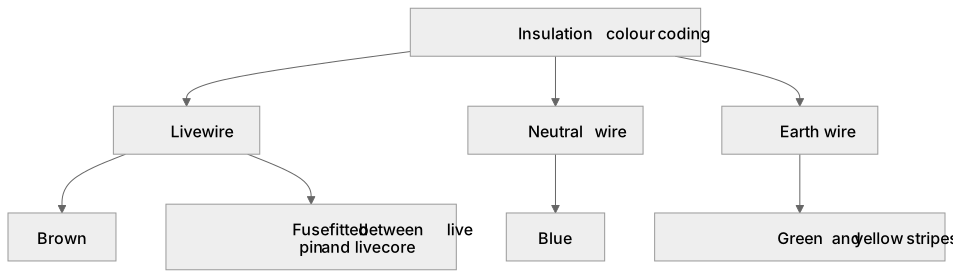
Mains electricity: The insulation covering each wire is colour coded for easy identification: live wire – brown neutral wire – blue earth wire – green and yellow stripes.
The colour is on the plastic insulation, not on the copper, and it is standardised so that anyone wiring a plug can identify each core without testing it.
Checked against the AQA 8463 specification (opens in a new tab) on .
- Point 2 of 8
- 4 key terms
Study notes
From the checked teaching notes for this specification point.
The idea
The colour is on the plastic insulation, not on the copper, and it is standardised so that anyone wiring a plug can identify each core without testing it. Live is brown, neutral is blue, and earth is green and yellow stripes, the only core with two colours, which is deliberate because it is the safety core and must never be confused. Inside a UK plug the cores always land in the same places: earth goes to the longest top pin, live to the pin on the right as you look into the open plug, and neutral to the pin on the left, with the fuse fitted between the live pin and the live core. Learn the three colours as a set, because questions often give a table of wires to match, one mark per correct row.
What earns the marks
- The earth wire as green and yellow.
- The live wire as brown.
- The neutral wire as blue.
- The fuse being fitted in the live side of the circuit.
Common mistakes and how to put them right
Swapping brown and blue, so the live wire is given as blue.
Writing 'green' alone for the earth wire instead of green and yellow stripes.
Quoting the obsolete red, black and green colours from old wiring.
Colouring the copper core rather than the insulation on a labelled diagram.
Exam tips
- Match-the-wire tables carry one mark per row, so fill in every row even where you are unsure.
- Remember earth is the two-colour wire; that alone rules out wrong options in a multiple-choice list.
- In a plug diagram find the fuse first, because the core it connects to must be the brown live wire.
Try the lesson
The start of the Mains electricity: The insulation covering each wire is colour coded for easy identification: live wire – brown neutral wire – blue earth wire – green and yellow stripes. lesson, made from checked teaching notes for this specification point.
Have a go first
In a three-core mains cable, which colour of insulation covers the live wire?
Listen
The colour is on the plastic insulation, not on the copper, and it is standardised so that anyone wiring a plug can identify each core without testing it. Live is brown, neutral is blue, and earth is green and yellow stripes, the only core with two colours, which is deliberate because it is the safety core and must never be confused. Inside a UK plug the cores always land in the same places: earth goes to the longest top pin, live to the pin on the right as you look into the open plug, and neutral to the pin on the left, with the fuse fitted between the live pin and the live core. Learn the three colours as a set, because questions often give a table of wires to match, one mark per correct row. A strong answer earns marks for these points. the earth wire as green and yellow. the live wire as brown. the neutral wire as blue. the fuse being fitted in the live side of the circuit. Exam tip: Match-the-wire tables carry one mark per row, so fill in every row even where you are unsure.
See it
Key words
Say what each word means before you turn the card.
colour coding
Try answering aloud or in your head before turning the card.
brown live
Try answering aloud or in your head before turning the card.
blue neutral
Try answering aloud or in your head before turning the card.
green and yellow earth
Try answering aloud or in your head before turning the card.
See every definition
- colour coding
- The insulation covering each wire is colour coded for easy identification.
- brown live
- The live wire is identified by brown insulation covering it.
- blue neutral
- The neutral wire is identified by blue insulation covering it.
- green and yellow earth
- The earth wire is identified by green and yellow stripes on its insulation.
Label the diagram
Some boxes have lost their names. Pick the right name for each number.
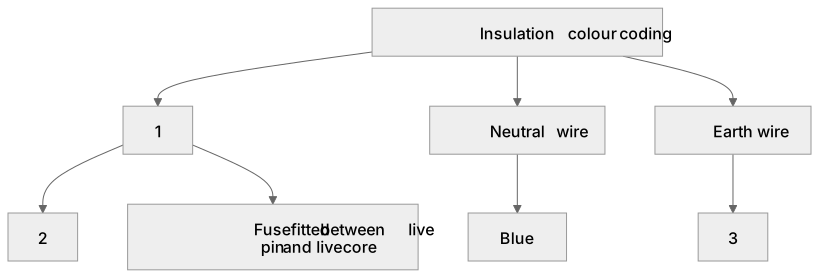
1Box 1
2Box 2
3Box 3
There is more to this lesson
The full lesson goes on to check your understanding and help you earn the marks. Create a free account to carry on, with your progress saved.
A week of Premium from your first lesson · Then the free plan continues · No card, no charge
Test your understanding of Mains electricity: The insulation covering each wire is colour coded for easy identification: live wire – brown neutral wire – blue earth wire – green and yellow stripes.
Active recall beats re-reading. Take an instant quiz now to test what you’ve learned and lock it into long-term memory.
A week of Premium from your first lesson · Then the free plan continues · No card, no charge