AQA · GCSE · Physics
Course version: 8463 · Version from Sept 2016
Mains electricity: The neutral wire completes the circuit.
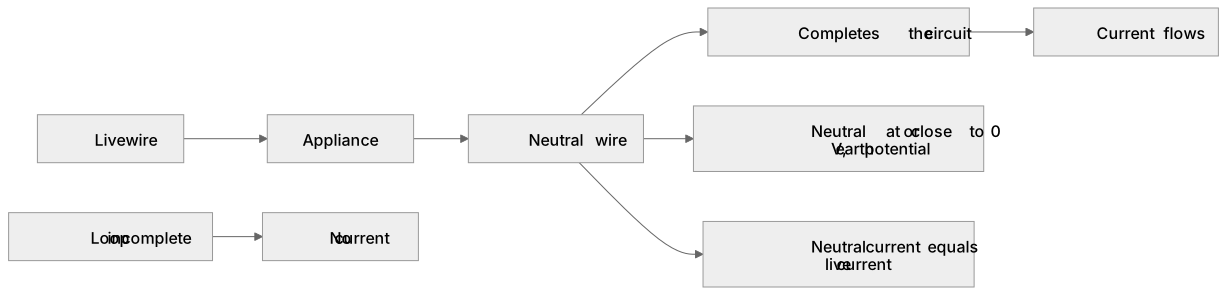
The appliance is only part of a loop: charge driven out along the live wire has to get back, and the neutral wire is that return path.
Checked against the AQA 8463 specification (opens in a new tab) on .
- Point 4 of 8
- 4 key terms
Study notes
From the checked teaching notes for this specification point.
The idea
The appliance is only part of a loop: charge driven out along the live wire has to get back, and the neutral wire is that return path. Without it the circuit is not complete and there is no current, which is why a plug needs at least two cores. Because live and neutral are in series with the appliance, the current in the neutral wire is exactly the same size as the current in the live wire, since the appliance does not use charge up. The neutral wire is held at or very close to earth potential, 0 V, by the supply company, so the potential difference between neutral and earth is nearly zero and touching neutral is far less dangerous than touching live. It is still not safe, because a fault can raise it above 0 V.
What earns the marks
- The neutral wire providing the return path that completes the circuit.
- The current in the neutral wire equalling the current in the live wire.
- The neutral wire sitting at or close to 0 V, earth potential.
- No current passing when the loop is incomplete.
Common mistakes and how to put them right
Saying the neutral wire carries no current because it is at 0 V.
Claiming charge is used up in the appliance so less returns along the neutral wire.
Confusing the neutral wire with the earth wire because both sit near 0 V.
Describing the neutral core as the 'negative' wire of an ac supply.
Exam tips
- Separate the two near-zero wires: neutral carries the working current, earth normally carries none.
- If asked why the neutral current equals the live current, say the two are in series with the appliance.
- Use the phrase 'completes the circuit', because a vague 'takes electricity back' may not be credited.
Try the lesson
The start of the Mains electricity: The neutral wire completes the circuit. lesson, made from checked teaching notes for this specification point.
Have a go first
Which wire in a three-core mains cable completes the circuit?
Listen
The appliance is only part of a loop: charge driven out along the live wire has to get back, and the neutral wire is that return path. Without it the circuit is not complete and there is no current, which is why a plug needs at least two cores. Because live and neutral are in series with the appliance, the current in the neutral wire is exactly the same size as the current in the live wire, since the appliance does not use charge up. The neutral wire is held at or very close to earth potential, 0 V, by the supply company, so the potential difference between neutral and earth is nearly zero and touching neutral is far less dangerous than touching live. It is still not safe, because a fault can raise it above 0 V. A strong answer earns marks for these points. the neutral wire providing the return path that completes the circuit. the current in the neutral wire equalling the current in the live wire. the neutral wire sitting at or close to 0 V, earth potential. no current passing when the loop is incomplete. Exam tip: Separate the two near-zero wires: neutral carries the working current, earth normally carries none.
See it
Key words
Say what each word means before you turn the card.
neutral wire
Try answering aloud or in your head before turning the card.
return path
Try answering aloud or in your head before turning the card.
complete circuit
Try answering aloud or in your head before turning the card.
equal current
Try answering aloud or in your head before turning the card.
See every definition
- neutral wire
- It completes the circuit, providing the return path for charge driven out along the live wire.
- return path
- The route by which charge driven out along the live wire has to get back, provided by the neutral wire.
- complete circuit
- The loop that must exist for there to be a current; without the neutral wire it is not complete.
- equal current
- The current in the neutral wire is exactly the same size as the current in the live wire, since the appliance does not use charge up.
Label the diagram
Some boxes have lost their names. Pick the right name for each number.
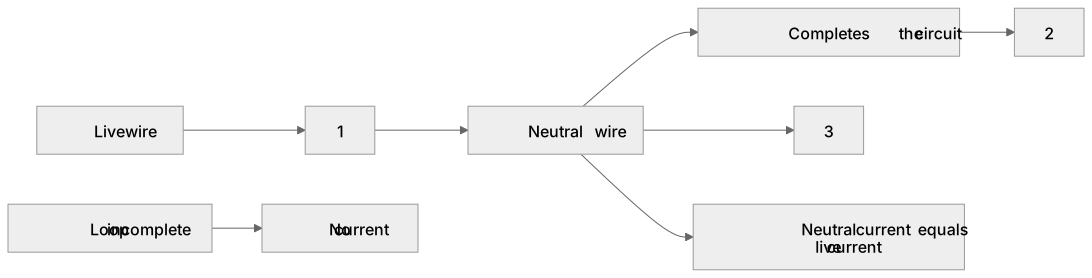
1Box 1
2Box 2
3Box 3
There is more to this lesson
The full lesson goes on to check your understanding and help you earn the marks. Create a free account to carry on, with your progress saved.
A week of Premium from your first lesson · Then the free plan continues · No card, no charge
Test your understanding of Mains electricity: The neutral wire completes the circuit.
Active recall beats re-reading. Take an instant quiz now to test what you’ve learned and lock it into long-term memory.
A week of Premium from your first lesson · Then the free plan continues · No card, no charge