AQA · GCSE · Physics
Course version: 8463 · Version from Sept 2016
Students should be able to relate differences between isotopes to…
Full specification wording
Mass number, atomic number and isotopes: Students should be able to relate differences between isotopes to differences in conventional representations of their identities, charges and masses.
Read a nuclide symbol as three separate questions.
Checked against the AQA 8463 specification (opens in a new tab) on .
- Point 7 of 7
- 4 key terms
Study notes
From the checked teaching notes for this specification point.
The idea
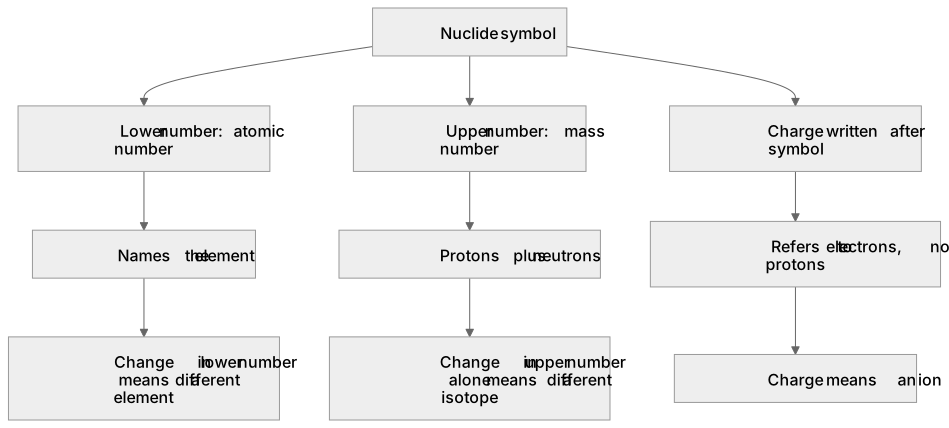
Read a nuclide symbol as three separate questions. The lower number, the atomic number, names the element, so ³⁵₁₇Cl and ³⁷₁₇Cl are both chlorine. The upper number, the mass number, gives protons plus neutrons, so those two have 18 and 20 neutrons: same element, different isotope, different mass. Any charge written after the symbol refers to electrons, not protons, so ²⁴₁₂Mg²⁺ still has twelve protons but only ten electrons. Put together, a change in the lower number means a different element, a change in the upper number alone means a different isotope, and a charge means an ion. Neutral isotopes of an element always have identical electron counts.
What earns the marks
- Comparing the lower numbers to show two atoms are the same element.
- Comparing the upper numbers and calculating the different numbers of neutrons.
- Stating that a charge written after the symbol shows electrons lost or gained, not protons.
- Stating that neutral isotopes of an element have identical numbers of electrons.
Common mistakes and how to put them right
Reading a charge of 2+ as two extra protons in the nucleus.
Comparing mass numbers and concluding the atoms must be different elements.
Forgetting to subtract the atomic number when counting neutrons from a nuclide symbol.
Assuming every isotope written with a large mass number must be radioactive.
Exam tips
- Annotate the symbol in the margin: protons, neutrons, electrons, before you answer anything.
- Give the neutron count as a subtraction shown in your working, so the method earns credit.
- For an ion, adjust only the electron count and leave the two nuclear numbers alone.
Try the lesson
The start of the Mass number, atomic number and isotopes: Students should be able to relate differences between isotopes to differences in conventional representations of their identities, charges and masses. lesson, made from checked teaching notes for this specification point.
Have a go first
Two isotopes of carbon are carbon-12 and carbon-14. What is the same for both isotopes?
Listen
Read a nuclide symbol as three separate questions. The lower number, the atomic number, names the element, so ³⁵₁₇Cl and ³⁷₁₇Cl are both chlorine. The upper number, the mass number, gives protons plus neutrons, so those two have 18 and 20 neutrons: same element, different isotope, different mass. Any charge written after the symbol refers to electrons, not protons, so ²⁴₁₂Mg²⁺ still has twelve protons but only ten electrons. Put together, a change in the lower number means a different element, a change in the upper number alone means a different isotope, and a charge means an ion. Neutral isotopes of an element always have identical electron counts. A strong answer earns marks for these points. comparing the lower numbers to show two atoms are the same element. comparing the upper numbers and calculating the different numbers of neutrons. stating that a charge written after the symbol shows electrons lost or gained, not protons. stating that neutral isotopes of an element have identical numbers of electrons. Exam tip: Annotate the symbol in the margin: protons, neutrons, electrons, before you answer anything.
See it
Key words
Say what each word means before you turn the card.
nuclide symbols
Try answering aloud or in your head before turning the card.
identity, charge and mass
Try answering aloud or in your head before turning the card.
counting neutrons
Try answering aloud or in your head before turning the card.
ions
Try answering aloud or in your head before turning the card.
See every definition
- nuclide symbols
- A representation read as three separate questions, where the lower number names the element and the upper number gives protons plus neutrons.
- identity, charge and mass
- A change in the lower number means a different element, a change in the upper number alone means a different isotope, and a charge means an ion.
- counting neutrons
- The upper number, the mass number, gives protons plus neutrons, so the neutron count is found by subtracting the atomic number.
- ions
- Any charge written after the symbol refers to electrons, not protons, so an ion has lost or gained electrons while the two nuclear numbers stay the same.
Label the diagram
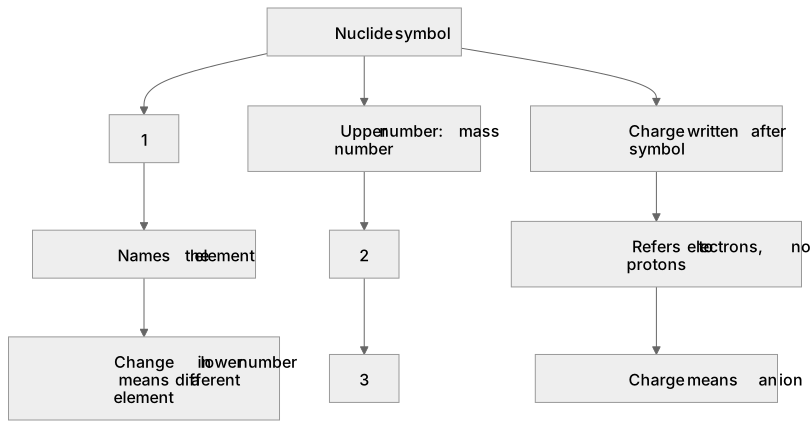
Some boxes have lost their names. Pick the right name for each number.
1Box 1
2Box 2
3Box 3
There is more to this lesson
The full lesson goes on to check your understanding and help you earn the marks. Create a free account to carry on, with your progress saved.
A week of Premium from your first lesson · Then the free plan continues · No card, no charge
Test your understanding of Mass number, atomic number and isotopes: Students should be able to relate differences between isotopes to differences in conventional representations of their identities, charges and masses.
Active recall beats re-reading. Take an instant quiz now to test what you’ve learned and lock it into long-term memory.
A week of Premium from your first lesson · Then the free plan continues · No card, no charge