AQA · GCSE · Physics
Course version: 8463 · Version from Sept 2016
Momentum is defined by the equation: momentum = mass × velocity p = m v…
Full specification wording
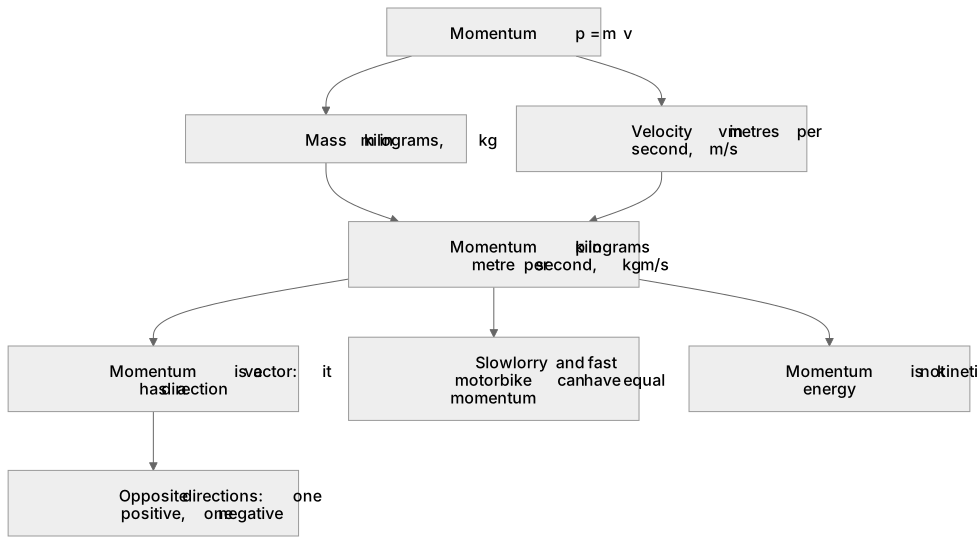
Momentum is a property of moving objects: Momentum is defined by the equation: momentum = mass × velocity p = m v momentum, p, in kilograms metre per second, kg m/s mass, m, in kilograms, kg velocity, v, in metres per second, m/s
Momentum measures how hard a moving object is to stop.
Checked against the AQA 8463 specification (opens in a new tab) on .
- 4 key terms
Study notes
From the checked teaching notes for this specification point.
The idea
Momentum measures how hard a moving object is to stop. It is the product of mass and velocity, p = m v, with mass in kilograms, velocity in metres per second and momentum in kilograms metre per second, kg m/s. A 1200 kg car at 15 m/s has a momentum of 18 000 kg m/s. Because velocity is a vector, momentum is a vector too: it has a direction, and in a calculation with objects moving opposite ways one direction must be taken as positive and the other as negative. A slow lorry and a fast motorbike can have the same momentum, which is why mass and velocity must always be quoted together, never one on its own. Momentum is not kinetic energy: two objects can carry equal momentum yet very different energies, because energy depends on the square of the velocity.
What earns the marks
- Writing momentum = mass × velocity.
- A correct substitution with mass in kg and velocity in m/s.
- The answer with the unit kg m/s.
- Stating the direction, or using a sign, when momentum is treated as a vector.
Common mistakes and how to put them right
Giving the unit as kg/m/s or kg m/s².
Leaving the mass in grams or the velocity in km/h before substituting.
Treating momentum as a scalar and adding two oppositely directed momenta.
Confusing momentum with kinetic energy, which uses the square of the velocity.
Exam tips
- Write the equation before the numbers; p = m v is worth a mark on its own in many schemes.
- Choose a positive direction at the top of your working and label it, then keep to it.
- Check the unit carefully: kg m/s has no division sign anywhere in it.
Try the lesson
The start of the Momentum is a property of moving objects: Momentum is defined by the equation: momentum = mass × velocity p = m v momentum, p, in kilograms metre per second, kg m/s mass, m, in kilograms, kg velocity, v, in metres per second, m/s lesson, made from checked teaching notes for this specification point.
Have a go first
A cyclist and bicycle have a combined mass of 80 kg and are moving at a velocity of 5 m/s. Calculate the momentum of the cyclist and bicycle.
Listen
Momentum measures how hard a moving object is to stop. It is the product of mass and velocity, p = m v, with mass in kilograms, velocity in metres per second and momentum in kilograms metre per second, kg m/s. A 1200 kg car at 15 m/s has a momentum of 18 000 kg m/s. Because velocity is a vector, momentum is a vector too: it has a direction, and in a calculation with objects moving opposite ways one direction must be taken as positive and the other as negative. A slow lorry and a fast motorbike can have the same momentum, which is why mass and velocity must always be quoted together, never one on its own. Momentum is not kinetic energy: two objects can carry equal momentum yet very different energies, because energy depends on the square of the velocity. A strong answer earns marks for these points. writing momentum = mass × velocity. a correct substitution with mass in kg and velocity in m/s. the answer with the unit kg m/s. stating the direction, or using a sign, when momentum is treated as a vector. Exam tip: Write the equation before the numbers; p = m v is worth a mark on its own in many schemes.
See it
Key words
Say what each word means before you turn the card.
momentum
Try answering aloud or in your head before turning the card.
p = m v
Try answering aloud or in your head before turning the card.
vector quantity
Try answering aloud or in your head before turning the card.
unit kg m/s
Try answering aloud or in your head before turning the card.
See every definition
- momentum
- A property of moving objects, defined by the equation momentum = mass × velocity, p = m v, measured in kilograms metre per second, kg m/s.
- p = m v
- The equation for momentum, in which p is momentum, m is mass in kilograms and v is velocity in metres per second.
- vector quantity
- A quantity that has a direction, as momentum does because velocity is a vector.
- unit kg m/s
- The unit of momentum, kilograms metre per second, with no division sign anywhere in it.
Label the diagram
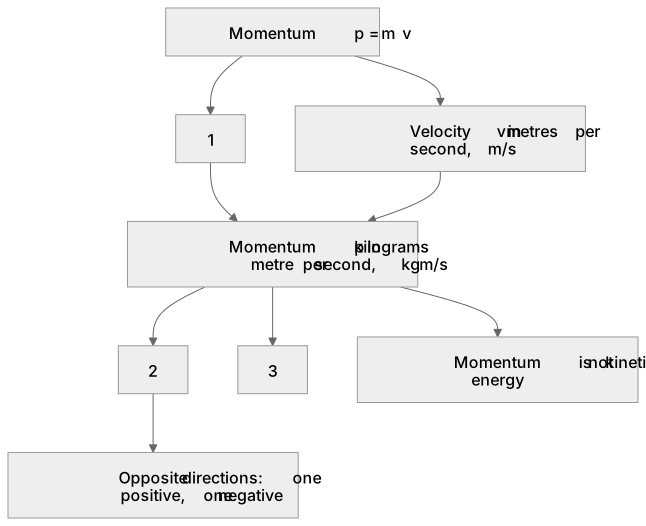
Some boxes have lost their names. Pick the right name for each number.
1Box 1
2Box 2
3Box 3
There is more to this lesson
The full lesson goes on to check your understanding and help you earn the marks. Create a free account to carry on, with your progress saved.
A week of Premium from your first lesson · Then the free plan continues · No card, no charge
Test your understanding of Momentum is a property of moving objects: Momentum is defined by the equation: momentum = mass × velocity p = m v momentum, p, in kilograms metre per second, kg m/s mass, m, in kilograms, kg velocity, v, in metres per second, m/s
Active recall beats re-reading. Take an instant quiz now to test what you’ve learned and lock it into long-term memory.
A week of Premium from your first lesson · Then the free plan continues · No card, no charge