AQA · GCSE · Physics
Course version: 8463 · Version from Sept 2016
Newton’s First Law: If the resultant force acting on an object is zero…
Full specification wording
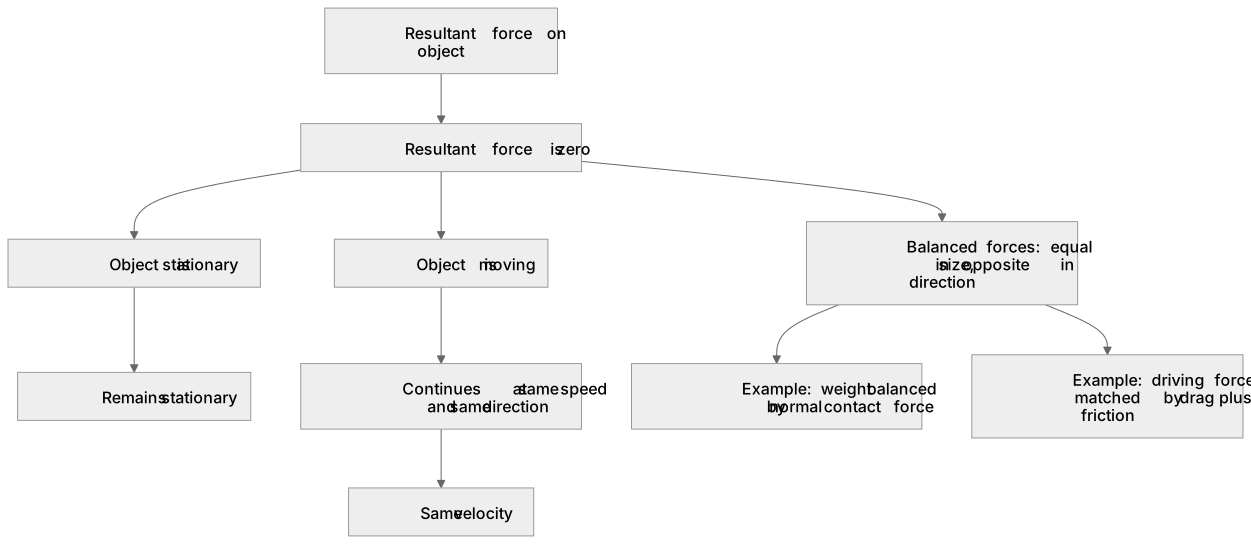
Newton's First Law: Newton’s First Law: If the resultant force acting on an object is zero and: the object is stationary, the object remains stationary the object is moving, the object continues to move at the same speed and in the same direction. So the object continues to move at the same velocity.
A resultant force is what remains when every force on an object is added as a vector.
Checked against the AQA 8463 specification (opens in a new tab) on .
- Point 1 of 5
- 3 key terms
Study notes
From the checked teaching notes for this specification point.
The idea
A resultant force is what remains when every force on an object is added as a vector. If that total is zero, velocity cannot change: a stationary object stays still, and a moving object keeps the same speed in a straight line. Zero resultant force is not the same as no forces at all. A car cruising on a level road has multiple forces acting on it: weight is balanced by the normal contact force, while the driving force is exactly matched by the sum of drag and friction. A hailstone at terminal velocity has its weight exactly matched by air resistance. In these cases, forces balance out, so the object neither speeds up nor slows down. Because velocity is a vector, this law also means direction cannot change: an object with zero resultant force never turns.
What earns the marks
- Stating that the resultant force acting on the object is zero.
- Saying the object stays stationary, or continues at the same speed in the same direction.
- Naming the forces that balance, such as weight and normal contact force, or driving force and drag plus friction.
- Stating that the balanced forces are equal in size and opposite in direction.
Common mistakes and how to put them right
Writing that no forces act on an object moving at a constant velocity, instead of saying the forces are balanced.
Claiming a resultant force is needed to keep an object moving at a steady speed.
Treating a car going round a bend at a steady speed as having zero resultant force, when its direction is changing.
Assuming only two forces act on a cruising car, ignoring vertical forces like weight and normal contact force.
Exam tips
- Write the words 'resultant force is zero' rather than 'the forces cancel out'; the mark scheme looks for that phrase.
- Whenever a question says steady speed, constant velocity or terminal velocity, make zero resultant force your first sentence.
- Identify all forces acting on an object, including vertical forces like weight and normal contact force, before describing the motion.
Try the lesson
The start of the Newton's First Law: Newton’s First Law: If the resultant force acting on an object is zero and: the object is stationary, the object remains stationary the object is moving, the object continues to move at the same speed and in the same direction. So the object continues to move at the same velocity. lesson, made from checked teaching notes for this specification point.
Have a go first
A book is resting on a table. The forces acting on the book are balanced. What happens to the book?
Listen
A resultant force is what remains when every force on an object is added as a vector. If that total is zero, velocity cannot change: a stationary object stays still, and a moving object keeps the same speed in a straight line. Zero resultant force is not the same as no forces at all. A car cruising on a level road has multiple forces acting on it: weight is balanced by the normal contact force, while the driving force is exactly matched by the sum of drag and friction. A hailstone at terminal velocity has its weight exactly matched by air resistance. In these cases, forces balance out, so the object neither speeds up nor slows down. Because velocity is a vector, this law also means direction cannot change: an object with zero resultant force never turns. A strong answer earns marks for these points. stating that the resultant force acting on the object is zero. saying the object stays stationary, or continues at the same speed in the same direction. naming the forces that balance, such as weight and normal contact force, or driving force and drag plus friction. stating that the balanced forces are equal in size and opposite in direction. Exam tip: Write the words 'resultant force is zero' rather than 'the forces cancel out'; the mark scheme looks for that phrase.
See it
Key words
Say what each word means before you turn the card.
resultant force
Try answering aloud or in your head before turning the card.
balanced forces
Try answering aloud or in your head before turning the card.
constant velocity
Try answering aloud or in your head before turning the card.
See every definition
- resultant force
- What remains when every force on an object is added as a vector.
- balanced forces
- Forces that are equal in size and opposite in direction, so that the resultant force is zero.
- constant velocity
- Moving at the same speed and in the same direction, which continues when the resultant force is zero.
Label the diagram
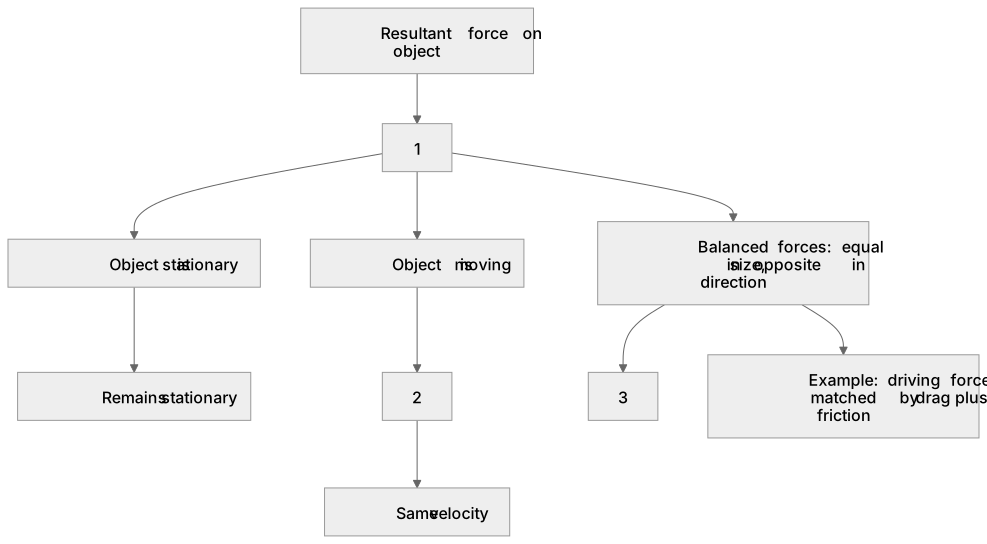
Some boxes have lost their names. Pick the right name for each number.
1Box 1
2Box 2
3Box 3
There is more to this lesson
The full lesson goes on to check your understanding and help you earn the marks. Create a free account to carry on, with your progress saved.
A week of Premium from your first lesson · Then the free plan continues · No card, no charge
Test your understanding of Newton's First Law: Newton’s First Law: If the resultant force acting on an object is zero and: the object is stationary, the object remains stationary the object is moving, the object continues to move at the same speed and in the same direction. So the object continues to move at the same velocity.
Active recall beats re-reading. Take an instant quiz now to test what you’ve learned and lock it into long-term memory.
A week of Premium from your first lesson · Then the free plan continues · No card, no charge