AQA · GCSE · Physics
Course version: 8463 · Version from Sept 2016
Newton's Second Law: F = m a
Newton's second law links the resultant force on an object to its mass and acceleration through F = m a.
Checked against the AQA 8463 specification (opens in a new tab) on .
- Point 3 of 11
- 4 key terms
Study notes
From the checked teaching notes for this specification point.
The idea
Newton's second law links the resultant force on an object to its mass and acceleration through F = m a. Here F is the resultant force in newtons, m is the mass in kilograms and a is the acceleration in metres per second squared. The equation shows that a larger resultant force produces a larger acceleration for the same mass, while a larger mass needs a larger force for the same acceleration. For example, a 1200 kg car with a resultant forward force of 3600 N accelerates at 3600 ÷ 1200 = 3 m s⁻². Rearranged, a = F ÷ m and m = F ÷ a. Always use the resultant force, found by adding or subtracting all forces along the line of motion, and keep units consistent before substituting.
What earns the marks
- State the equation as F = m a and identify F as the resultant force in newtons, m as mass in kilograms and a as acceleration in metres per second squared.
- Substitute values into F = m a with consistent SI units, converting grams to kilograms and kilometres per hour to metres per second where needed.
- Rearrange the equation correctly to find acceleration using a = F ÷ m or mass using m = F ÷ a.
- Calculate the resultant force by combining all forces acting along the line of motion before using F = m a.
- Interpret a numerical answer in context, for example stating that doubling the resultant force doubles the acceleration when mass is unchanged.
Common mistakes and how to put them right
Using one individual force instead of the resultant force.
Put it right by adding forces in the same direction and subtracting forces in the opposite direction first.
Substituting mass in grams or force in kilonewtons without converting.
Put it right by converting to kilograms and newtons before calculating.
Rearranging incorrectly, such as dividing mass by force when finding acceleration.
Put it right by using a = F ÷ m and checking the rearrangement by substituting simple numbers.
Exam tips
- Write the equation, then the substituted values with units, then the answer with its unit; this makes method clear even if the final arithmetic slips.
- Underline the word resultant in a question and show the addition or subtraction of forces before using F = m a.
- Check the size and unit of your answer: a car accelerating at 3 m s⁻² is reasonable, while 3000 m s⁻² suggests a unit or rearrangement error.
Try the lesson
The start of the Newton's Second Law: F = m a lesson, made from checked teaching notes for this specification point.
Have a go first
A trolley of mass 4 kg accelerates at 3 m/s². Using F = m a, what is the resultant force on the trolley?
Listen
Newton's second law links the resultant force on an object to its mass and acceleration through F = m a. Here F is the resultant force in newtons, m is the mass in kilograms and a is the acceleration in metres per second squared. The equation shows that a larger resultant force produces a larger acceleration for the same mass, while a larger mass needs a larger force for the same acceleration. For example, a 1200 kg car with a resultant forward force of 3600 N accelerates at 3600 ÷ 1200 = 3 m s⁻². Rearranged, a = F ÷ m and m = F ÷ a. Always use the resultant force, found by adding or subtracting all forces along the line of motion, and keep units consistent before substituting. A strong answer earns marks for these points. State the equation as F = m a and identify F as the resultant force in newtons, m as mass in kilograms and a as acceleration in metres per second squared. Substitute values into F = m a with consistent SI units, converting grams to kilograms and kilometres per hour to metres per second where needed. Rearrange the equation correctly to find acceleration using a = F ÷ m or mass using m = F ÷ a. Calculate the resultant force by combining all forces acting along the line of motion before using F = m a. A common slip: Using one individual force instead of the resultant force. Instead, adding forces in the same direction and subtracting forces in the opposite direction first. Exam tip: Write the equation, then the substituted values with units, then the answer with its unit; this makes method clear even if the final arithmetic slips.
See it
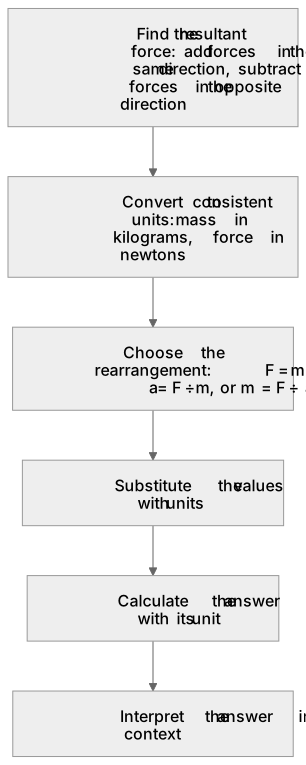
Put it in order
Put these steps in the order they happen.
- 1. Choose the rearrangement: F = m a, a = F ÷ m, or m = F ÷ a
- 2. Convert to consistent SI units: mass in kilograms, force in newtons
- 3. Find the resultant force: add forces in the same direction, subtract forces in the opposite direction
- 4. Interpret the answer in context
- 5. Calculate the answer with its unit
- 6. Substitute the values with units
Key words
Say what each word means before you turn the card.
Resultant force
Try answering aloud or in your head before turning the card.
F = m a
Try answering aloud or in your head before turning the card.
Rearranging equations
Try answering aloud or in your head before turning the card.
SI units and unit conversion
Try answering aloud or in your head before turning the card.
See every definition
- Resultant force
- Found by adding or subtracting all forces along the line of motion, and it must always be used in F = m a.
- F = m a
- Equation linking the resultant force in newtons, the mass in kilograms and the acceleration in metres per second squared.
- Rearranging equations
- The equation can be rearranged to a = F ÷ m to find acceleration or m = F ÷ a to find mass.
- SI units and unit conversion
- Keep units consistent before substituting, converting grams to kilograms and kilometres per hour to metres per second where needed.
Label the diagram
Some boxes have lost their names. Pick the right name for each number.
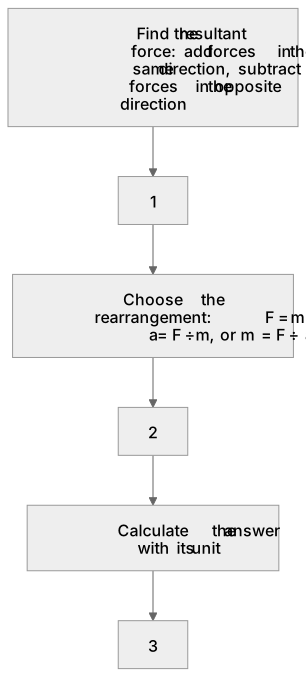
1Box 1
2Box 2
3Box 3
There is more to this lesson
The full lesson goes on to check your understanding and help you earn the marks. Create a free account to carry on, with your progress saved.
A week of Premium from your first lesson · Then the free plan continues · No card, no charge
Test your understanding of Newton's Second Law: F = m a
Active recall beats re-reading. Take an instant quiz now to test what you’ve learned and lock it into long-term memory.
A week of Premium from your first lesson · Then the free plan continues · No card, no charge