AQA · GCSE · Physics
Course version: 8463 · Version from Sept 2016
Newton's Second Law: mass, m, in kilograms, kg
Mass measures how much matter an object contains and how strongly it resists a change in motion.
Checked against the AQA 8463 specification (opens in a new tab) on .
- Point 5 of 11
- 3 key terms
Study notes
From the checked teaching notes for this specification point.
The idea
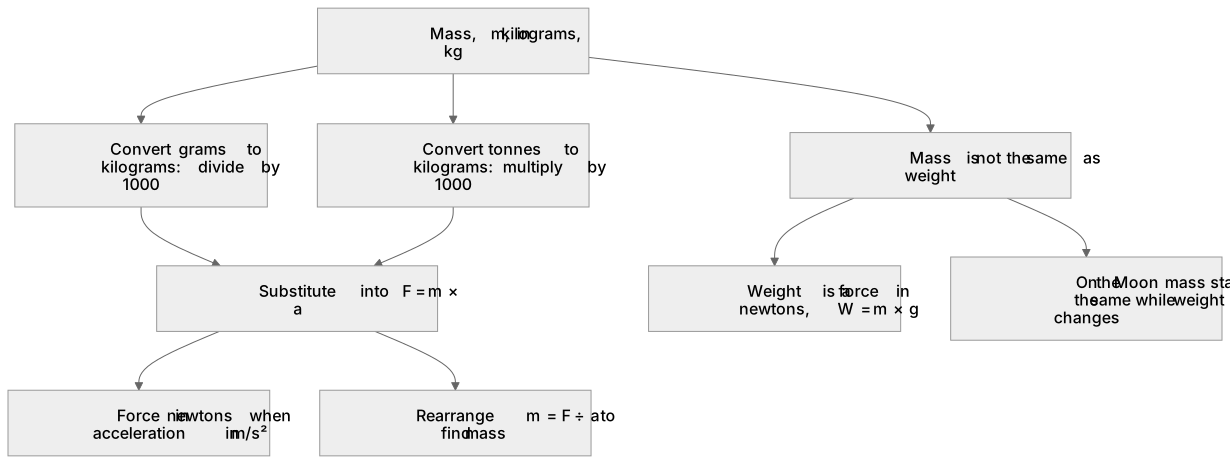
Mass measures how much matter an object contains and how strongly it resists a change in motion. In Newton's Second Law, F = m × a, mass must be in kilograms so that force comes out in newtons when acceleration is in m/s². A newton is defined as the force giving a 1 kg mass an acceleration of 1 m/s², so the kilogram is the coherent SI unit here. Always convert before substituting: 250 g becomes 0.25 kg, and 2.4 tonnes becomes 2400 kg. Mass is not the same as weight; weight is a force in newtons, calculated as W = m × g. On the Moon your mass stays the same while your weight changes. When rearranging, m = F ÷ a, so a larger mass needs a larger force for the same acceleration.
What earns the marks
- State that mass is measured in kilograms (kg) and is the quantity of matter in an object.
- Convert grams to kilograms by dividing by 1000, and tonnes to kilograms by multiplying by 1000, before using F = m × a.
- Explain that the kilogram is the SI base unit of mass and is required for force to be calculated in newtons.
- Use m = F ÷ a to find mass when force in newtons and acceleration in m/s² are known.
- Distinguish mass (kg, scalar, unchanged by location) from weight (N, a force, dependent on gravitational field strength).
Common mistakes and how to put them right
Substituting grams directly into F = m × a, giving a force 1000 times too large.
Put it right by converting to kilograms first.
Treating mass and weight as interchangeable and quoting mass in newtons.
Put it right by giving mass in kg and weight in N.
Forgetting to convert tonnes, so 3 tonnes is used as 3 kg instead of 3000 kg.
Put it right by multiplying tonnes by 1000.
Exam tips
- Write the unit kg next to every mass value in your working to keep the quantity clear.
- Convert all masses to kilograms in a single step at the start of a calculation before substituting.
- Check the size of your answer: a car of mass 1200 kg accelerating at 2 m/s² needs 2400 N, so a force of 2.4 N signals a conversion error.
Try the lesson
The start of the Newton's Second Law: mass, m, in kilograms, kg lesson, made from checked teaching notes for this specification point.
Have a go first
In the equation F = m × a, what is the unit of the quantity m?
Listen
Mass measures how much matter an object contains and how strongly it resists a change in motion. In Newton's Second Law, F = m × a, mass must be in kilograms so that force comes out in newtons when acceleration is in m/s². A newton is defined as the force giving a 1 kg mass an acceleration of 1 m/s², so the kilogram is the coherent SI unit here. Always convert before substituting: 250 g becomes 0.25 kg, and 2.4 tonnes becomes 2400 kg. Mass is not the same as weight; weight is a force in newtons, calculated as W = m × g. On the Moon your mass stays the same while your weight changes. When rearranging, m = F ÷ a, so a larger mass needs a larger force for the same acceleration. A strong answer earns marks for these points. State that mass is measured in kilograms (kg) and is the quantity of matter in an object. Convert grams to kilograms by dividing by 1000, and tonnes to kilograms by multiplying by 1000, before using F = m × a. Explain that the kilogram is the SI base unit of mass and is required for force to be calculated in newtons. Use m = F ÷ a to find mass when force in newtons and acceleration in m/s² are known. A common slip: Substituting grams directly into F = m × a, giving a force 1000 times too large. Instead, converting to kilograms first. Exam tip: Write the unit kg next to every mass value in your working to keep the quantity clear.
See it
Key words
Say what each word means before you turn the card.
mass
Try answering aloud or in your head before turning the card.
kilogram
Try answering aloud or in your head before turning the card.
weight
Try answering aloud or in your head before turning the card.
See every definition
- mass
- Measured in kilograms (kg) with the symbol m, it is the quantity of matter in an object and resists a change in motion.
- kilogram
- The coherent SI unit of mass, required so that force comes out in newtons when acceleration is in m/s².
- weight
- A force in newtons, calculated as W = m × g, which changes with location while mass stays the same.
Label the diagram
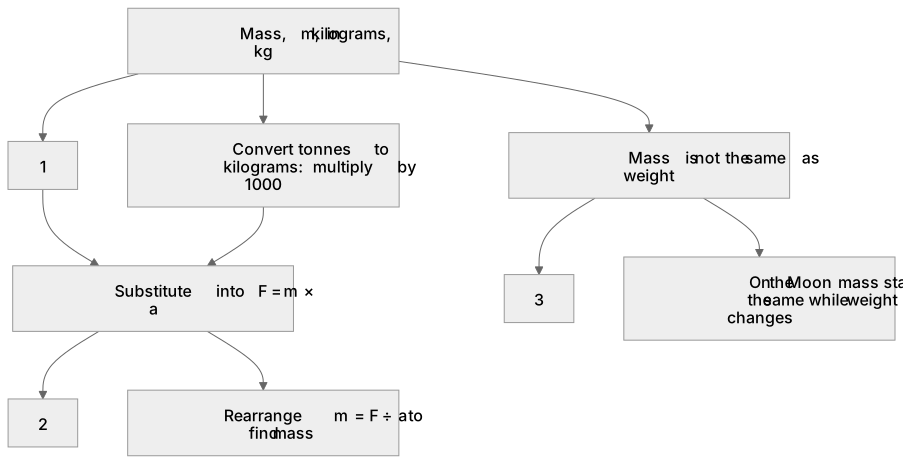
Some boxes have lost their names. Pick the right name for each number.
1Box 1
2Box 2
3Box 3
There is more to this lesson
The full lesson goes on to check your understanding and help you earn the marks. Create a free account to carry on, with your progress saved.
A week of Premium from your first lesson · Then the free plan continues · No card, no charge
Test your understanding of Newton's Second Law: mass, m, in kilograms, kg
Active recall beats re-reading. Take an instant quiz now to test what you’ve learned and lock it into long-term memory.
A week of Premium from your first lesson · Then the free plan continues · No card, no charge