AQA · GCSE · Physics
Course version: 8463 · Version from Sept 2016
Newton’s Second Law: The acceleration of an object is proportional to the…
Full specification wording
Newton's Second Law: Newton’s Second Law: The acceleration of an object is proportional to the resultant force acting on the object, and inversely proportional to the mass of the object.
Newton's Second Law joins two proportional relationships.
Checked against the AQA 8463 specification (opens in a new tab) on .
- Point 1 of 11
Study notes
From the checked teaching notes for this specification point.
The idea
Newton's Second Law joins two proportional relationships. At fixed mass, acceleration is directly proportional to the resultant force, so trebling the force trebles the acceleration. At fixed resultant force, acceleration is inversely proportional to mass, so a trolley loaded to twice its mass accelerates at half the rate. This is why a fully laden lorry pulls away far more slowly than an empty one with the same engine. In symbols, a = F ÷ m, usually written F = m a. The word resultant matters: if a 900 N driving force acts against 300 N of drag on a 200 kg quad bike, the resultant is 600 N and the acceleration is 3 m/s², not 4.5 m/s². Because acceleration is the ratio F ÷ m, a graph of acceleration against resultant force at fixed mass is a straight line through the origin.
What earns the marks
- Identifying the resultant force before applying the law.
- A proportional statement such as doubling the resultant force doubles the acceleration.
- Stating that doubling the mass at constant force halves the acceleration.
- A correct calculation using resultant force = mass × acceleration with consistent units.
Common mistakes and how to put them right
Writing that acceleration is proportional to mass rather than inversely proportional to it.
Using the driving force rather than the resultant force in the calculation.
Substituting the weight of an object on a horizontal surface as the resultant force.
Reading 'inversely proportional' as simply 'decreases', then predicting any smaller value.
Exam tips
- When a question changes two quantities at once, deal with the force first, then the mass.
- Show the subtraction that gives the resultant force as a separate line of working.
- If the acceleration is negative, say the vehicle is decelerating rather than dropping the sign.
Try the lesson
The start of the Newton's Second Law: Newton’s Second Law: The acceleration of an object is proportional to the resultant force acting on the object, and inversely proportional to the mass of the object. lesson, made from checked teaching notes for this specification point.
Have a go first
A trolley is pushed with a resultant force of 6 N and it accelerates at 3 m/s². Using Newton's Second Law, what is the mass of the trolley?
Listen
Newton's Second Law joins two proportional relationships. At fixed mass, acceleration is directly proportional to the resultant force, so trebling the force trebles the acceleration. At fixed resultant force, acceleration is inversely proportional to mass, so a trolley loaded to twice its mass accelerates at half the rate. This is why a fully laden lorry pulls away far more slowly than an empty one with the same engine. In symbols, a = F ÷ m, usually written F = m a. The word resultant matters: if a 900 N driving force acts against 300 N of drag on a 200 kg quad bike, the resultant is 600 N and the acceleration is 3 m/s², not 4.5 m/s². Because acceleration is the ratio F ÷ m, a graph of acceleration against resultant force at fixed mass is a straight line through the origin. A strong answer earns marks for these points. identifying the resultant force before applying the law. a proportional statement such as doubling the resultant force doubles the acceleration. stating that doubling the mass at constant force halves the acceleration. a correct calculation using resultant force = mass × acceleration with consistent units. Exam tip: When a question changes two quantities at once, deal with the force first, then the mass.
See it
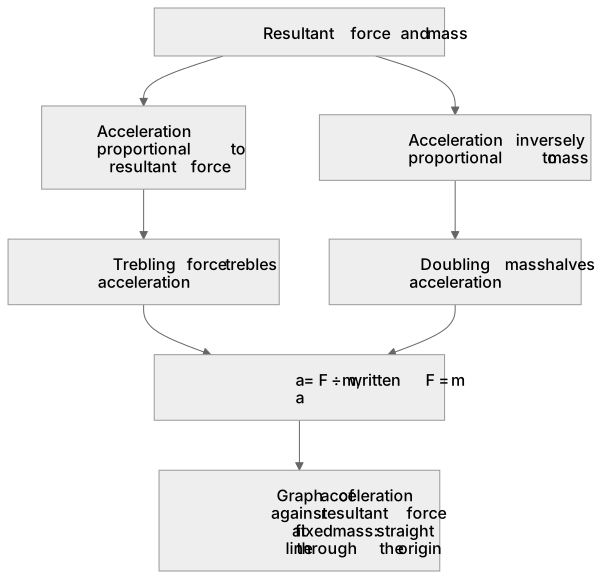
Label the diagram
Some boxes have lost their names. Pick the right name for each number.
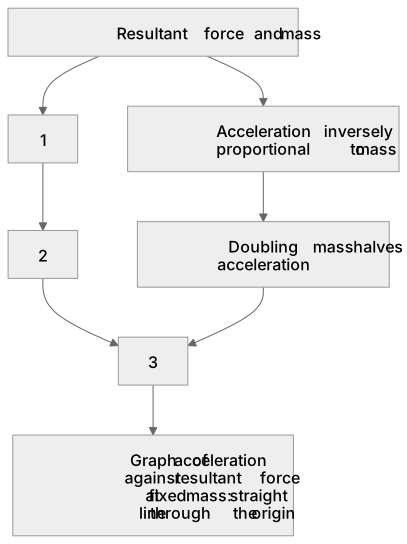
1Box 1
2Box 2
3Box 3
There is more to this lesson
The full lesson goes on to check your understanding and help you earn the marks. Create a free account to carry on, with your progress saved.
A week of Premium from your first lesson · Then the free plan continues · No card, no charge
Test your understanding of Newton's Second Law: Newton’s Second Law: The acceleration of an object is proportional to the resultant force acting on the object, and inversely proportional to the mass of the object.
Active recall beats re-reading. Take an instant quiz now to test what you’ve learned and lock it into long-term memory.
A week of Premium from your first lesson · Then the free plan continues · No card, no charge