
Study Notes
Overview
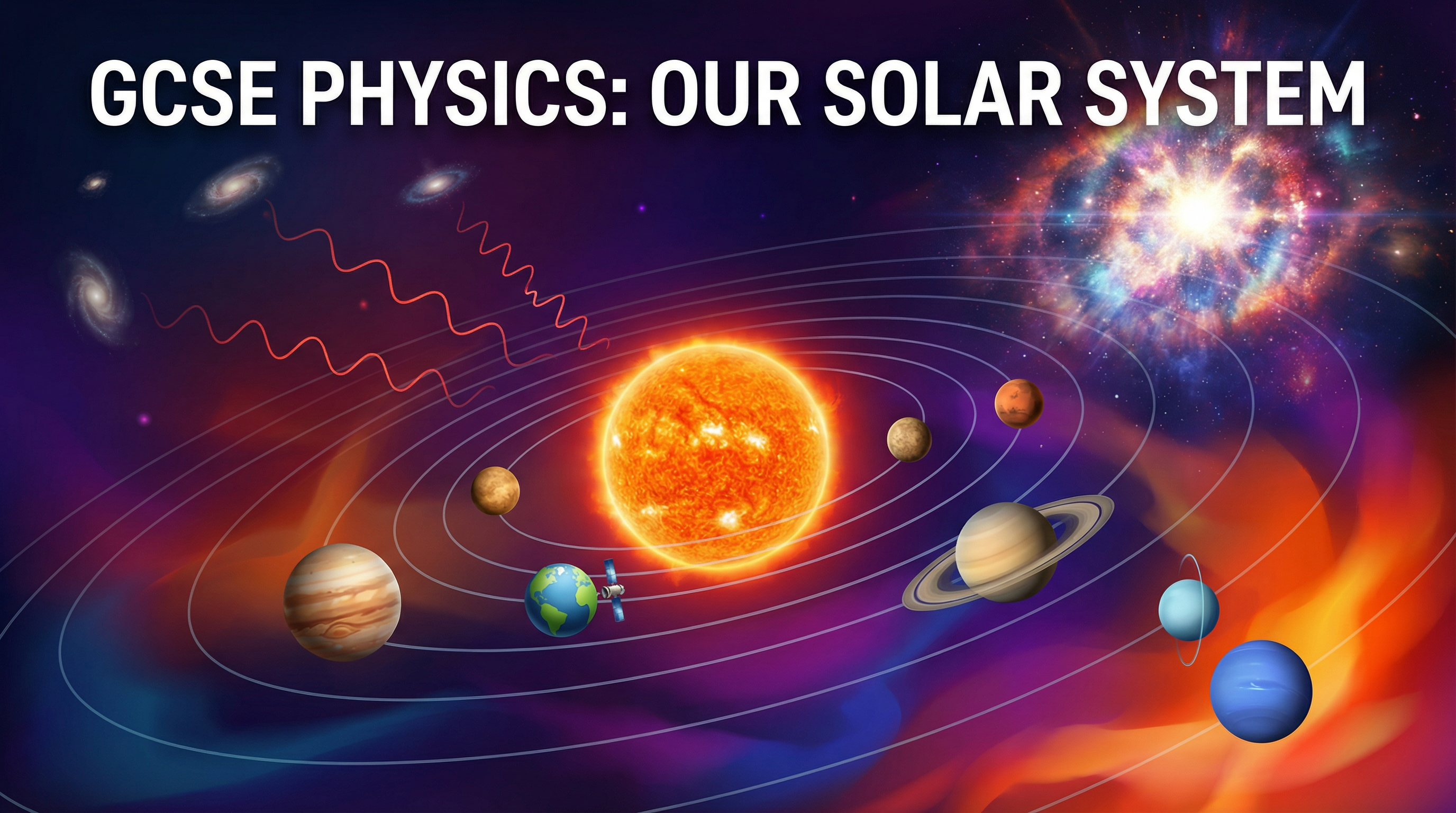
Welcome to the study of Our Solar System and the wider universe. This topic, AQA specification 8.1, takes you on a journey from the birth of stars to the evidence for the universe's expansion. It’s a crucial part of your GCSE, blending pure recall of facts (AO1) with the application of physical principles (AO2). Examiners frequently test your ability to describe sequences, like stellar evolution, and explain concepts like Red Shift. Expect questions that require you to compare the life cycles of different stars or explain why gravity is essential for orbits. Mastering the clear, logical explanations in this guide will directly translate into marks.
Key Concepts
Concept 1: The Life Cycle of Stars
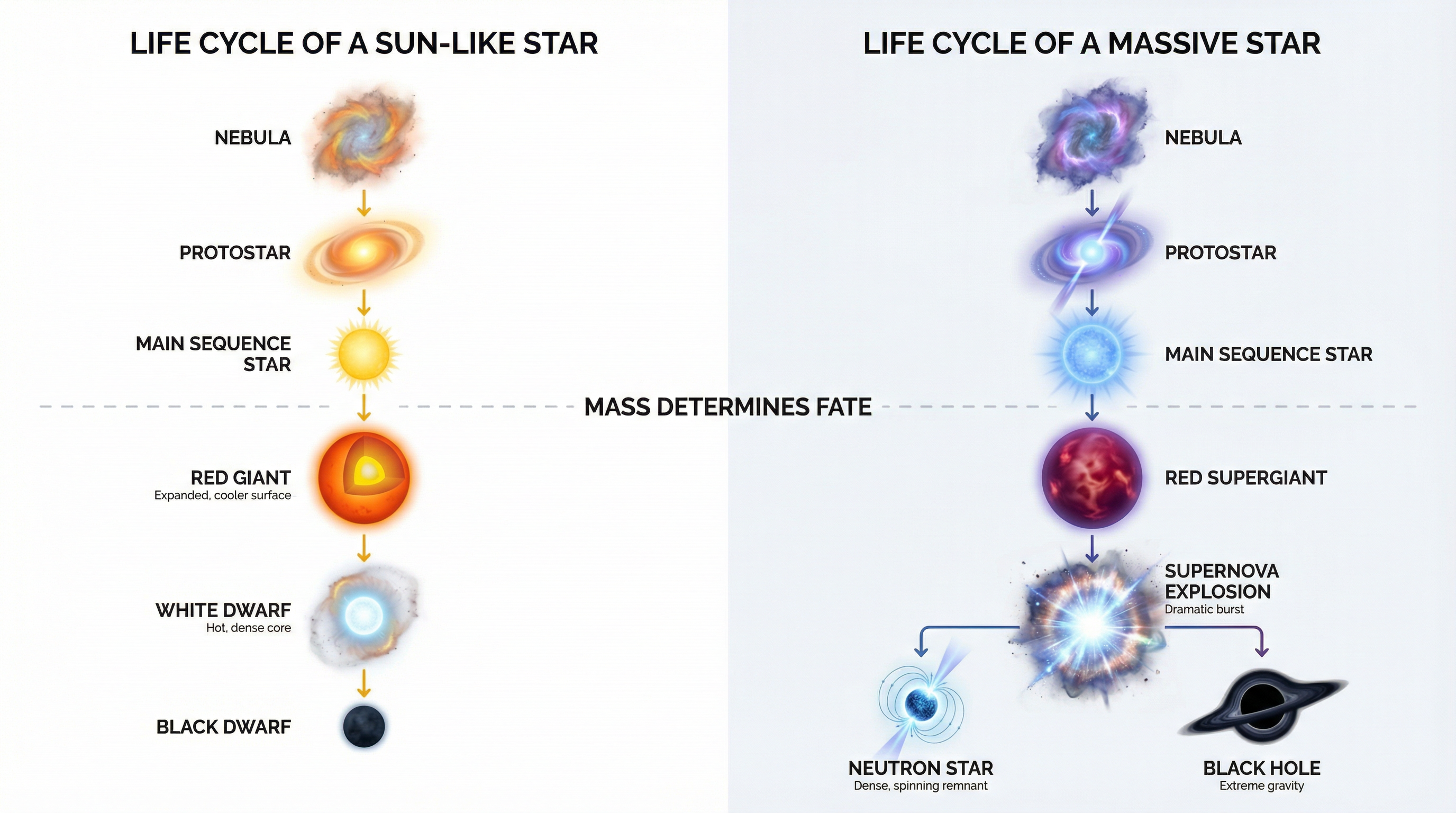
All stars begin their lives in the same way, born from vast, cold clouds of gas and dust known as nebulae. Gravity pulls this material together into a dense, hot core called a protostar. As the protostar accumulates more mass, its core temperature and pressure increase until nuclear fusion ignites. This marks the birth of a main sequence star – a stable phase where the outward pressure from fusion energy perfectly balances the inward pull of gravity. Our Sun is currently a main sequence star.
The star's fate is determined by its initial mass.
**Sun-like Stars (Average Mass):**After billions of years, the hydrogen fuel in the core runs low. The star swells dramatically, cools, and becomes a red giant. The outer layers then drift away, leaving behind the hot, dense core – a white dwarf. This remnant cools over an immense timescale to become a black dwarf.
**Massive Stars (Much More Massive than the Sun):**These stars have shorter, more dramatic lives. They evolve into red supergiants before ending in a cataclysmic supernova explosion. This explosion is so powerful that it forges all elements heavier than iron and scatters them across the universe. The remnant left behind is either a super-dense neutron star or, if the original star was exceptionally massive, a black hole – an object with gravity so strong that not even light can escape.
Concept 2: Orbits of Planets, Moons, and Satellites
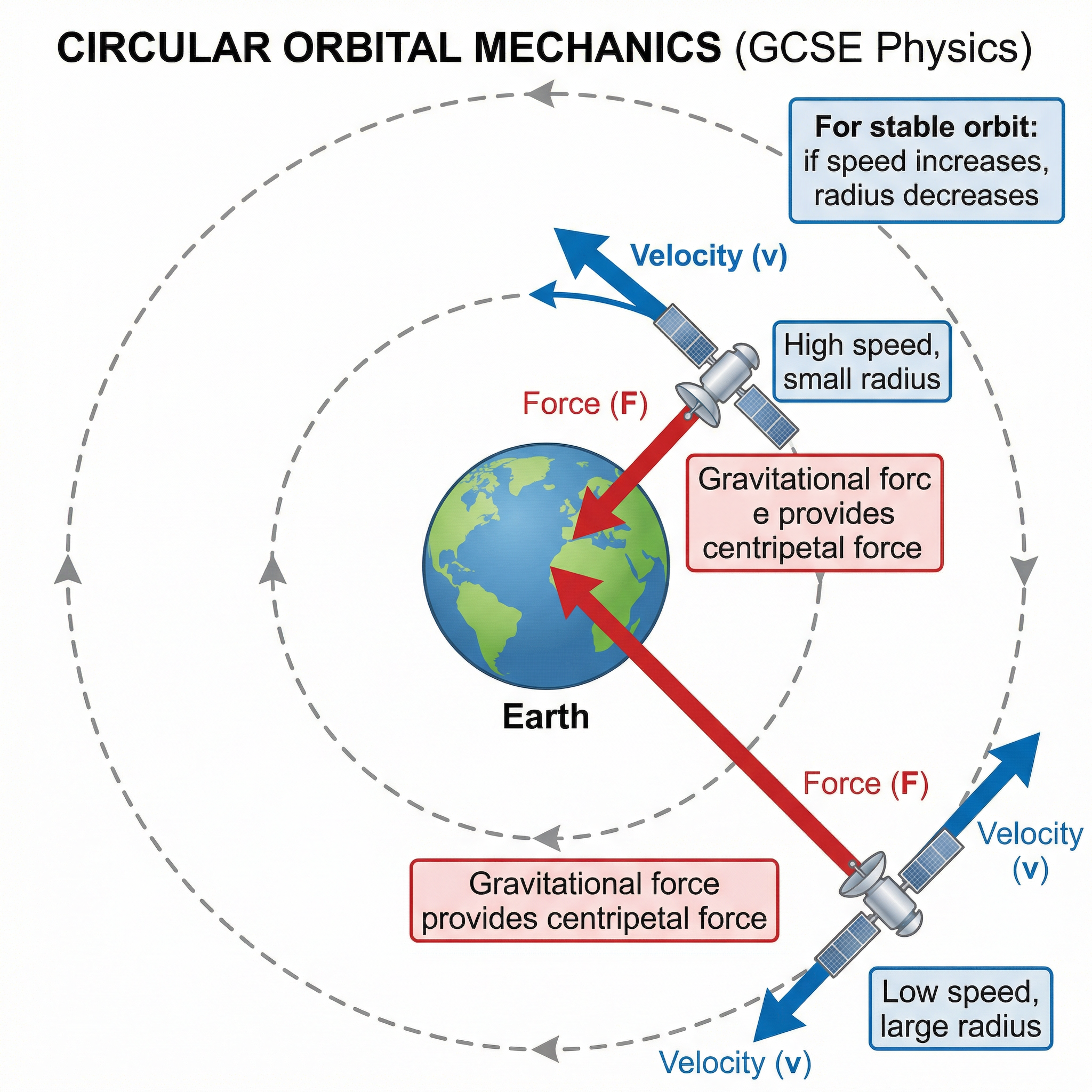
Objects in space are constantly in motion, governed by gravitational forces. For planets orbiting the Sun, or a satellite orbiting Earth, gravity provides the centripetal force necessary to maintain a circular path. This force is always directed towards the center of the object being orbited.
An object in a stable circular orbit has a constant speed, but its velocity is always changing. This is a key distinction that earns marks. Velocity is a vector quantity, meaning it has both magnitude (speed) and direction. Since the direction of the orbiting object is constantly changing, its velocity is also constantly changing.
Higher Tier Only: For a stable orbit, the radius of the orbit is inversely related to its speed. If a satellite needs to move to a smaller (lower) orbit, it must increase its speed. Conversely, to move to a larger (higher) orbit, it must decrease its speed. This is because a stronger gravitational force (experienced at smaller radii) is required to keep a faster-moving object in a circular path.
Concept 3: Red Shift and the Expanding Universe
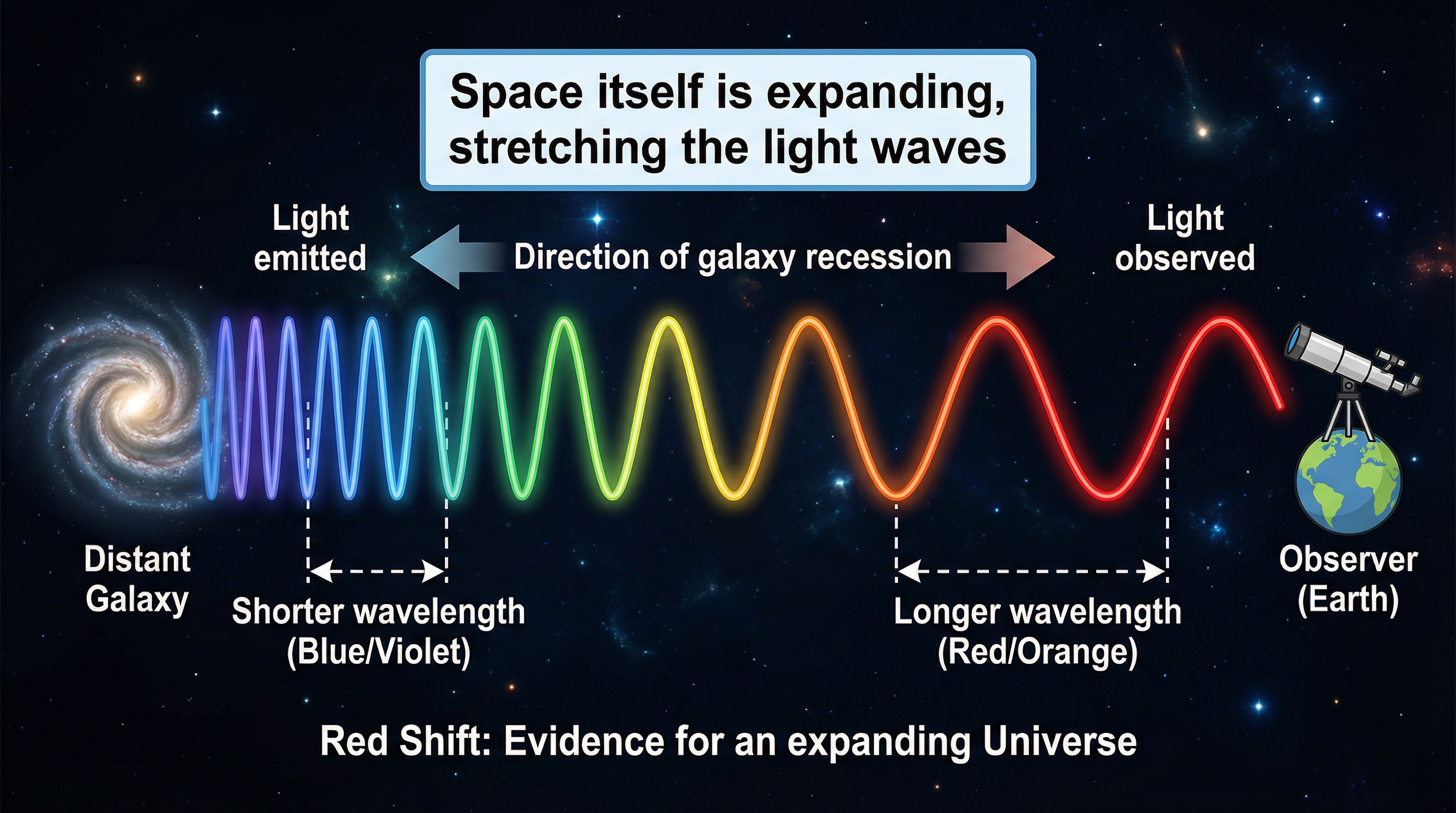
Red Shift is the cornerstone of modern cosmology and provides strong evidence for the Big Bang theory. When we observe light from distant galaxies, we find that its wavelength has been stretched, shifting it towards the red end of the electromagnetic spectrum. This is the Red Shift phenomenon.
This stretching occurs because the fabric of space itself is expanding. As light travels across the universe, the expansion of space lengthens its wavelength. It is not that the galaxy is moving through space away from us, but that the space between us and the galaxy is expanding.
Observations show a crucial relationship: the further away a galaxy is, the greater its Red Shift, and therefore the faster it is receding from us. This provides evidence that the universe is expanding from a single point, a conclusion that underpins the Big Bang theory.
Mathematical/Scientific Relationships
There are no specific formulas to memorise for calculations in this topic at GCSE level. However, you must understand the conceptual relationships:
- Stellar Stability: Gravitational Force (inward) = Fusion Pressure (outward)
- Circular Orbits: The magnitude of the gravitational force provides the required centripetal force.
- Orbital Speed and Radius (Higher Tier): For a stable orbit, Speed is inversely proportional to the square root of the radius. A simplified way to remember this for GCSE is:
if speed ↑, radius ↓andif speed ↓, radius ↑.
Practical Applications
- Artificial Satellites: Understanding orbital mechanics is fundamental to placing satellites in specific orbits for telecommunications (geostationary orbits), Earth observation, and GPS.
- Stellar Nucleosynthesis: The fact that elements heavier than iron are only formed in supernovae explains the origin of materials like gold and platinum on Earth. We are, in a very real sense, made of stardust.