OCR · GCSE · Physics
Work Done and Energy Transfer
This guide provides a comprehensive overview of the Conservation of Energy principle for OCR GCSE Physics. It covers key concepts, mathematical relationships, and exam techniques to help students secure top marks.
- 4 min read
- 3 worked examples
- 5 practice questions
- 6 key terms
Study Notes

Overview
The principle of conservation of energy is a cornerstone of physics, stating that energy cannot be created or destroyed, only transferred from one store to another. For your OCR GCSE Physics exam, a deep understanding of this topic (specification point 1.4) is crucial. It is frequently tested through both calculation and explanation questions, often carrying a high mark weighting. This guide will equip you with the knowledge to confidently tackle questions on energy stores, transfers, and efficiency, ensuring you can clearly articulate the concepts as an examiner would expect.
Key Concepts
Concept 1: The Principle of Conservation of Energy
This fundamental law is simple but profound. In any process, the total amount of energy in a closed system remains constant. It is vital to use precise language: energy is not 'lost' or 'used up', but rather 'transferred' or 'dissipated'. Using the term 'lost' will result in a loss of marks. The key is to identify where the energy came from (the initial store) and where it went (the final store).
Concept 2: Energy Stores and Transfers
OCR uses a model of energy stores and transfers. You must be able to identify the main energy stores and the pathways by which energy is transferred between them.
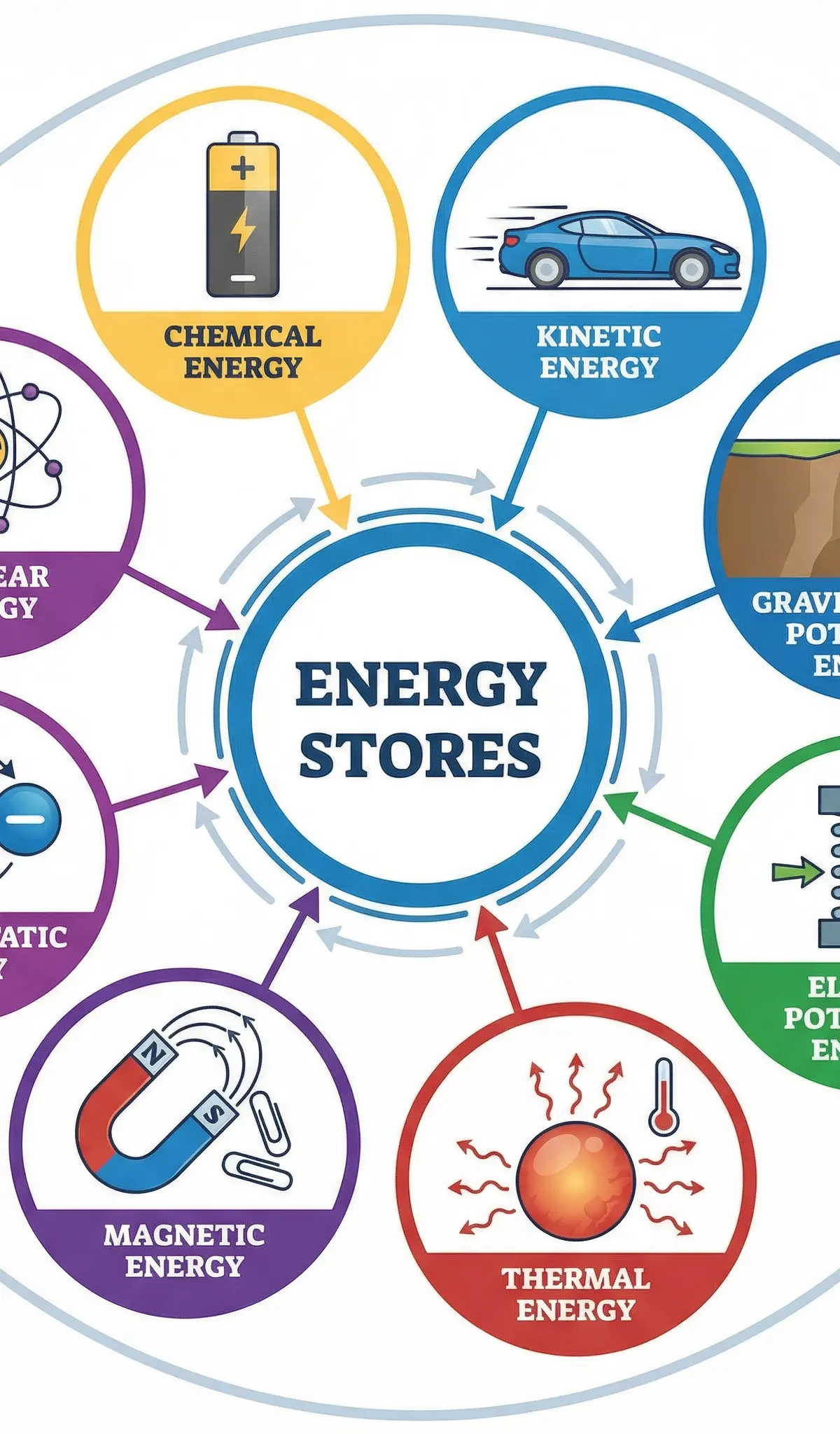
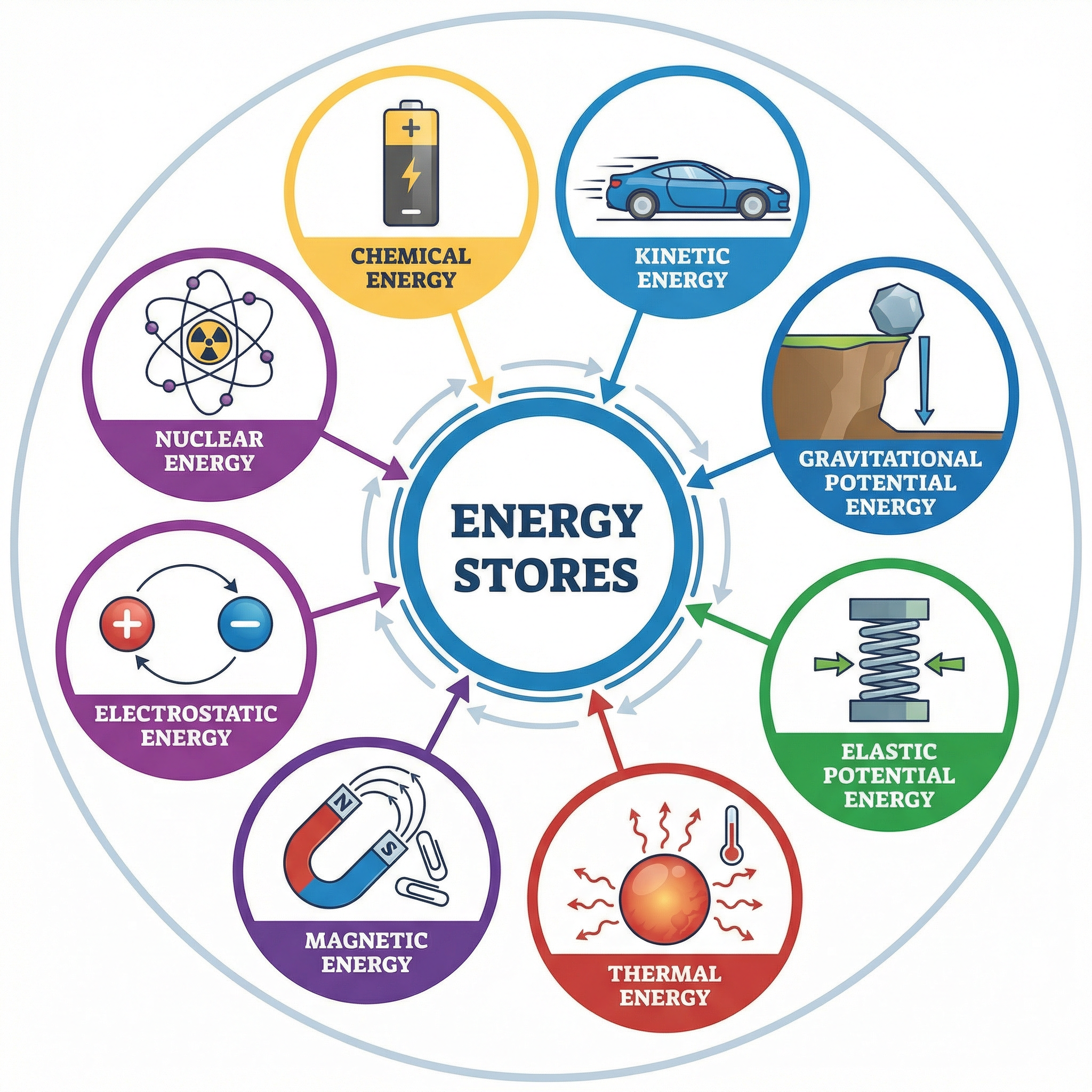
The 8 Energy Stores:
- Chemical: Energy stored in bonds between atoms (e.g., in food, fuel, batteries).
- Kinetic: Energy of a moving object.
- Gravitational Potential (GPE): Energy an object has due to its position in a gravitational field.
- Elastic Potential: Energy stored when an object is stretched or compressed.
- Thermal: The total kinetic and potential energy of the particles in an object.
- Magnetic: Energy stored when repelling poles have been pushed closer together or attracting poles have been pulled further apart.
- Electrostatic: Energy stored when repelling charges have been moved closer together or attracting charges have been pulled further apart.
- Nuclear: Energy stored in the nucleus of an atom.
The 4 Energy Transfer Pathways:
- Mechanically: An object moving due to a force acting on it (e.g., pushing, pulling, stretching).
- Electrically: A charge moving through a potential difference (e.g., current in a circuit).
- By heating: Due to a temperature difference.
- By radiation: Energy transferred as a wave (e.g., light, sound).
Concept 3: Efficiency
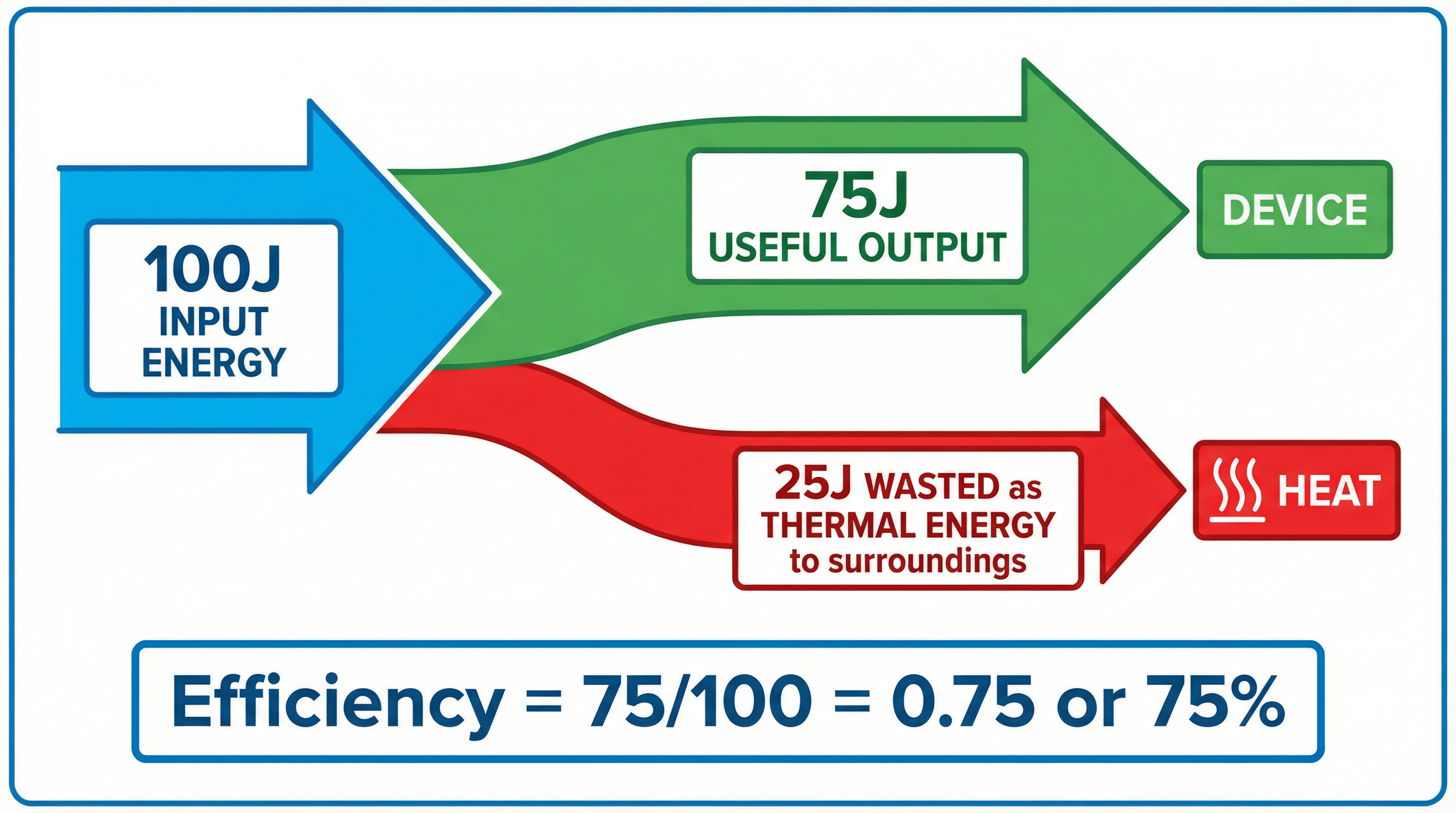
In real-world systems, not all input energy is transferred to a useful output store. Some energy is always dissipated, usually to the thermal store of the surroundings. Efficiency is a measure of how much of the input energy is usefully transferred.
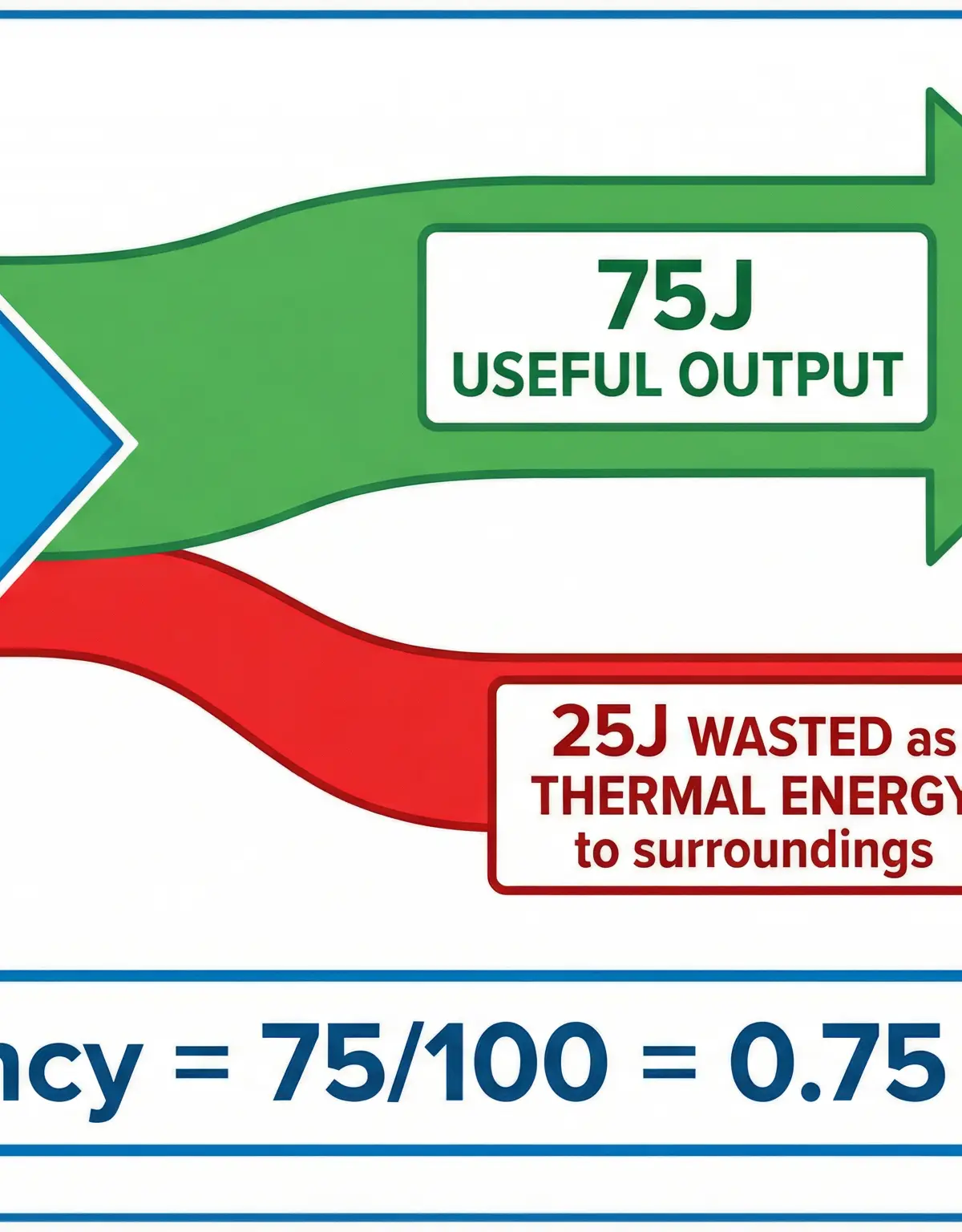
Efficiency can be calculated as a ratio or a percentage. An efficiency greater than 1 or 100% is impossible as it would violate the principle of conservation of energy.
Mathematical/Scientific Relationships
- Kinetic Energy (KE): KE = ½mv² (Must memorise)
- KE = Kinetic Energy (Joules, J)
- m = mass (kilograms, kg)
- v = velocity (metres per second, m/s)
- Gravitational Potential Energy (GPE): GPE = mgh (Must memorise)
- GPE = Gravitational Potential Energy (Joules, J)
- m = mass (kilograms, kg)
- g = gravitational field strength (Newtons per kilogram, N/kg - on Earth, g ≈ 9.8 N/kg)
- h = height (metres, m)
- Efficiency: Efficiency = Useful Energy Output / Total Energy Input (Given on formula sheet)
Practical Applications
This topic is directly linked to the required practical investigating the specific heat capacity of materials. In this experiment, you heat a block of material using an electric heater and measure the temperature change. By measuring the energy input from the heater (Power x time) and the temperature change of the block, you can calculate the specific heat capacity. However, a key source of error is the dissipation of thermal energy to the surroundings, which makes the calculated value for specific heat capacity higher than the true value. This demonstrates that not all the electrical energy supplied is transferred to the thermal store of the block.
Visual Resources
2 diagrams and illustrations
Interactive Diagrams
2 interactive diagrams to visualise key concepts
Conceptual Flow Outline
Flowchart showing the energy transfers for a rollercoaster car.
Conceptual Flow Outline
Concept map illustrating the energy transformations during a bungee jump.
Worked Examples
3 worked examples — open one to explore the question and available guidance.
Practice Questions
Test your understanding — click to reveal model answers
A 2 kg ball is dropped from a height of 10 m. Assuming no air resistance, calculate its speed just before it hits the ground. (g = 9.8 N/kg)
Hint: Equate the initial Gravitational Potential Energy to the final Kinetic Energy.
Describe the energy transfers that occur when a car brakes to a stop.
Hint: Think about the main energy store of a moving car and where that energy goes when it stops.
A student claims that if you drop a bouncy ball, it will never return to its original height because energy is destroyed. Evaluate this statement.
Hint: Address the student's claim directly and use the principle of conservation of energy in your explanation.
An electric kettle has a power rating of 2.5 kW. It takes 2 minutes to boil 1 kg of water from 20°C to 100°C. The specific heat capacity of water is 4200 J/kg°C. Calculate the efficiency of the kettle.
Hint: First, calculate the total energy supplied to the kettle. Then, calculate the useful energy gained by the water. Finally, use the efficiency formula.
A pendulum is released from a height of 20 cm. Describe the energy transfers as it swings to its maximum height on the other side and back to the centre.
Hint: Consider the energy stores at the highest point and the lowest point of the swing.
Test your understanding of Work Done and Energy Transfer
Active recall beats re-reading. Take an instant quiz now to test what you’ve learned and lock it into long-term memory.
7 days Premium · Then free forever · No card, no charge