
Study Notes
Overview
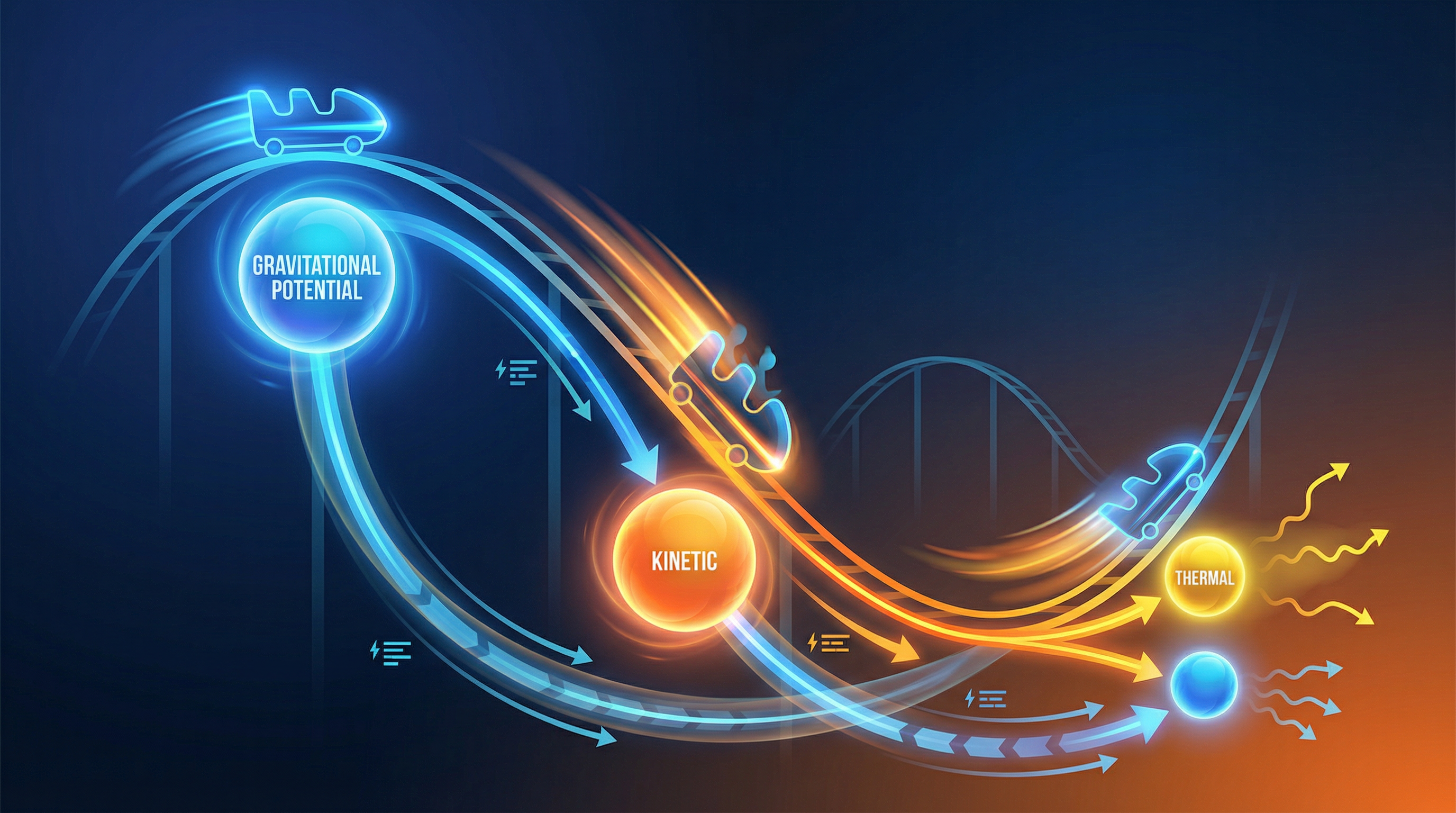
Welcome to the AQA GCSE Physics topic on Conservation of Energy (1.4). This is a cornerstone of physics, stating that energy is never 'lost,' but simply changes form. Understanding this principle is crucial for exam success, as it underpins many other topics, from electricity to mechanics. In this guide, we will explore the different 'stores' of energy, the ways it can be transferred between them, and how to calculate efficiency. By mastering these concepts, you will be able to confidently tackle a wide range of exam questions, from simple definitions to complex calculations. This topic frequently appears in exams, often in the context of real-world scenarios like vehicles or household appliances, so a solid understanding is essential for achieving top marks.
Key Concepts
Concept 1: The Law of Conservation of Energy
The fundamental principle of this topic is the Law of Conservation of Energy. It states that energy cannot be created or destroyed, only transferred, stored, or dissipated. This means the total amount of energy in a closed system remains constant. It is crucial to use this precise wording in an exam to be awarded marks. Avoid saying energy is 'lost' or 'used up'; instead, use the term 'dissipated,' which means spread out to the surroundings, usually as thermal energy.
Concept 2: Energy Stores
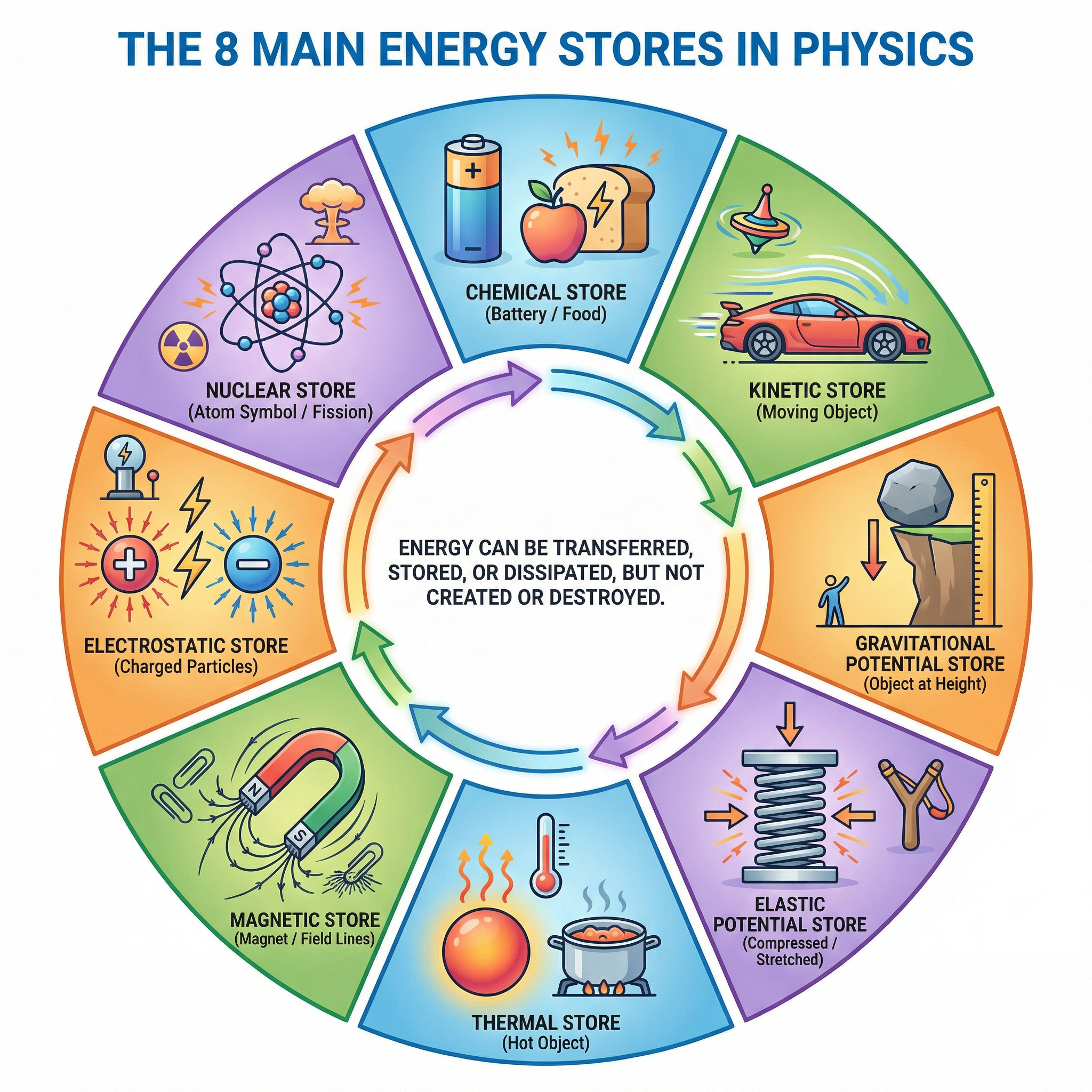
Energy is held in different 'stores.' You need to be able to identify and name the eight main energy stores:
- Chemical Store: Energy stored in chemical bonds, found in food, fuel, and batteries.
- Kinetic Store: Energy of a moving object. The faster an object moves, the more energy in its kinetic store.
- Gravitational Potential Store (GPE): Energy an object has due to its position in a gravitational field. The higher the object, the more GPE it has.
- Elastic Potential Store: Energy stored when an object is stretched or compressed, like a spring or elastic band.
- Thermal Store: The total kinetic and potential energy of the particles in an object. The hotter the object, the more thermal energy it has.
- Magnetic Store: Energy stored when repelling poles have been pushed closer together or attracting poles have been pulled further apart.
- Electrostatic Store: Energy stored when repelling charges have been moved closer together or attracting charges have been pulled further apart.
- Nuclear Store: Energy stored in the nucleus of an atom, released during nuclear reactions.
Concept 3: Energy Transfer Pathways
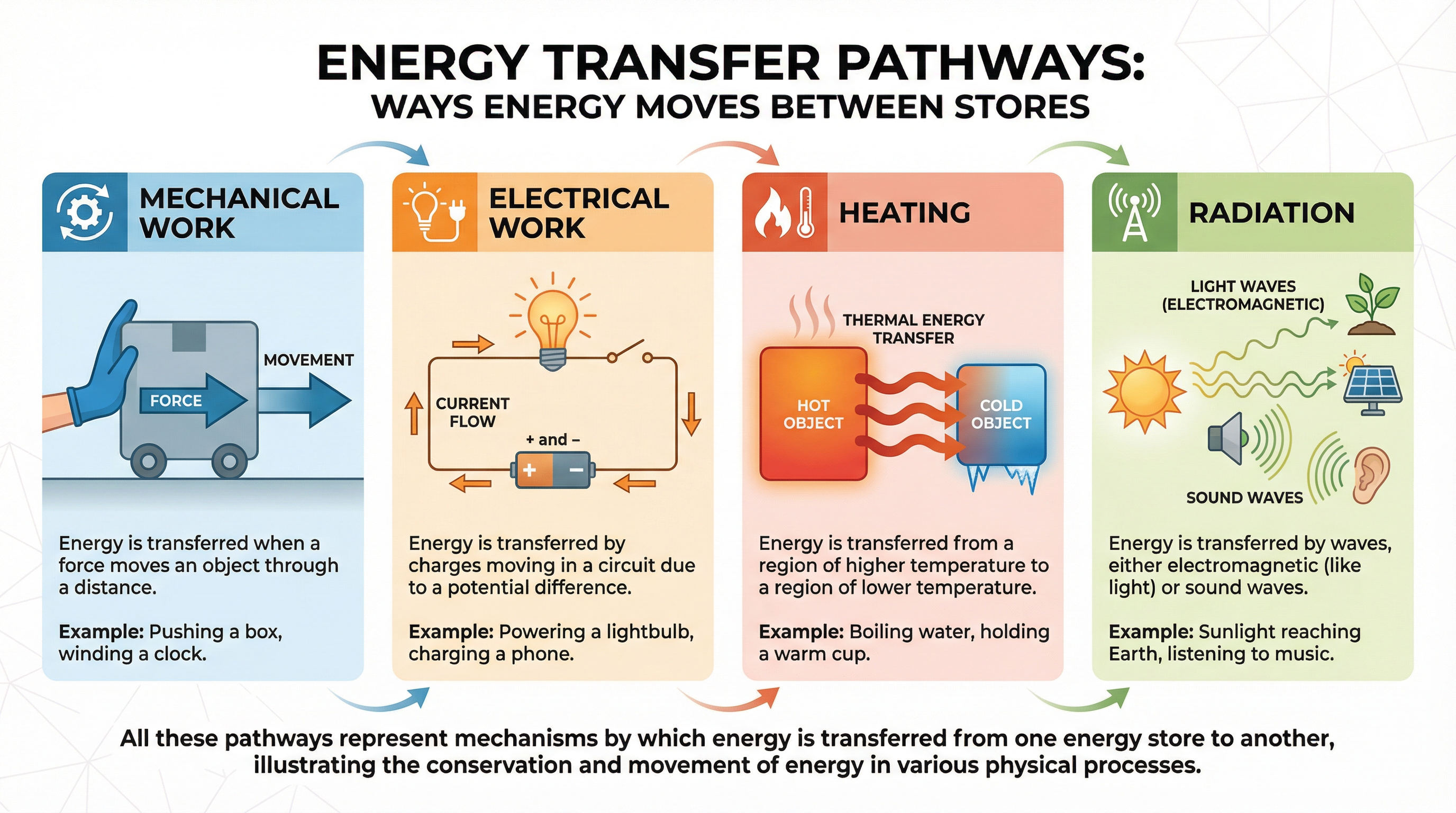
Energy moves from one store to another through four main pathways:
- Mechanical Work: When a force acts on an object and causes it to move.
- Electrical Work: When an electric current flows.
- Heating: The transfer of thermal energy from a hotter object to a colder one.
- Radiation: Energy transferred by waves, such as light or sound.
Concept 4: Efficiency
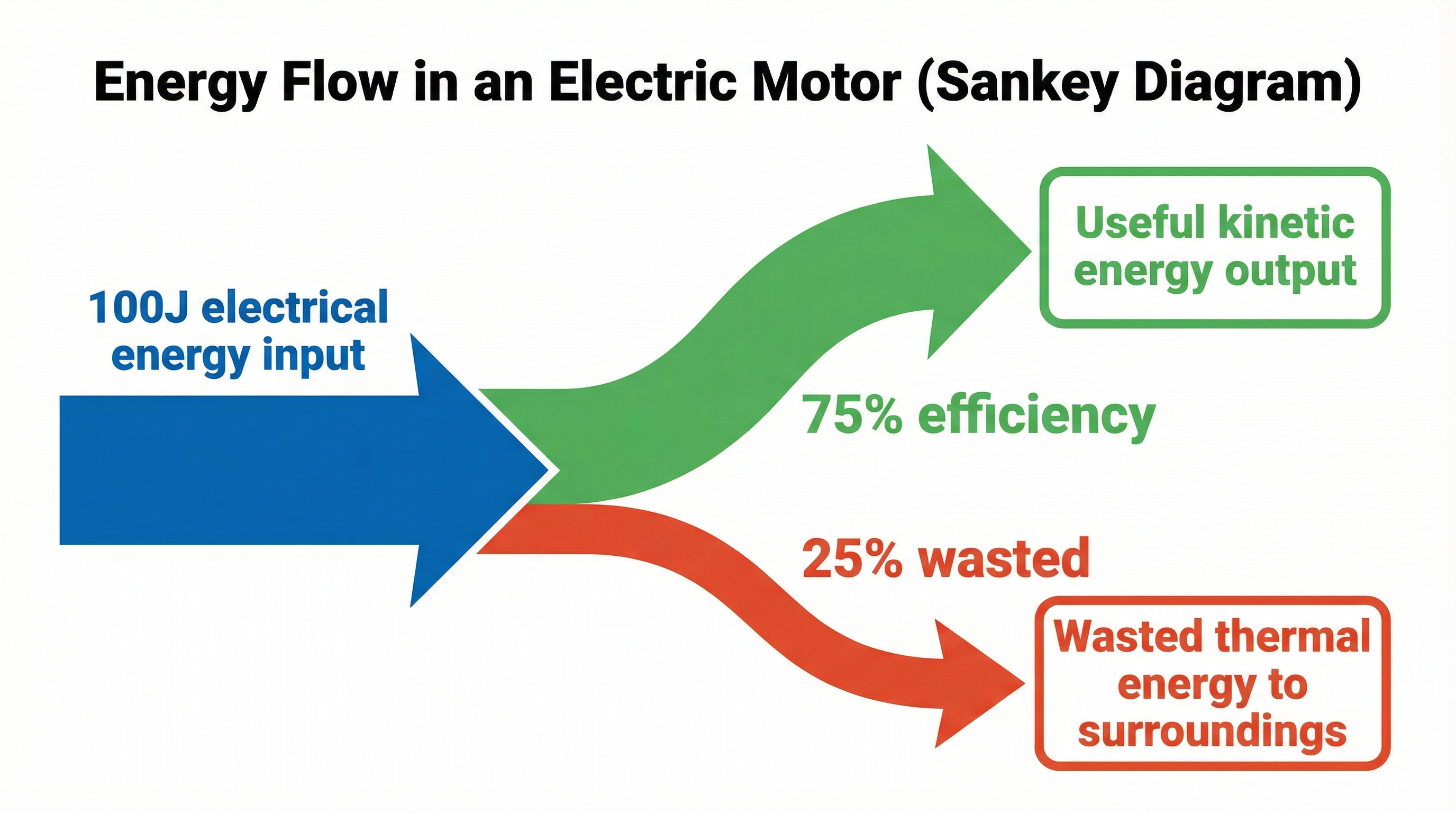
Efficiency is a measure of how much of the input energy is transferred to useful output energy. No device is 100% efficient; some energy is always dissipated to the surroundings. The formula for efficiency is:
**Efficiency = (Useful output energy transfer) / (Total input energy transfer)**Efficiency can be given as a decimal or a percentage. To get a percentage, multiply the decimal by 100. A key exam tip is that efficiency can never be greater than 1 or 100%. If you get a larger value, you have likely divided the numbers the wrong way around.
Mathematical/Scientific Relationships
- Kinetic Energy (KE): KE = ½ × m × v² (Must memorise)
- m = mass (kg)
- v = velocity (m/s)
- Gravitational Potential Energy (GPE): GPE = m × g × h (Given on formula sheet)
- m = mass (kg)
- g = gravitational field strength (N/kg, approximately 9.8 N/kg on Earth)
- h = height (m)
- Elastic Potential Energy (EPE): EPE = ½ × k × e² (Given on formula sheet)
- k = spring constant (N/m)
- e = extension (m)
- Efficiency: Efficiency = Useful output / Total input (Must memorise)
Practical Applications
This topic has many real-world applications. For example, in a car engine, the chemical energy in fuel is transferred to kinetic energy, but a lot is also dissipated as thermal energy. Lubricants are used to reduce friction between moving parts, which reduces the amount of energy dissipated, making the car more efficient.
Required Practical: Investigating Thermal Insulation
This practical involves investigating the effectiveness of different materials as thermal insulators. A common method is to wrap different materials around a beaker of hot water and measure the temperature change over time. The material that results in the smallest temperature drop is the best insulator.
- Apparatus: Beakers, kettle, thermometer, stopwatch, various insulating materials (e.g., bubble wrap, cotton wool, foil).
- Method:
- Boil water in a kettle and fill three beakers with the same volume of hot water.
- Measure the initial temperature of the water in each beaker.
- Wrap one beaker in the first insulating material, the second in another, and leave the third as a control.
- Start the stopwatch and record the temperature of the water in each beaker every 2 minutes for 20 minutes.
- Expected Results: The beakers with insulating material will cool more slowly than the control beaker. The best insulator will show the smallest temperature decrease.
- Common Errors: Not using the same volume of water in each beaker, not using the same thickness of insulating material, reading the thermometer incorrectly.
- Exam Questions: Examiners may ask you to describe the method, identify variables, analyse data, or suggest improvements to the experiment.