AQA · GCSE · Physics
Course version: 8463 · Version from Sept 2016
Students should be able to explain: that all bodies (objects) emit…
Full specification wording
Perfect black bodies and radiation: Students should be able to explain: that all bodies (objects) emit radiation that the intensity and wavelength distribution of any emission depends on the temperature of the body.
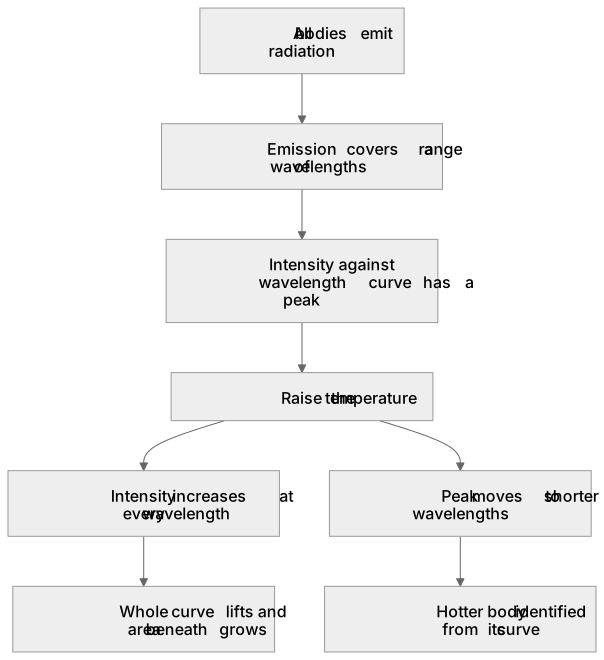
Every body emits radiation across a whole range of wavelengths, not at a single one, and a graph of intensity against wavelength for a black body is a curve with a peak.
Checked against the AQA 8463 specification (opens in a new tab) on .
- Point 1 of 6
- 4 key terms
Study notes
From the checked teaching notes for this specification point.
The idea
Every body emits radiation across a whole range of wavelengths, not at a single one, and a graph of intensity against wavelength for a black body is a curve with a peak. Temperature controls that curve in two ways. Raise the temperature and the intensity increases at every wavelength, so the whole curve lifts and the area beneath it grows. Raise the temperature and the peak also shifts towards shorter wavelengths. That is why an electric hob glows dull red before it glows orange, why blue-white stars are hotter than red ones, and why objects at room temperature look dark to the eye: their peak lies in the infrared, so we detect them with a thermal camera rather than by sight.
What earns the marks
- Stating that all bodies emit radiation over a range of wavelengths.
- Stating that the intensity emitted at every wavelength increases as the temperature increases.
- Stating that the peak of the distribution moves to shorter wavelengths as the temperature increases.
- Identifying the hotter of two plotted curves and justifying the choice.
Common mistakes and how to put them right
Saying a hotter body emits only shorter wavelengths, rather than more at every wavelength.
Reading the peak as the only wavelength the body emits.
Claiming that objects at room temperature emit no radiation because they do not glow.
Comparing two curves by their height at a single wavelength only.
Exam tips
- Describe both changes, the height of the curve and the position of its peak, for full marks.
- Use 'intensity' for energy emitted per second per unit area rather than vague words like amount.
- When sketching a hotter curve, keep it above the cooler one everywhere.
Try the lesson
The start of the Perfect black bodies and radiation: Students should be able to explain: that all bodies (objects) emit radiation that the intensity and wavelength distribution of any emission depends on the temperature of the body. lesson, made from checked teaching notes for this specification point.
Have a go first
Which statement describes the radiation emitted by every object?
Listen
Every body emits radiation across a whole range of wavelengths, not at a single one, and a graph of intensity against wavelength for a black body is a curve with a peak. Temperature controls that curve in two ways. Raise the temperature and the intensity increases at every wavelength, so the whole curve lifts and the area beneath it grows. Raise the temperature and the peak also shifts towards shorter wavelengths. That is why an electric hob glows dull red before it glows orange, why blue-white stars are hotter than red ones, and why objects at room temperature look dark to the eye: their peak lies in the infrared, so we detect them with a thermal camera rather than by sight. A strong answer earns marks for these points. stating that all bodies emit radiation over a range of wavelengths. stating that the intensity emitted at every wavelength increases as the temperature increases. stating that the peak of the distribution moves to shorter wavelengths as the temperature increases. identifying the hotter of two plotted curves and justifying the choice. Exam tip: Describe both changes, the height of the curve and the position of its peak, for full marks.
See it
Key words
Say what each word means before you turn the card.
intensity against wavelength
Try answering aloud or in your head before turning the card.
peak wavelength
Try answering aloud or in your head before turning the card.
temperature dependence
Try answering aloud or in your head before turning the card.
glowing objects
Try answering aloud or in your head before turning the card.
See every definition
- intensity against wavelength
- A graph of this for a black body is a curve with a peak, and raising the temperature lifts the whole curve and grows the area beneath it.
- peak wavelength
- The wavelength at the peak of the curve, which shifts towards shorter wavelengths as the temperature increases.
- temperature dependence
- The intensity and wavelength distribution of any emission depends on the temperature of the body, with intensity increasing at every wavelength as temperature increases.
- glowing objects
- An electric hob glows dull red before it glows orange, while objects at room temperature look dark to the eye because their peak lies in the infrared.
Label the diagram
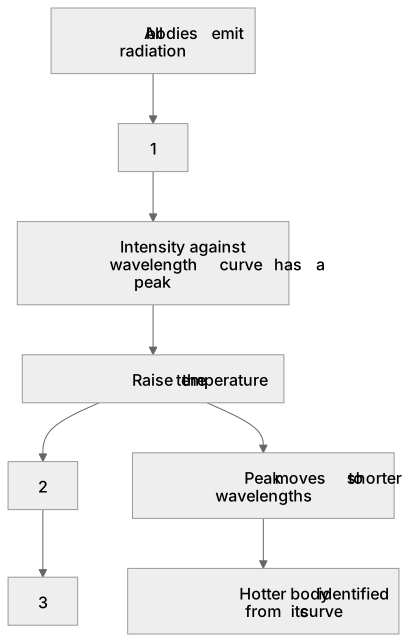
Some boxes have lost their names. Pick the right name for each number.
1Box 1
2Box 2
3Box 3
There is more to this lesson
The full lesson goes on to check your understanding and help you earn the marks. Create a free account to carry on, with your progress saved.
A week of Premium from your first lesson · Then the free plan continues · No card, no charge
Test your understanding of Perfect black bodies and radiation: Students should be able to explain: that all bodies (objects) emit radiation that the intensity and wavelength distribution of any emission depends on the temperature of the body.
Active recall beats re-reading. Take an instant quiz now to test what you’ve learned and lock it into long-term memory.
A week of Premium from your first lesson · Then the free plan continues · No card, no charge