AQA · GCSE · Physics
Course version: 8463 · Version from Sept 2016
Poles of a magnet: A permanent magnet produces its own magnetic field.
A permanent magnet is made from a hard magnetic material such as steel, alnico or neodymium, and it produces its own magnetic field all the time.
Checked against the AQA 8463 specification (opens in a new tab) on .
- Point 6 of 10
- 4 key terms
Study notes
From the checked teaching notes for this specification point.
The idea
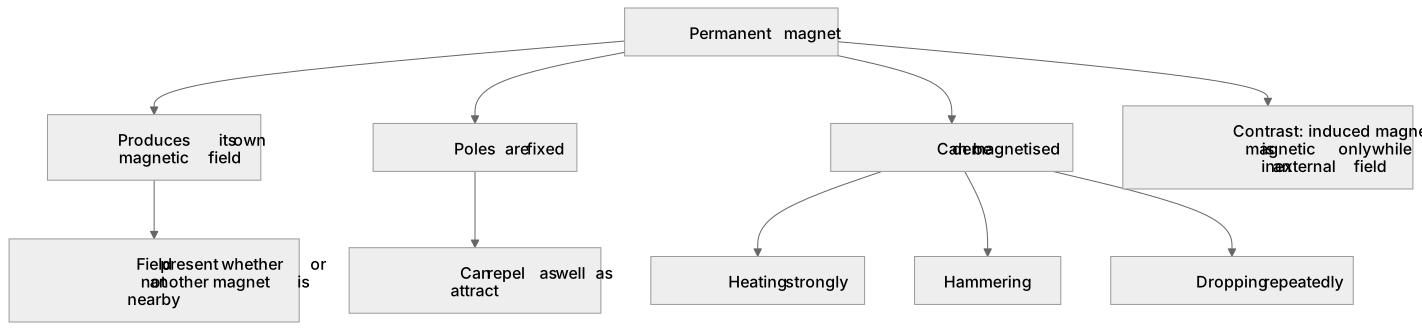
A permanent magnet is made from a hard magnetic material such as steel, alnico or neodymium, and it produces its own magnetic field all the time. Its north and south poles are fixed, and they are there whether or not another magnet is anywhere near. That is the crucial contrast with an induced magnet, which is only magnetic while it sits inside somebody else's field. Because a permanent magnet has its own fixed poles, it can repel as well as attract, which an induced magnet can never do. It is not indestructible: heating it strongly, hammering it or dropping it repeatedly jumbles the domains and demagnetises it, but simply moving it away from other magnets does not.
What earns the marks
- Stating that a permanent magnet produces its own magnetic field.
- Stating that the field is present whether or not another magnet is nearby.
- Stating that the poles of a permanent magnet are fixed, so it can repel as well as attract.
- Contrasting with an induced magnet, which is magnetic only while it is in an external field.
Common mistakes and how to put them right
Asserting that a permanent magnet can never lose its magnetism.
Describing a permanent magnet simply as one that is always attracting things.
Confusing a permanent magnet with an electromagnet, which needs a current.
Saying a permanent magnet has no field until something magnetic is brought near it.
Exam tips
- Difference questions need both sides written out, not just the permanent magnet.
- Use the phrase 'produces its own magnetic field' word for word.
- Mention that only a permanent magnet can repel, as your test for telling them apart.
Try the lesson
The start of the Poles of a magnet: A permanent magnet produces its own magnetic field. lesson, made from checked teaching notes for this specification point.
Have a go first
Which statement about a permanent magnet is correct?
Listen
A permanent magnet is made from a hard magnetic material such as steel, alnico or neodymium, and it produces its own magnetic field all the time. Its north and south poles are fixed, and they are there whether or not another magnet is anywhere near. That is the crucial contrast with an induced magnet, which is only magnetic while it sits inside somebody else's field. Because a permanent magnet has its own fixed poles, it can repel as well as attract, which an induced magnet can never do. It is not indestructible: heating it strongly, hammering it or dropping it repeatedly jumbles the domains and demagnetises it, but simply moving it away from other magnets does not. A strong answer earns marks for these points. stating that a permanent magnet produces its own magnetic field. stating that the field is present whether or not another magnet is nearby. stating that the poles of a permanent magnet are fixed, so it can repel as well as attract. contrasting with an induced magnet, which is magnetic only while it is in an external field. Exam tip: Difference questions need both sides written out, not just the permanent magnet.
See it
Key words
Say what each word means before you turn the card.
permanent magnets
Try answering aloud or in your head before turning the card.
own magnetic field
Try answering aloud or in your head before turning the card.
fixed poles
Try answering aloud or in your head before turning the card.
demagnetisation
Try answering aloud or in your head before turning the card.
See every definition
- permanent magnets
- A magnet that produces its own magnetic field all the time, with fixed north and south poles that are there whether or not another magnet is anywhere near.
- own magnetic field
- The field a permanent magnet produces all the time, present whether or not another magnet is nearby.
- fixed poles
- The north and south poles of a permanent magnet, which stay in place so that it can repel as well as attract.
- demagnetisation
- The jumbling of the domains when a magnet is heated strongly, hammered or dropped repeatedly, so that it loses its magnetism.
Label the diagram
Some boxes have lost their names. Pick the right name for each number.
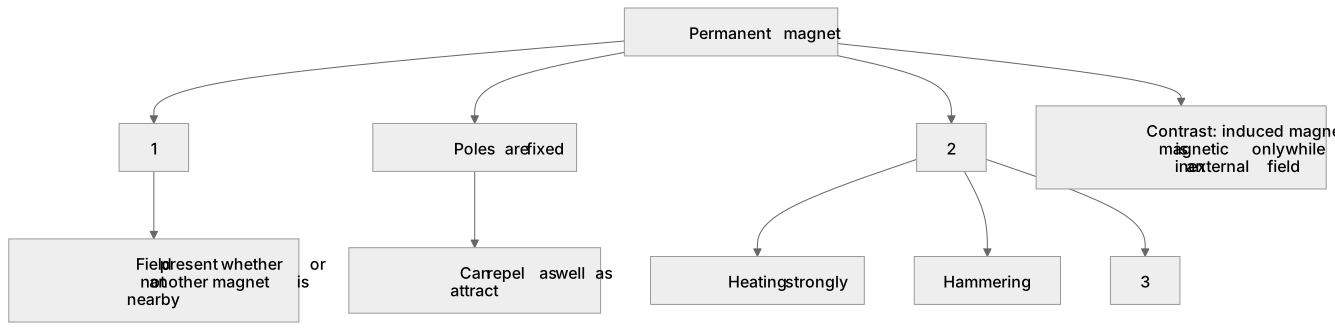
1Box 1
2Box 2
3Box 3
There is more to this lesson
The full lesson goes on to check your understanding and help you earn the marks. Create a free account to carry on, with your progress saved.
A week of Premium from your first lesson · Then the free plan continues · No card, no charge
Test your understanding of Poles of a magnet: A permanent magnet produces its own magnetic field.
Active recall beats re-reading. Take an instant quiz now to test what you’ve learned and lock it into long-term memory.
A week of Premium from your first lesson · Then the free plan continues · No card, no charge