AQA · GCSE · Physics
Course version: 8463 · Version from Sept 2016
Students should be able to describe: the attraction and repulsion between…
Full specification wording
Poles of a magnet: Students should be able to describe: the attraction and repulsion between unlike and like poles for permanent magnets the difference between permanent and induced magnets.
This pulls the section together, and answers need both halves.
Checked against the AQA 8463 specification (opens in a new tab) on .
- Point 10 of 10
- 3 key terms
Study notes
From the checked teaching notes for this specification point.
The idea
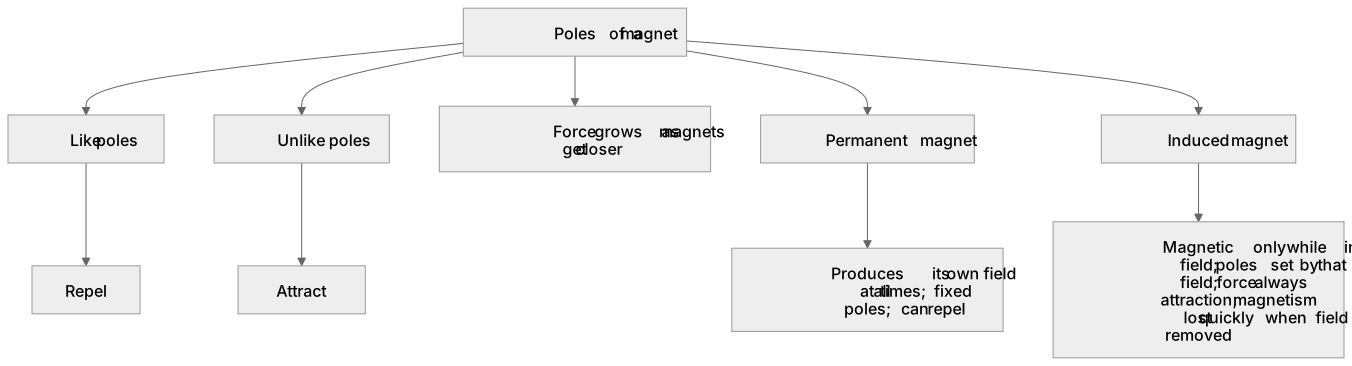
This pulls the section together, and answers need both halves. For poles: like poles repel, unlike poles attract, and the force grows as the magnets get closer. For magnet types: a permanent magnet produces its own field all the time with fixed poles and can repel, whereas an induced magnet is magnetic only while it is in a field, its poles are set by that field, the force is always attraction, and it loses most or all of its magnetism quickly once the field is removed. In a table of pole pairings every row is judged separately, with AQA awarding one of the two marks for three out of four rows correct.
What earns the marks
- A table of pole pairings with all four rows correct; one mark if three rows are correct.
- Stating that a permanent magnet produces its own magnetic field at all times.
- Stating that an induced magnet is magnetic only while it is in a magnetic field.
- Stating that induced magnetism always causes attraction and is lost quickly when the field is removed.
Common mistakes and how to put them right
Filling in a table of pole pairs by pattern instead of reading each pair of poles.
Defining an induced magnet only as temporary, which is not enough for the mark.
Describing the difference by material alone rather than by behaviour in a field.
Forgetting that a permanent magnet is also attracted to the induced magnet it creates.
Exam tips
- Check each row of a table independently; three right out of four still scores something.
- A difference question wants a statement about each type, written as a comparison.
- If asked to describe, give the behaviour, not just the name of the material.
Try the lesson
The start of the Poles of a magnet: Students should be able to describe: the attraction and repulsion between unlike and like poles for permanent magnets the difference between permanent and induced magnets. lesson, made from checked teaching notes for this specification point.
Have a go first
Two permanent bar magnets are placed with their north poles facing each other. What happens between the two north poles?
Listen
This pulls the section together, and answers need both halves. For poles: like poles repel, unlike poles attract, and the force grows as the magnets get closer. For magnet types: a permanent magnet produces its own field all the time with fixed poles and can repel, whereas an induced magnet is magnetic only while it is in a field, its poles are set by that field, the force is always attraction, and it loses most or all of its magnetism quickly once the field is removed. In a table of pole pairings every row is judged separately, with AQA awarding one of the two marks for three out of four rows correct. A strong answer earns marks for these points. a table of pole pairings with all four rows correct; one mark if three rows are correct. stating that a permanent magnet produces its own magnetic field at all times. stating that an induced magnet is magnetic only while it is in a magnetic field. stating that induced magnetism always causes attraction and is lost quickly when the field is removed. Exam tip: Check each row of a table independently; three right out of four still scores something.
See it
Key words
Say what each word means before you turn the card.
like and unlike poles
Try answering aloud or in your head before turning the card.
permanent magnets
Try answering aloud or in your head before turning the card.
induced magnets
Try answering aloud or in your head before turning the card.
See every definition
- like and unlike poles
- Like poles repel and unlike poles attract, and the force grows as the magnets get closer.
- permanent magnets
- These produce their own field all the time with fixed poles and can repel.
- induced magnets
- These are magnetic only while in a field, their poles are set by that field, the force is always attraction, and magnetism is lost quickly once the field is removed.
Label the diagram
Some boxes have lost their names. Pick the right name for each number.
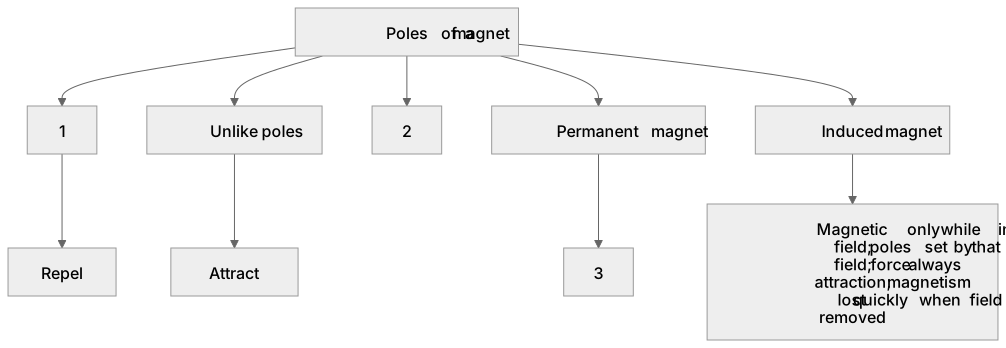
1Box 1
2Box 2
3Box 3
There is more to this lesson
The full lesson goes on to check your understanding and help you earn the marks. Create a free account to carry on, with your progress saved.
A week of Premium from your first lesson · Then the free plan continues · No card, no charge
Test your understanding of Poles of a magnet: Students should be able to describe: the attraction and repulsion between unlike and like poles for permanent magnets the difference between permanent and induced magnets.
Active recall beats re-reading. Take an instant quiz now to test what you’ve learned and lock it into long-term memory.
A week of Premium from your first lesson · Then the free plan continues · No card, no charge