AQA · GCSE · Physics
Course version: 8463 · Version from Sept 2016
Poles of a magnet: Two unlike poles attract each other.
A north pole and a south pole attract each other.
Checked against the AQA 8463 specification (opens in a new tab) on .
- Point 4 of 10
- 4 key terms
Study notes
From the checked teaching notes for this specification point.
The idea
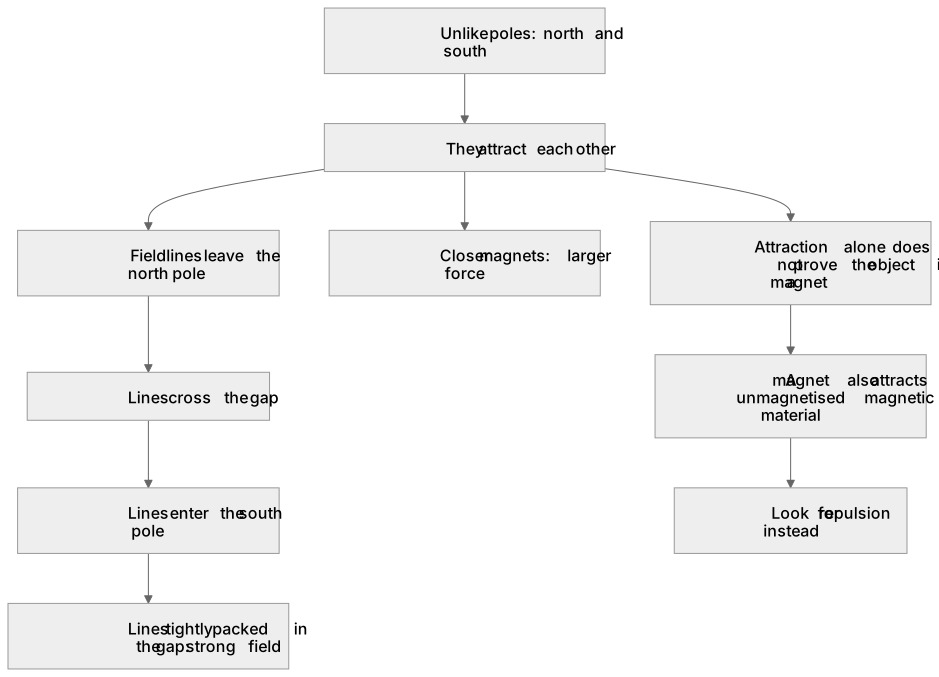
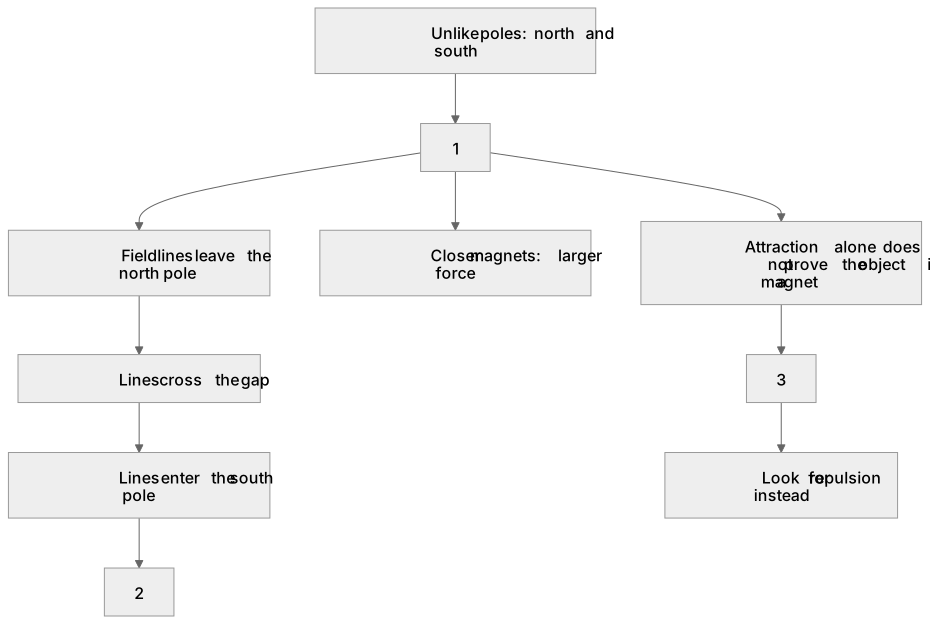
A north pole and a south pole attract each other. The field pattern shows it clearly: the lines leave the north pole of one magnet, cross the gap and enter the south pole of the other, and they are tightly packed in the gap because the field there is strong. The closer the magnets, the larger the force. Attraction is the more common observation but the less useful one, because a magnet also attracts an unmagnetised magnetic material such as an iron nail, which becomes an induced magnet. So if you are asked to decide whether an unknown bar is a magnet or just a piece of iron, attraction cannot settle it; look for repulsion instead.
What earns the marks
- Stating that a north pole and a south pole attract each other.
- Drawing field lines that run from the north pole of one magnet into the south pole of the other.
- Stating that the force increases as the two magnets are brought closer together.
- Explaining that attraction alone does not prove the second object is a magnet.
Common mistakes and how to put them right
Drawing the arrows the wrong way round, from south to north outside the magnets.
Concluding that an object is a magnet because it was attracted to one.
Forgetting that each magnet pulls on the other with an equally sized force.
Leaving gaps in the field lines between the two poles.
Exam tips
- Arrowheads carry marks: every line needs one, pointing north to south outside the magnet.
- Pair this with induced magnetism whenever a question asks 'is it a magnet?'.
- Draw the lines in the gap closer together to show the stronger field there.
Try the lesson
The start of the Poles of a magnet: Two unlike poles attract each other. lesson, made from checked teaching notes for this specification point.
Have a go first
The north pole of one bar magnet is brought close to the south pole of another bar magnet. What happens between these two poles?
Listen
A north pole and a south pole attract each other. The field pattern shows it clearly: the lines leave the north pole of one magnet, cross the gap and enter the south pole of the other, and they are tightly packed in the gap because the field there is strong. The closer the magnets, the larger the force. Attraction is the more common observation but the less useful one, because a magnet also attracts an unmagnetised magnetic material such as an iron nail, which becomes an induced magnet. So if you are asked to decide whether an unknown bar is a magnet or just a piece of iron, attraction cannot settle it; look for repulsion instead. A strong answer earns marks for these points. stating that a north pole and a south pole attract each other. drawing field lines that run from the north pole of one magnet into the south pole of the other. stating that the force increases as the two magnets are brought closer together. explaining that attraction alone does not prove the second object is a magnet. Exam tip: Arrowheads carry marks: every line needs one, pointing north to south outside the magnet.
See it
Key words
Say what each word means before you turn the card.
unlike poles
Try answering aloud or in your head before turning the card.
field lines between poles
Try answering aloud or in your head before turning the card.
force and separation
Try answering aloud or in your head before turning the card.
induced magnetism
Try answering aloud or in your head before turning the card.
See every definition
- unlike poles
- A north pole and a south pole attract each other.
- field lines between poles
- The lines leave the north pole of one magnet, cross the gap and enter the south pole of the other, and are tightly packed in the gap because the field there is strong.
- force and separation
- The closer the magnets, the larger the force.
- induced magnetism
- A magnet also attracts an unmagnetised magnetic material such as an iron nail, which becomes an induced magnet.
Label the diagram
Some boxes have lost their names. Pick the right name for each number.
1Box 1
2Box 2
3Box 3
There is more to this lesson
The full lesson goes on to check your understanding and help you earn the marks. Create a free account to carry on, with your progress saved.
A week of Premium from your first lesson · Then the free plan continues · No card, no charge
Test your understanding of Poles of a magnet: Two unlike poles attract each other.
Active recall beats re-reading. Take an instant quiz now to test what you’ve learned and lock it into long-term memory.
A week of Premium from your first lesson · Then the free plan continues · No card, no charge