AQA · GCSE · Physics
Course version: 8463 · Version from Sept 2016
The pressure at the surface of a fluid can be calculated using the equation:
Full specification wording
Pressure in a fluid 1: The pressure at the surface of a fluid can be calculated using the equation:
Pressure at a surface is the force acting normally per unit area.
Checked against the AQA 8463 specification (opens in a new tab) on .
- Point 3 of 9
- 2 key terms
Study notes
From the checked teaching notes for this specification point.
The idea
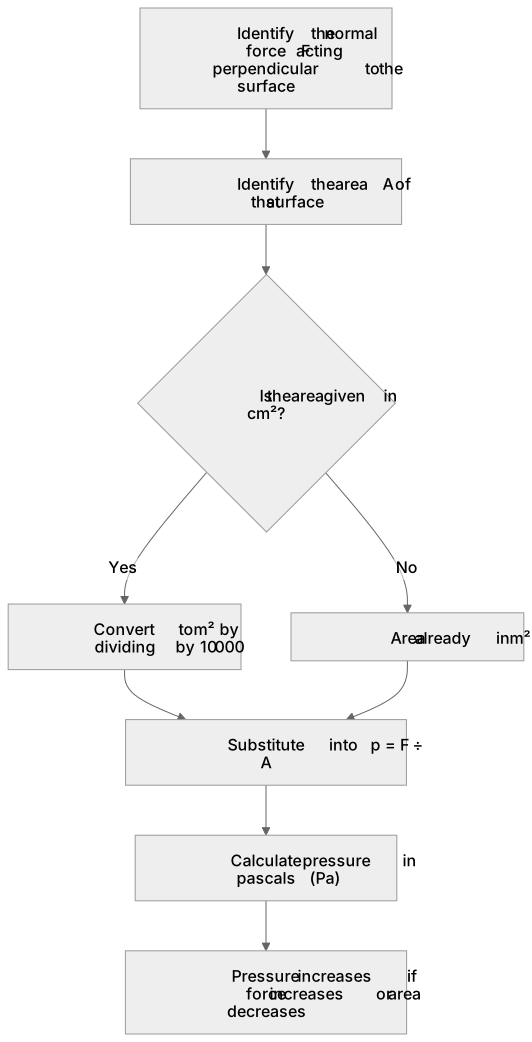
Pressure at a surface is the force acting normally per unit area. For a fluid, the pressure at the surface is calculated using p = F ÷ A, where p is pressure in pascals (Pa), F is the normal force in newtons (N) and A is the area in square metres (m²). A pascal is one newton per square metre. To use the equation, identify the force acting perpendicular to the surface and the area of that surface. For example, a force of 20 N acting normally on an area of 0.5 m² gives p = 20 N ÷ 0.5 m² = 40 Pa. If the area is given in cm², convert to m² by dividing by 10 000 before substituting. The equation shows that pressure increases if the force increases or if the area decreases. This applies to any fluid at a surface, including liquids and gases.
What earns the marks
- State the pressure equation as p = F ÷ A, where p is pressure, F is normal force and A is area.
- Identify the force acting perpendicular to the surface and the area of that surface from the information given.
- Convert area to square metres when it is given in other units, for example 1 cm² = 1 × 10⁻⁴ m².
- Substitute values into the equation with correct units and calculate the pressure in pascals.
- Rearrange the equation to calculate force or area when required, for example F = p × A or A = F ÷ p.
- Explain that pressure increases when the force increases or when the area decreases, for a constant value of the other variable.
Common mistakes and how to put them right
Using the area in square centimetres without converting to square metres.
Put it right by converting cm² to m² by dividing by 10 000 before calculating.
Using a force that is not perpendicular to the surface.
Put it right by using the component of force acting normally to the surface.
Confusing pressure with force.
Put it right by stating that pressure is force per unit area and is measured in pascals, while force is measured in newtons.
Forgetting to square the conversion factor when converting areas.
Put it right by remembering that 1 m = 100 cm, so 1 m² = 10 000 cm².
Exam tips
- Write the equation p = F ÷ A before substituting values, so the examiner can see your method.
- Check that the area is in square metres and the force is in newtons before calculating.
- Give the unit pascal (Pa) with your answer, and remember that 1 Pa = 1 N m⁻².
- If the question asks for pressure at the surface of a fluid, use the normal force acting on that surface, not the weight of the fluid unless it is the relevant force.
Try the lesson
The start of the Pressure in a fluid 1: The pressure at the surface of a fluid can be calculated using the equation: lesson, made from checked teaching notes for this specification point.
Have a go first
Which equation gives the pressure at a surface in a fluid in terms of the force acting normally on the surface and the area of the surface?
Listen
Pressure at a surface is the force acting normally per unit area. For a fluid, the pressure at the surface is calculated using p = F ÷ A, where p is pressure in pascals (Pa), F is the normal force in newtons (N) and A is the area in square metres (m²). A pascal is one newton per square metre. To use the equation, identify the force acting perpendicular to the surface and the area of that surface. For example, a force of 20 N acting normally on an area of 0.5 m² gives p = 20 N ÷ 0.5 m² = 40 Pa. If the area is given in cm², convert to m² by dividing by 10 000 before substituting. The equation shows that pressure increases if the force increases or if the area decreases. This applies to any fluid at a surface, including liquids and gases. A strong answer earns marks for these points. State the pressure equation as p = F ÷ A, where p is pressure, F is normal force and A is area. Identify the force acting perpendicular to the surface and the area of that surface from the information given. Convert area to square metres when it is given in other units, for example 1 cm² = 1 × 10⁻⁴ m². Substitute values into the equation with correct units and calculate the pressure in pascals. A common slip: Using the area in square centimetres without converting to square metres. Instead, converting cm² to m² by dividing by 10 000 before calculating. Exam tip: Write the equation p = F ÷ A before substituting values, so the examiner can see your method.
See it
Key words
Say what each word means before you turn the card.
Pressure in fluids
Try answering aloud or in your head before turning the card.
Force and area relationship
Try answering aloud or in your head before turning the card.
See every definition
- Pressure in fluids
- The force acting normally per unit area at the surface of a fluid, calculated using p = F ÷ A.
- Force and area relationship
- Pressure increases if the force increases or if the area decreases, for a constant value of the other variable.
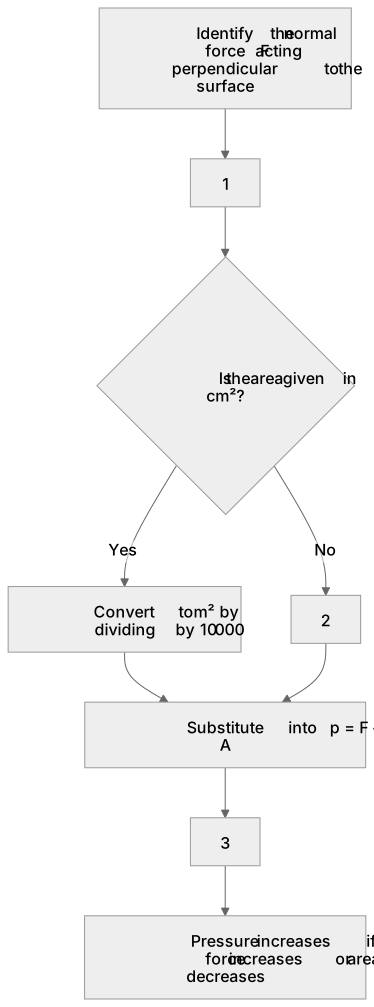
Label the diagram
Some boxes have lost their names. Pick the right name for each number.
1Box 1
2Box 2
3Box 3
There is more to this lesson
The full lesson goes on to check your understanding and help you earn the marks. Create a free account to carry on, with your progress saved.
A week of Premium from your first lesson · Then the free plan continues · No card, no charge
Test your understanding of Pressure in a fluid 1: The pressure at the surface of a fluid can be calculated using the equation:
Active recall beats re-reading. Take an instant quiz now to test what you’ve learned and lock it into long-term memory.
A week of Premium from your first lesson · Then the free plan continues · No card, no charge