AQA · GCSE · Physics
Course version: 8463 · Version from Sept 2016
For a fixed mass of gas held at a constant temperature: pressure × volume…
Full specification wording
Pressure in gases (physics only): For a fixed mass of gas held at a constant temperature: pressure × volume = constant p V = constant pressure, p, in pascals, Pa volume, V, in metres cubed, m Students should be able to calculate the change in the pressure of a gas or the volume of a gas (a fixed mass held at constant temperature) when either the pressure or volume is increased or decreased.
For a fixed mass of gas at a constant temperature the product of pressure and volume does not change, so p₁V₁ = p₂V₂.
Checked against the AQA 8463 specification (opens in a new tab) on .
- Point 3 of 3
- 4 key terms
Study notes
From the checked teaching notes for this specification point.
The idea
For a fixed mass of gas at a constant temperature the product of pressure and volume does not change, so p₁V₁ = p₂V₂. Pressure and volume are inversely proportional: halve the volume and the pressure doubles. A gas at 100 kPa occupying 2.0 × 10⁻⁴ m³, squeezed to 5.0 × 10⁻⁵ m³, ends at p₂ = (100 000 × 2.0 × 10⁻⁴) ÷ (5.0 × 10⁻⁵) = 400 kPa. The units do not have to be pascals and cubic metres, but both pressures must share one unit and both volumes must share another, because the conversion factors cancel. Plotted against volume the relationship is a curve; plotted against 1/V it is a straight line through the origin. It only holds while the temperature and the mass of gas stay fixed.
What earns the marks
- Writing p₁V₁ = p₂V₂, or for stating that pressure × volume is constant.
- Substitution with both pressures in the same unit and both volumes in the same unit.
- The calculated value with a correct unit.
- Stating that the mass of gas and the temperature must remain constant for the relationship to hold.
Common mistakes and how to put them right
Adding pressure and volume, or dividing one by the other, instead of multiplying.
Mixing kPa on one side of the equation with Pa on the other.
Using p V = constant for a gas that has been heated or cooled.
Quoting one volume in cm³ and the other in m³ within the same calculation.
Exam tips
- Write p₁V₁ = p₂V₂ and label which numbers are the before values before you substitute anything.
- Sense check the answer: a smaller volume must give a larger pressure, so if it does not, you have divided the wrong way round.
- Only convert units if the two sides disagree; matching units cancel and save time.
Try the lesson
The start of the Pressure in gases (physics only): For a fixed mass of gas held at a constant temperature: pressure × volume = constant p V = constant pressure, p, in pascals, Pa volume, V, in metres cubed, m Students should be able to calculate the change in the pressure of a gas or the volume of a gas (a fixed mass held at constant temperature) when either the pressure or volume is increased or decreased. lesson, made from checked teaching notes for this specification point.
Have a go first
A fixed mass of gas at constant temperature has a pressure of 100000 Pa and a volume of 0.2 m³. The volume is changed to 0.4 m³ at the same temperature. What is the new pressure of the gas?
Listen
For a fixed mass of gas at a constant temperature the product of pressure and volume does not change, so p₁V₁ = p₂V₂. Pressure and volume are inversely proportional: halve the volume and the pressure doubles. A gas at 100 kPa occupying 2.0 × 10⁻⁴ m³, squeezed to 5.0 × 10⁻⁵ m³, ends at p₂ = (100 000 × 2.0 × 10⁻⁴) ÷ (5.0 × 10⁻⁵) = 400 kPa. The units do not have to be pascals and cubic metres, but both pressures must share one unit and both volumes must share another, because the conversion factors cancel. Plotted against volume the relationship is a curve; plotted against 1/V it is a straight line through the origin. It only holds while the temperature and the mass of gas stay fixed. A strong answer earns marks for these points. writing p₁V₁ = p₂V₂, or for stating that pressure × volume is constant. substitution with both pressures in the same unit and both volumes in the same unit. the calculated value with a correct unit. stating that the mass of gas and the temperature must remain constant for the relationship to hold. Exam tip: Write p₁V₁ = p₂V₂ and label which numbers are the before values before you substitute anything.
See it
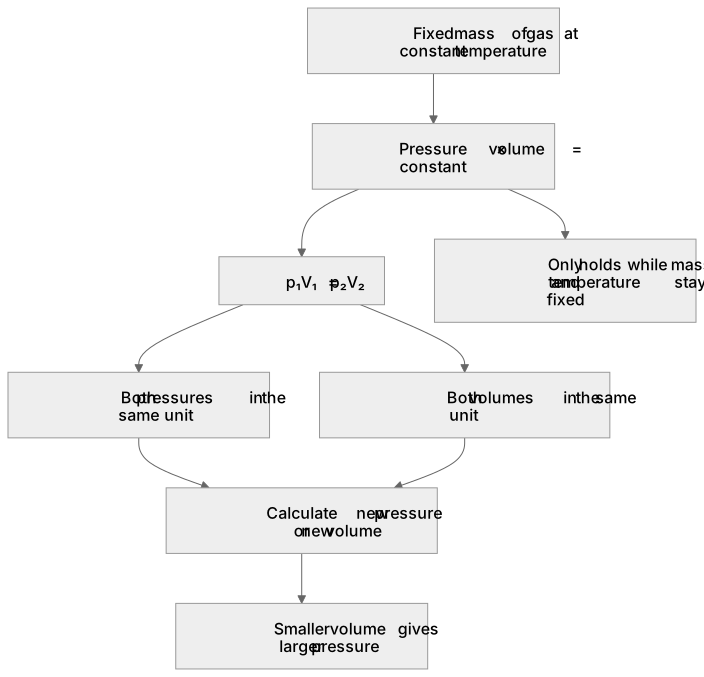
Key words
Say what each word means before you turn the card.
pressure and volume
Try answering aloud or in your head before turning the card.
inverse proportion
Try answering aloud or in your head before turning the card.
fixed mass of gas
Try answering aloud or in your head before turning the card.
consistent units
Try answering aloud or in your head before turning the card.
See every definition
- pressure and volume
- For a fixed mass of gas at a constant temperature, pressure multiplied by volume gives a constant value.
- inverse proportion
- Halving the volume doubles the pressure, so pressure and volume are inversely proportional.
- fixed mass of gas
- The relationship only holds while the temperature and the mass of gas stay fixed.
- consistent units
- Both pressures must share one unit and both volumes must share another, because the conversion factors cancel.
Label the diagram
Some boxes have lost their names. Pick the right name for each number.
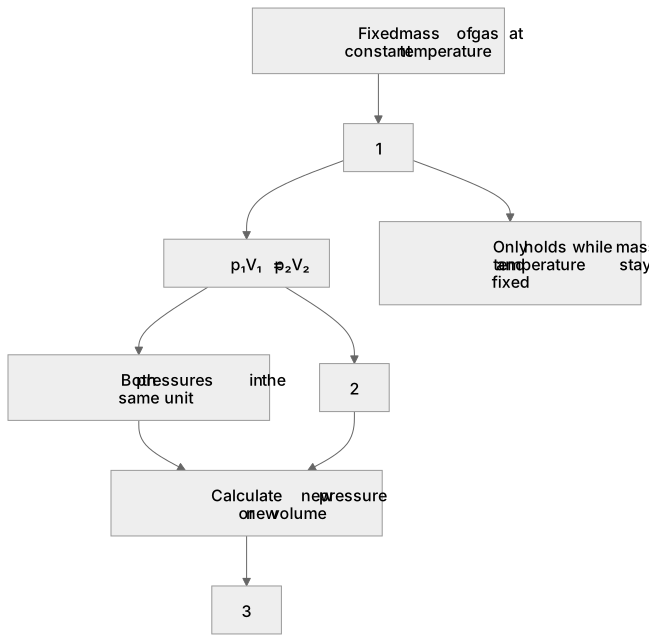
1Box 1
2Box 2
3Box 3
There is more to this lesson
The full lesson goes on to check your understanding and help you earn the marks. Create a free account to carry on, with your progress saved.
A week of Premium from your first lesson · Then the free plan continues · No card, no charge
Test your understanding of Pressure in gases (physics only): For a fixed mass of gas held at a constant temperature: pressure × volume = constant p V = constant pressure, p, in pascals, Pa volume, V, in metres cubed, m Students should be able to calculate the change in the pressure of a gas or the volume of a gas (a fixed mass held at constant temperature) when either the pressure or volume is increased or decreased.
Active recall beats re-reading. Take an instant quiz now to test what you’ve learned and lock it into long-term memory.
A week of Premium from your first lesson · Then the free plan continues · No card, no charge