AQA · GCSE · Physics
Course version: 8463 · Version from Sept 2016
Gamma rays originate from changes in the nucleus of an atom.
Full specification wording
Properties of electromagnetic waves 2: Gamma rays originate from changes in the nucleus of an atom.
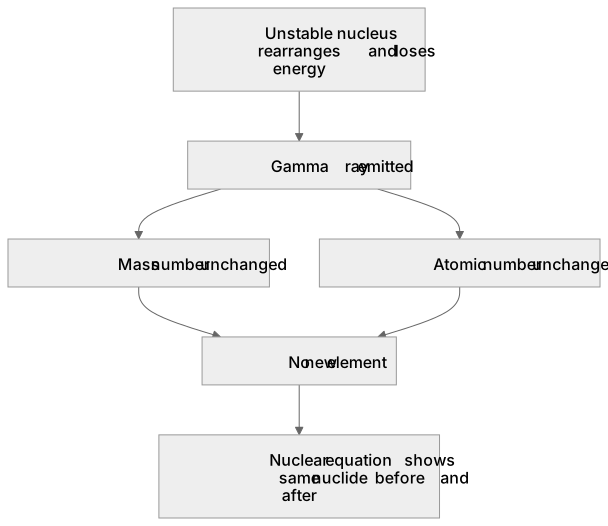
Gamma rays are emitted when an unstable nucleus rearranges itself and loses energy, usually immediately after an alpha or beta decay has left it in an excited state.
Checked against the AQA 8463 specification (opens in a new tab) on .
- Point 4 of 11
- 4 key terms
Study notes
From the checked teaching notes for this specification point.
The idea
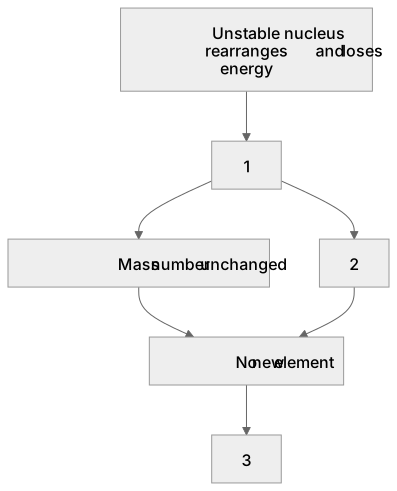
Gamma rays are emitted when an unstable nucleus rearranges itself and loses energy, usually immediately after an alpha or beta decay has left it in an excited state. Nothing but energy leaves the nucleus, so the mass number and the atomic number do not change, there is no new element, and a nuclear equation shows the same nuclide before and after. Gamma rays sit at the highest frequency and shortest wavelength end of the electromagnetic spectrum. They are the most penetrating of the nuclear radiations, needing thick lead or metres of concrete to reduce them appreciably, and they are the least ionising per interaction, which is exactly why they travel so far. Nuclear fission also releases gamma rays along with neutrons.
What earns the marks
- Stating that a gamma ray comes from a change in the nucleus, not from the electrons.
- Saying that the mass number and atomic number are unchanged by gamma emission.
- Identifying gamma as the most penetrating of the nuclear radiations.
- Choosing an absorbing material, such as aluminium, that stops beta while gamma still passes through.
Common mistakes and how to put them right
Changing the mass number or atomic number in a nuclear equation for gamma emission.
Saying gamma rays are particles emitted from the nucleus rather than electromagnetic waves.
Claiming gamma is stopped completely by a thin aluminium sheet, which is what stops beta.
Confusing gamma rays with X-rays by saying both come from the nucleus.
Exam tips
- In a nuclear equation, gamma emission leaves both numbers unchanged; check that before you write anything.
- For absorber questions remember the ladder: paper stops alpha, aluminium stops beta, thick lead reduces gamma.
- Say where the radiation comes from when the question uses the word originate.
Try the lesson
The start of the Properties of electromagnetic waves 2: Gamma rays originate from changes in the nucleus of an atom. lesson, made from checked teaching notes for this specification point.
Have a go first
Which of the following describes the origin of a gamma ray emitted by a radioactive atom?
Listen
Gamma rays are emitted when an unstable nucleus rearranges itself and loses energy, usually immediately after an alpha or beta decay has left it in an excited state. Nothing but energy leaves the nucleus, so the mass number and the atomic number do not change, there is no new element, and a nuclear equation shows the same nuclide before and after. Gamma rays sit at the highest frequency and shortest wavelength end of the electromagnetic spectrum. They are the most penetrating of the nuclear radiations, needing thick lead or metres of concrete to reduce them appreciably, and they are the least ionising per interaction, which is exactly why they travel so far. Nuclear fission also releases gamma rays along with neutrons. A strong answer earns marks for these points. stating that a gamma ray comes from a change in the nucleus, not from the electrons. saying that the mass number and atomic number are unchanged by gamma emission. identifying gamma as the most penetrating of the nuclear radiations. choosing an absorbing material, such as aluminium, that stops beta while gamma still passes through. Exam tip: In a nuclear equation, gamma emission leaves both numbers unchanged; check that before you write anything.
See it
Key words
Say what each word means before you turn the card.
nuclear origin
Try answering aloud or in your head before turning the card.
no change in nucleon number
Try answering aloud or in your head before turning the card.
highly penetrating
Try answering aloud or in your head before turning the card.
shortest wavelength
Try answering aloud or in your head before turning the card.
See every definition
- nuclear origin
- Gamma rays originate from changes in the nucleus of an atom, not from the electrons.
- no change in nucleon number
- Nothing but energy leaves the nucleus, so the mass number and the atomic number do not change.
- highly penetrating
- Gamma rays are the most penetrating of the nuclear radiations, needing thick lead or metres of concrete to reduce them appreciably.
- shortest wavelength
- Gamma rays sit at the highest frequency and shortest wavelength end of the electromagnetic spectrum.
Label the diagram
Some boxes have lost their names. Pick the right name for each number.
1Box 1
2Box 2
3Box 3
There is more to this lesson
The full lesson goes on to check your understanding and help you earn the marks. Create a free account to carry on, with your progress saved.
A week of Premium from your first lesson · Then the free plan continues · No card, no charge
Test your understanding of Properties of electromagnetic waves 2: Gamma rays originate from changes in the nucleus of an atom.
Active recall beats re-reading. Take an instant quiz now to test what you’ve learned and lock it into long-term memory.
A week of Premium from your first lesson · Then the free plan continues · No card, no charge