AQA · GCSE · Physics
Course version: 8463 · Version from Sept 2016
Activity is the rate at which a source of unstable nuclei decays.
Full specification wording
Radioactive decay and nuclear radiation: Activity is the rate at which a source of unstable nuclei decays.
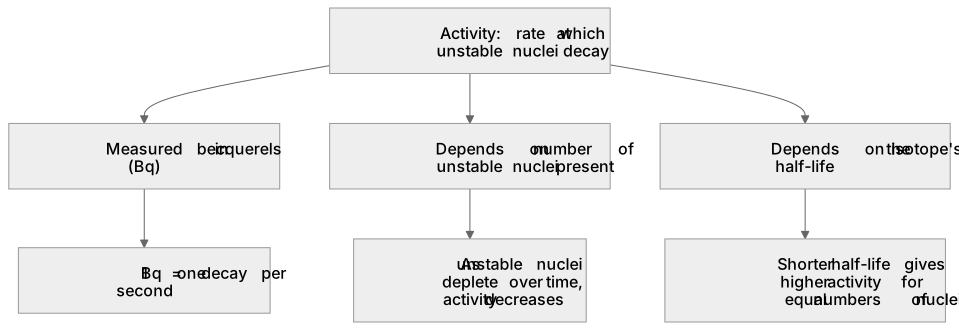
The measurement of radioactive decay focuses on how frequently unstable nuclei emit radiation, quantified in becquerels (Bq), where 1 Bq equals one decay per second.
Checked against the AQA 8463 specification (opens in a new tab) on .
- Point 2 of 6
- 2 key terms
Study notes
From the checked teaching notes for this specification point.
The idea
The measurement of radioactive decay focuses on how frequently unstable nuclei emit radiation, quantified in becquerels (Bq), where 1 Bq equals one decay per second. This frequency depends on the total number of unstable nuclei present and the specific isotope's half-life. Given identical starting quantities of two isotopes, the one with a shorter half-life exhibits a higher initial frequency of decay events. For example, a sample of polonium-210 (half-life 138 days) registers significantly more counts per second on a detector than an equal sample of polonium-209 (half-life 125 years). As unstable nuclei deplete over time, the frequency of decay events naturally decreases, meaning the sample becomes less radioactive.
What earns the marks
- Identifies that the activity of a radioactive source is measured in becquerels (Bq).
- States that one becquerel is equivalent to one nuclear decay per second.
- Explains that activity decreases over time as the number of unstable nuclei in the sample reduces.
- Compares two sources to conclude that for an equal number of nuclei, a shorter half-life results in a higher activity.
Common mistakes and how to put them right
Confusing activity with the total number of undecayed nuclei remaining in a sample.
Put it right: Activity is the rate of decay (decays per second), not the absolute number of unstable nuclei present.
Assuming that a longer half-life means a higher activity.
Put it right: A longer half-life means the nuclei are more stable and decay less frequently, resulting in a lower activity for a given number of nuclei.
Believing that the activity of a specific radioactive source remains constant over time.
Put it right: As unstable nuclei decay, there are fewer left to decay, so the activity decreases over time.
Exam tips
- When defining activity, always include the unit becquerel (Bq) and state that 1 Bq equals 1 decay per second.
- If asked to compare the activity of two samples, check both the number of unstable nuclei and their respective half-lives before concluding which is more active.
Try the lesson
The start of the Radioactive decay and nuclear radiation: Activity is the rate at which a source of unstable nuclei decays. lesson, made from checked teaching notes for this specification point.
Have a go first
What is meant by the activity of a radioactive source?
Listen
The measurement of radioactive decay focuses on how frequently unstable nuclei emit radiation, quantified in becquerels (Bq), where 1 Bq equals one decay per second. This frequency depends on the total number of unstable nuclei present and the specific isotope's half-life. Given identical starting quantities of two isotopes, the one with a shorter half-life exhibits a higher initial frequency of decay events. For example, a sample of polonium-210 (half-life 138 days) registers significantly more counts per second on a detector than an equal sample of polonium-209 (half-life 125 years). As unstable nuclei deplete over time, the frequency of decay events naturally decreases, meaning the sample becomes less radioactive. A strong answer earns marks for these points. Identifies that the activity of a radioactive source is measured in becquerels (Bq). States that one becquerel is equivalent to one nuclear decay per second. Explains that activity decreases over time as the number of unstable nuclei in the sample reduces. Compares two sources to conclude that for an equal number of nuclei, a shorter half-life results in a higher activity. Exam tip: When defining activity, always include the unit becquerel (Bq) and state that 1 Bq equals 1 decay per second.
See it
Key words
Say what each word means before you turn the card.
activity
Try answering aloud or in your head before turning the card.
becquerels
Try answering aloud or in your head before turning the card.
See every definition
- activity
- The rate at which a source of unstable nuclei decays, measured in becquerels (Bq), where 1 Bq equals one decay per second.
- becquerels
- The unit in which the activity of a radioactive source is measured, where 1 Bq equals one decay per second.
Label the diagram
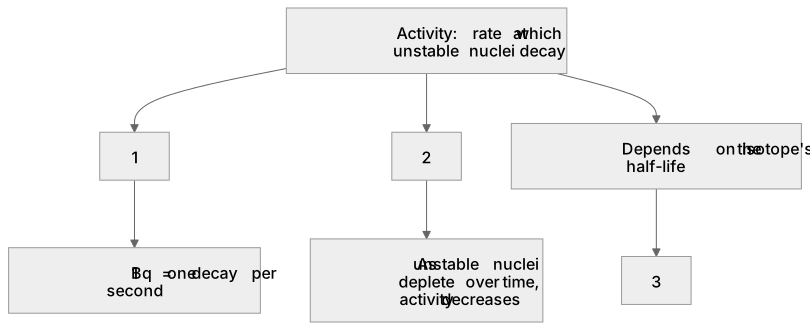
Some boxes have lost their names. Pick the right name for each number.
1Box 1
2Box 2
3Box 3
There is more to this lesson
The full lesson goes on to check your understanding and help you earn the marks. Create a free account to carry on, with your progress saved.
A week of Premium from your first lesson · Then the free plan continues · No card, no charge
Test your understanding of Radioactive decay and nuclear radiation: Activity is the rate at which a source of unstable nuclei decays.
Active recall beats re-reading. Take an instant quiz now to test what you’ve learned and lock it into long-term memory.
A week of Premium from your first lesson · Then the free plan continues · No card, no charge