AQA · GCSE · Physics
Course version: 8463 · Version from Sept 2016
Students should be able to apply their knowledge to the uses of radiation…
Full specification wording
Radioactive decay and nuclear radiation: Students should be able to apply their knowledge to the uses of radiation and evaluate the best sources of radiation to use in a given situation.
Choosing a source means matching penetration, ionising power and half-life to the job.
Checked against the AQA 8463 specification (opens in a new tab) on .
- Point 6 of 6
- 3 key terms
Study notes
From the checked teaching notes for this specification point.
The idea
Choosing a source means matching penetration, ionising power and half-life to the job. A smoke alarm uses alpha, because it ionises the air in the chamber strongly yet cannot reach anyone outside the detector. A thickness gauge for aluminium sheet uses beta, because alpha would be absorbed completely and gamma would pass straight through, so only beta gives a reading that changes with thickness. A medical tracer uses gamma, because it must pass out of the body to reach a detector while ionising as little tissue as possible on the way. Half-life matters too: long enough for the source to be useful, short enough that the activity does not persist and cause harm.
What earns the marks
- Naming the type of radiation suited to the situation described.
- Justifying the choice by penetration or range, for example gamma passing out of the body for a tracer.
- Justifying the choice by ionising power or by the risk to people nearby.
- Commenting on a suitable half-life, long enough to be useful but short enough to decay away.
Common mistakes and how to put them right
Choosing a source only because it is safe, without checking that the radiation could reach the detector at all.
Suggesting an alpha source as a medical tracer, when the radiation cannot leave the body.
Ignoring half-life completely in an evaluation question.
Calling a source safe because it is sealed, without saying which radiation it emits.
Exam tips
- Structure an evaluation as choice, then penetration, then ionising power, then half-life.
- Say why the rejected options fail as well as why your choice works; evaluate means weigh the alternatives.
- Use the data in the table the question supplies rather than remembered values.
Try the lesson
The start of the Radioactive decay and nuclear radiation: Students should be able to apply their knowledge to the uses of radiation and evaluate the best sources of radiation to use in a given situation. lesson, made from checked teaching notes for this specification point.
Have a go first
Which type of radiation is most suitable for monitoring the thickness of paper as it is being made in a factory?
Listen
Choosing a source means matching penetration, ionising power and half-life to the job. A smoke alarm uses alpha, because it ionises the air in the chamber strongly yet cannot reach anyone outside the detector. A thickness gauge for aluminium sheet uses beta, because alpha would be absorbed completely and gamma would pass straight through, so only beta gives a reading that changes with thickness. A medical tracer uses gamma, because it must pass out of the body to reach a detector while ionising as little tissue as possible on the way. Half-life matters too: long enough for the source to be useful, short enough that the activity does not persist and cause harm. A strong answer earns marks for these points. naming the type of radiation suited to the situation described. justifying the choice by penetration or range, for example gamma passing out of the body for a tracer. justifying the choice by ionising power or by the risk to people nearby. commenting on a suitable half-life, long enough to be useful but short enough to decay away. Exam tip: Structure an evaluation as choice, then penetration, then ionising power, then half-life.
See it

Key words
Say what each word means before you turn the card.
uses of radiation
Try answering aloud or in your head before turning the card.
thickness monitoring
Try answering aloud or in your head before turning the card.
choosing a half-life
Try answering aloud or in your head before turning the card.
See every definition
- uses of radiation
- Applying knowledge of penetration, ionising power and half-life to match a source to a job such as a smoke alarm, a thickness gauge or a medical tracer.
- thickness monitoring
- A thickness gauge for aluminium sheet uses beta, because alpha would be absorbed completely and gamma would pass straight through, so only beta gives a reading that changes with thickness.
- choosing a half-life
- A suitable half-life is long enough for the source to be useful but short enough that the activity does not persist and cause harm.
Label the diagram
Some boxes have lost their names. Pick the right name for each number.
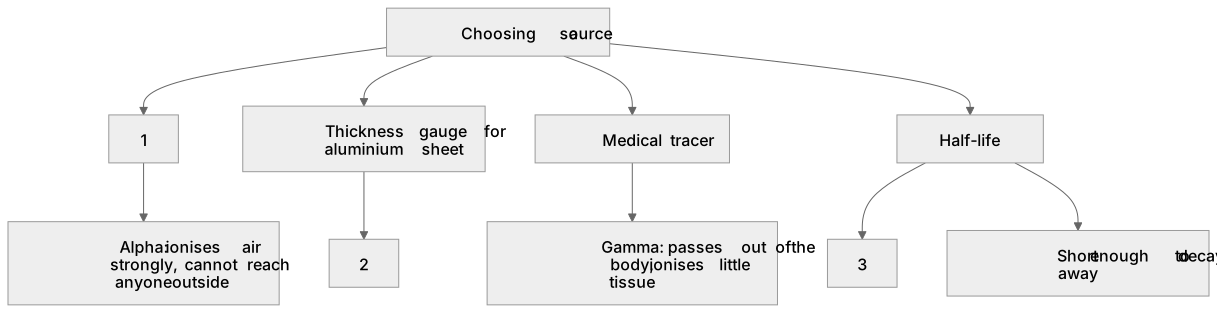
1Box 1
2Box 2
3Box 3
There is more to this lesson
The full lesson goes on to check your understanding and help you earn the marks. Create a free account to carry on, with your progress saved.
A week of Premium from your first lesson · Then the free plan continues · No card, no charge
Test your understanding of Radioactive decay and nuclear radiation: Students should be able to apply their knowledge to the uses of radiation and evaluate the best sources of radiation to use in a given situation.
Active recall beats re-reading. Take an instant quiz now to test what you’ve learned and lock it into long-term memory.
A week of Premium from your first lesson · Then the free plan continues · No card, no charge