AQA · GCSE · Physics
Course version: 8463 · Version from Sept 2016
The nuclear radiation emitted may be: an alpha particle (α) – this…
Full specification wording
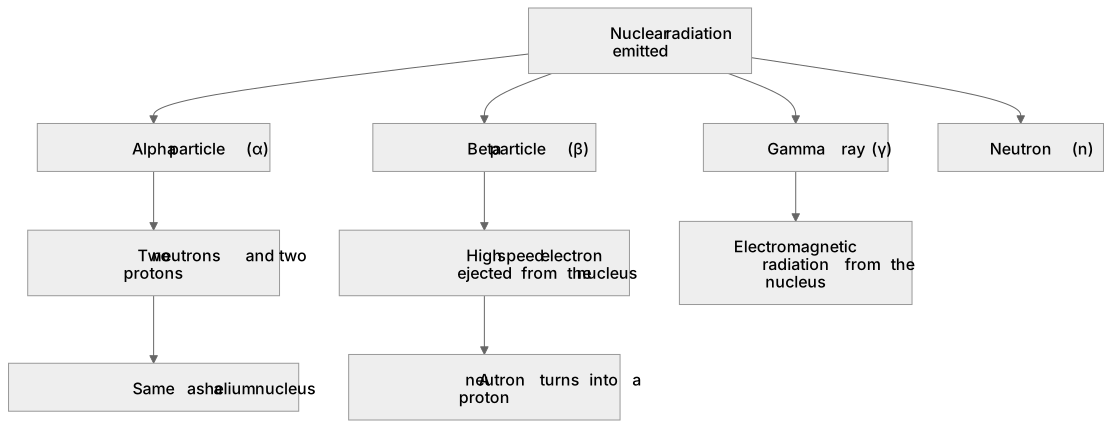
Radioactive decay and nuclear radiation: The nuclear radiation emitted may be: an alpha particle (α) – this consists of two neutrons and two protons, it is the same as a helium nucleus a beta particle (β) – a high speed electron ejected from the nucleus as a neutron turns into a proton a gamma ray (γ) – electromagnetic radiation from the nucleus a neutron (n).
Four kinds of nuclear radiation appear in this specification.
Checked against the AQA 8463 specification (opens in a new tab) on .
- Point 4 of 6
- 4 key terms
Study notes
From the checked teaching notes for this specification point.
The idea
Four kinds of nuclear radiation appear in this specification. An alpha particle is two protons and two neutrons bound together, identical to a helium nucleus, so it has a relative mass of 4 and a charge of +2. A beta particle is a high-speed electron thrown out of the nucleus at the moment a neutron changes into a proton; it has a charge of -1 and negligible mass, and it does not come from the electron shells. A gamma ray is electromagnetic radiation emitted from the nucleus, with no mass and no charge. A neutron may also be emitted, carrying a relative mass of 1 and no charge. All four leave the nucleus, never the electron arrangement.
What earns the marks
- An alpha particle being two protons and two neutrons, or a helium nucleus.
- A beta particle being a high-speed electron emitted from the nucleus.
- Stating that a neutron in the nucleus changes into a proton when a beta particle is emitted.
- A gamma ray being electromagnetic radiation emitted from the nucleus.
Common mistakes and how to put them right
Saying the beta particle comes from the electron shells outside the nucleus.
Describing an alpha particle as a helium atom rather than a helium nucleus.
Giving a gamma ray a small mass or a small charge.
Stating that a proton turns into a neutron when a beta particle is emitted, which is the wrong way round.
Exam tips
- Learn a table of the four radiations with mass, charge and origin; one-mark recall questions are common.
- Say helium nucleus, not helium atom, because an alpha particle has no electrons.
- In beta decay, name the change as neutron to proton; that phrase is worth a mark on its own.
Try the lesson
The start of the Radioactive decay and nuclear radiation: The nuclear radiation emitted may be: an alpha particle (α) – this consists of two neutrons and two protons, it is the same as a helium nucleus a beta particle (β) – a high speed electron ejected from the nucleus as a neutron turns into a proton a gamma ray (γ) – electromagnetic radiation from the nucleus a neutron (n). lesson, made from checked teaching notes for this specification point.
Have a go first
Which type of nuclear radiation is the same as a helium nucleus?
Listen
Four kinds of nuclear radiation appear in this specification. An alpha particle is two protons and two neutrons bound together, identical to a helium nucleus, so it has a relative mass of 4 and a charge of +2. A beta particle is a high-speed electron thrown out of the nucleus at the moment a neutron changes into a proton; it has a charge of -1 and negligible mass, and it does not come from the electron shells. A gamma ray is electromagnetic radiation emitted from the nucleus, with no mass and no charge. A neutron may also be emitted, carrying a relative mass of 1 and no charge. All four leave the nucleus, never the electron arrangement. A strong answer earns marks for these points. an alpha particle being two protons and two neutrons, or a helium nucleus. a beta particle being a high-speed electron emitted from the nucleus. stating that a neutron in the nucleus changes into a proton when a beta particle is emitted. a gamma ray being electromagnetic radiation emitted from the nucleus. Exam tip: Learn a table of the four radiations with mass, charge and origin; one-mark recall questions are common.
See it
Key words
Say what each word means before you turn the card.
alpha particle
Try answering aloud or in your head before turning the card.
beta particle
Try answering aloud or in your head before turning the card.
gamma ray
Try answering aloud or in your head before turning the card.
neutron emission
Try answering aloud or in your head before turning the card.
See every definition
- alpha particle
- Consists of two neutrons and two protons, and is the same as a helium nucleus.
- beta particle
- A high speed electron ejected from the nucleus as a neutron turns into a proton.
- gamma ray
- Electromagnetic radiation from the nucleus, with no mass and no charge.
- neutron emission
- A neutron may also be emitted, carrying a relative mass of 1 and no charge.
Label the diagram
Some boxes have lost their names. Pick the right name for each number.
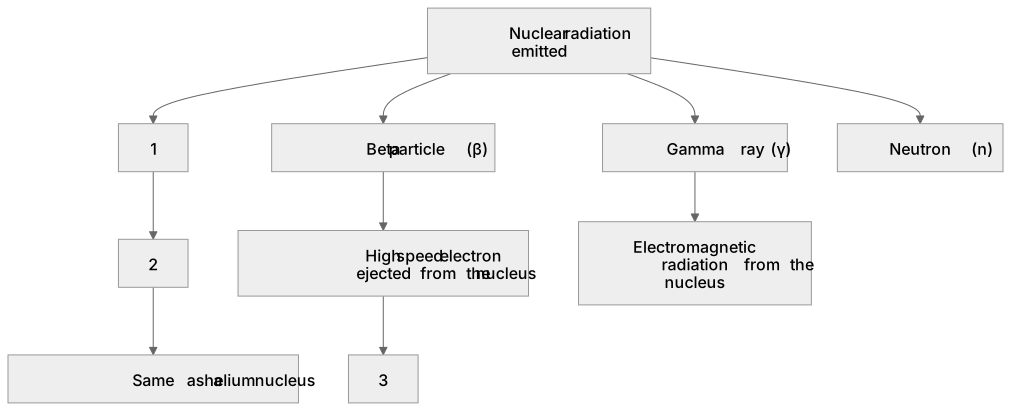
1Box 1
2Box 2
3Box 3
There is more to this lesson
The full lesson goes on to check your understanding and help you earn the marks. Create a free account to carry on, with your progress saved.
A week of Premium from your first lesson · Then the free plan continues · No card, no charge
Test your understanding of Radioactive decay and nuclear radiation: The nuclear radiation emitted may be: an alpha particle (α) – this consists of two neutrons and two protons, it is the same as a helium nucleus a beta particle (β) – a high speed electron ejected from the nucleus as a neutron turns into a proton a gamma ray (γ) – electromagnetic radiation from the nucleus a neutron (n).
Active recall beats re-reading. Take an instant quiz now to test what you’ve learned and lock it into long-term memory.
A week of Premium from your first lesson · Then the free plan continues · No card, no charge