AQA · GCSE · Physics
Course version: 8463 · Version from Sept 2016
Waves can be absorbed or transmitted at the boundary between two different…
Full specification wording
Reflection of waves (physics only): Waves can be absorbed or transmitted at the boundary between two different materials.
Reflection is only one of three things that can happen when a wave meets a boundary.
Checked against the AQA 8463 specification (opens in a new tab) on .
- Point 2 of 4
- 3 key terms
Study notes
From the checked teaching notes for this specification point.
The idea
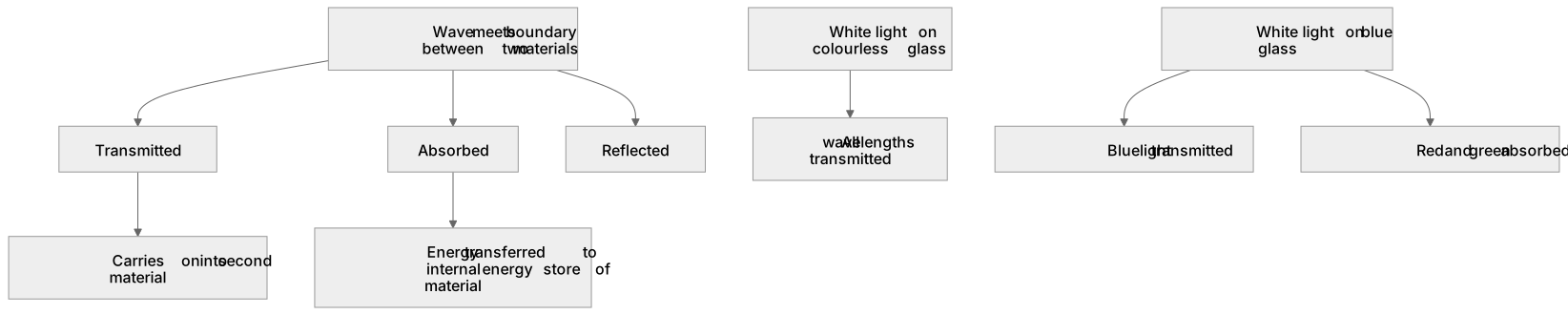
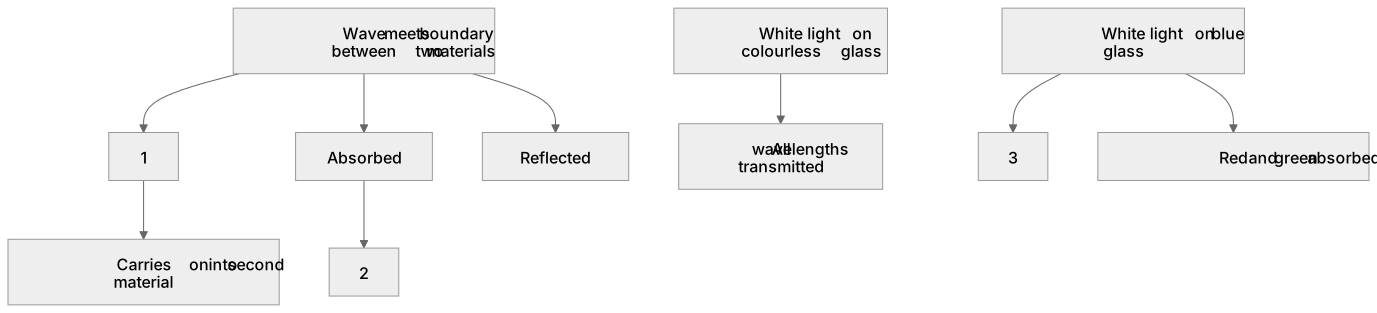
Reflection is only one of three things that can happen when a wave meets a boundary. The wave can be transmitted, carrying on into the second material, usually with a change of speed and direction; it can be absorbed, so its energy is transferred to the internal energy store of the material; or it can be reflected. Every real boundary does all three at once, and the shares depend on the material and on the wavelength. Colourless glass transmits all the wavelengths of white light, so it looks clear. Blue glass transmits only blue light and absorbs the red and green, which is why it works as a filter and why objects behind it look blue. A black surface absorbs most visible wavelengths and warms up; a silvered surface reflects most of them. Energy is conserved, shared between the reflected, transmitted and absorbed parts.
What earns the marks
- Saying that white light is transmitted by colourless glass.
- Saying that only blue light is transmitted by blue glass.
- Saying that all the other colours, wavelengths or frequencies are absorbed.
- Stating that absorbed energy is transferred to the thermal store of the material.
Common mistakes and how to put them right
Writing that blue glass turns the light blue, instead of saying it transmits blue and absorbs the rest.
Saying absorbed light disappears rather than its energy being transferred to the internal energy store of the absorber.
Treating transmission and reflection as alternatives, when part of the wave does each at the same boundary.
Claiming a filter adds colour to white light rather than removing wavelengths from it.
Exam tips
- If a question gives a coloured filter, answer in terms of which wavelengths are transmitted and which are absorbed.
- Name the material on each side of the boundary; at the boundary on its own rarely scores.
- Check whether the question asks about colour, energy, or both, and use the word absorbed for the energy part.
Try the lesson
The start of the Reflection of waves (physics only): Waves can be absorbed or transmitted at the boundary between two different materials. lesson, made from checked teaching notes for this specification point.
Have a go first
A light wave travelling through air meets a dark, opaque surface. The wave does not bounce back and does not pass through the material. Instead, its energy is taken in by the surface. What name is given to this process?
Listen
Reflection is only one of three things that can happen when a wave meets a boundary. The wave can be transmitted, carrying on into the second material, usually with a change of speed and direction; it can be absorbed, so its energy is transferred to the internal energy store of the material; or it can be reflected. Every real boundary does all three at once, and the shares depend on the material and on the wavelength. Colourless glass transmits all the wavelengths of white light, so it looks clear. Blue glass transmits only blue light and absorbs the red and green, which is why it works as a filter and why objects behind it look blue. A black surface absorbs most visible wavelengths and warms up; a silvered surface reflects most of them. Energy is conserved, shared between the reflected, transmitted and absorbed parts. A strong answer earns marks for these points. saying that white light is transmitted by colourless glass. saying that only blue light is transmitted by blue glass. saying that all the other colours, wavelengths or frequencies are absorbed. stating that absorbed energy is transferred to the thermal store of the material. Exam tip: If a question gives a coloured filter, answer in terms of which wavelengths are transmitted and which are absorbed.
See it
Key words
Say what each word means before you turn the card.
transmission
Try answering aloud or in your head before turning the card.
absorption
Try answering aloud or in your head before turning the card.
wavelength dependence
Try answering aloud or in your head before turning the card.
See every definition
- transmission
- When a wave meets a boundary it can carry on into the second material, usually with a change of speed and direction.
- absorption
- When a wave meets a boundary its energy can be transferred to the internal energy store of the material.
- wavelength dependence
- The shares of a wave that are reflected, transmitted and absorbed depend on the material and on the wavelength.
Label the diagram
Some boxes have lost their names. Pick the right name for each number.
1Box 1
2Box 2
3Box 3
There is more to this lesson
The full lesson goes on to check your understanding and help you earn the marks. Create a free account to carry on, with your progress saved.
A week of Premium from your first lesson · Then the free plan continues · No card, no charge
Test your understanding of Reflection of waves (physics only): Waves can be absorbed or transmitted at the boundary between two different materials.
Active recall beats re-reading. Take an instant quiz now to test what you’ve learned and lock it into long-term memory.
A week of Premium from your first lesson · Then the free plan continues · No card, no charge