AQA · GCSE · Physics
Course version: 8463 · Version from Sept 2016
Reaction times vary from person to person. Typical values range from 0.2 s…
Full specification wording
Reaction time: Reaction times vary from person to person. Typical values range from 0.2 s to 0.9 s.
Reaction times are personal: typical values run from about 0.2 s for an alert, practised person to about 0.9 s.
Checked against the AQA 8463 specification (opens in a new tab) on .
- Point 1 of 2
- 4 key terms
Study notes
From the checked teaching notes for this specification point.
The idea
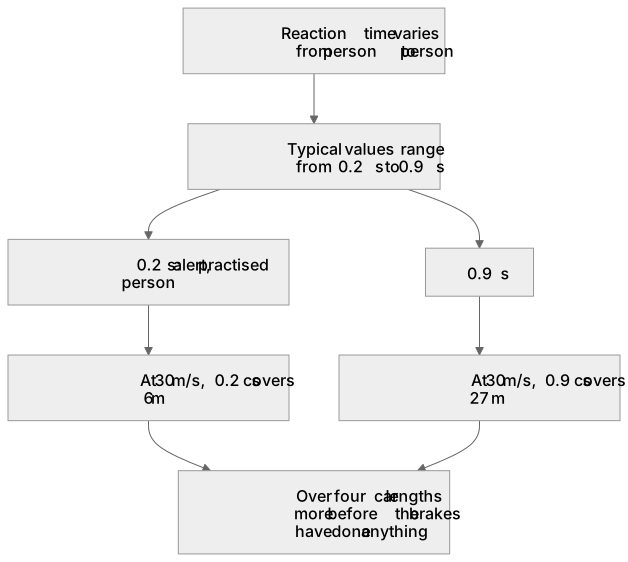
Reaction times are personal: typical values run from about 0.2 s for an alert, practised person to about 0.9 s. They can be measured simply by the ruler drop test, where one student releases a metre rule between another's fingers and the catch distance is converted to a time, or more precisely by a computer test that records the delay between a signal and a key press. Both need several trials and a mean, because reaction time varies from attempt to attempt. The effect on the road is large: at 30 m/s a 0.2 s reaction covers 6 m, while 0.9 s covers 27 m, over four car lengths more before the brakes have done anything at all. Because the values vary so much between people, a class set of results should be reported as a mean together with the range.
What earns the marks
- Quoting a typical reaction time inside the range 0.2 s to 0.9 s.
- Using thinking distance = speed × reaction time.
- A correct substitution such as 30 × 0.7.
- The answer in metres.
Common mistakes and how to put them right
Quoting a reaction time in milliseconds and then substituting the number without converting to seconds.
Giving a reaction time of several seconds, far outside the typical range.
Taking a single measurement rather than repeating and finding a mean.
Assuming every driver has the same reaction time, so one measured value applies to all.
Exam tips
- Learn the range 0.2 s to 0.9 s as a recall fact; questions often ask for a typical value with no data given.
- State the reaction time you are using before the substitution so the examiner can follow it.
- If asked to comment on a measured value, compare it with the typical range rather than calling it right or wrong.
Try the lesson
The start of the Reaction time: Reaction times vary from person to person. Typical values range from 0.2 s to 0.9 s. lesson, made from checked teaching notes for this specification point.
Have a go first
Which of these is a typical reaction time for a person?
Listen
Reaction times are personal: typical values run from about 0.2 s for an alert, practised person to about 0.9 s. They can be measured simply by the ruler drop test, where one student releases a metre rule between another's fingers and the catch distance is converted to a time, or more precisely by a computer test that records the delay between a signal and a key press. Both need several trials and a mean, because reaction time varies from attempt to attempt. The effect on the road is large: at 30 m/s a 0.2 s reaction covers 6 m, while 0.9 s covers 27 m, over four car lengths more before the brakes have done anything at all. Because the values vary so much between people, a class set of results should be reported as a mean together with the range. A strong answer earns marks for these points. quoting a typical reaction time inside the range 0.2 s to 0.9 s. using thinking distance = speed × reaction time. a correct substitution such as 30 × 0.7. the answer in metres. Exam tip: Learn the range 0.2 s to 0.9 s as a recall fact; questions often ask for a typical value with no data given.
See it
Key words
Say what each word means before you turn the card.
typical reaction times
Try answering aloud or in your head before turning the card.
variation between people
Try answering aloud or in your head before turning the card.
ruler drop test
Try answering aloud or in your head before turning the card.
repeats and means
Try answering aloud or in your head before turning the card.
See every definition
- typical reaction times
- Values that range from 0.2 s to 0.9 s, varying from person to person.
- variation between people
- Because values vary so much between people, a class set of results should be reported as a mean together with the range.
- ruler drop test
- One student releases a metre rule between another's fingers and the catch distance is converted to a time.
- repeats and means
- Several trials and a mean are needed because reaction time varies from attempt to attempt.
Label the diagram
Some boxes have lost their names. Pick the right name for each number.
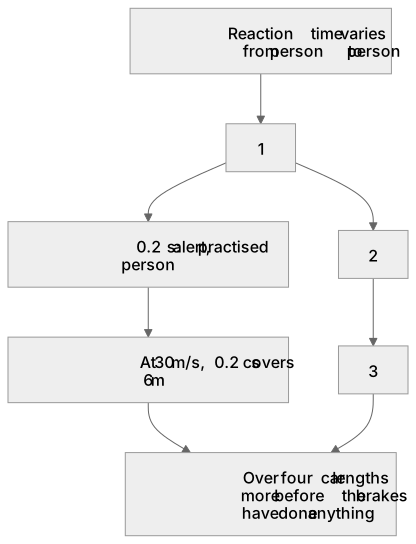
1Box 1
2Box 2
3Box 3
There is more to this lesson
The full lesson goes on to check your understanding and help you earn the marks. Create a free account to carry on, with your progress saved.
A week of Premium from your first lesson · Then the free plan continues · No card, no charge
Test your understanding of Reaction time: Reaction times vary from person to person. Typical values range from 0.2 s to 0.9 s.
Active recall beats re-reading. Take an instant quiz now to test what you’ve learned and lock it into long-term memory.
A week of Premium from your first lesson · Then the free plan continues · No card, no charge