AQA · GCSE · Physics
Course version: 8463 · Version from Sept 2016
The further away the galaxies, the faster they are moving and the bigger…
Full specification wording
Red-shift (physics only): The further away the galaxies, the faster they are moving and the bigger the observed increase in wavelength.
Hubble's key result is a pattern rather than a single number: plot the speed of a galaxy against its distance and the points lie close to a straight line through the origin, so the further away a…
Checked against the AQA 8463 specification (opens in a new tab) on .
- Point 2 of 7
- 3 key terms
Study notes
From the checked teaching notes for this specification point.
The idea
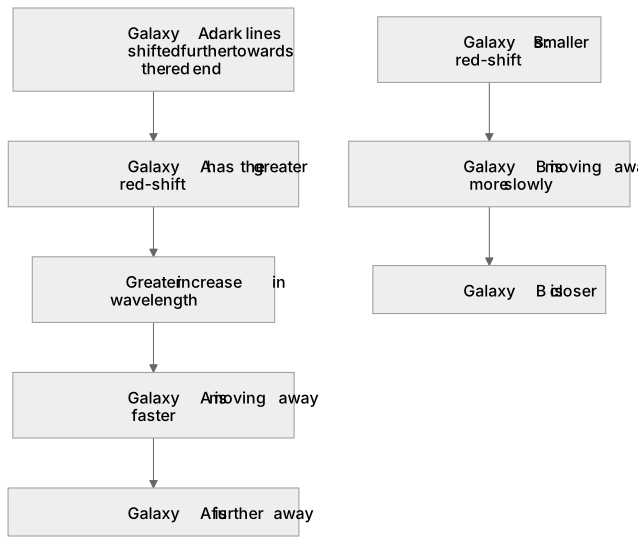
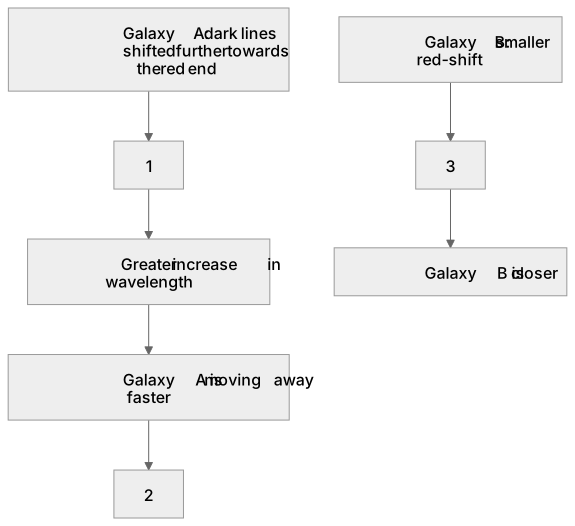
Hubble's key result is a pattern rather than a single number: plot the speed of a galaxy against its distance and the points lie close to a straight line through the origin, so the further away a galaxy is, the faster it is moving away from us. Because a greater speed of recession produces a greater red-shift, distance and red-shift go together too. That is how spectra are read in exam questions. If the dark lines of galaxy A are shifted further towards the red end than those of galaxy B, then A has the greater red-shift, so A is moving away faster, so A is further away. The chain runs shift, then speed, then distance, and each link is usually worth a separate mark.
What earns the marks
- The greater red-shift meaning the greater increase in wavelength.
- The galaxy with the greater red-shift moving away faster.
- That galaxy therefore being further away.
- Describing the relationship as the further away the galaxy, the faster it is receding.
Common mistakes and how to put them right
Getting the chain backwards and concluding that the more shifted galaxy is the closer one.
Saying the galaxies move faster because they are hotter or lighter.
Describing a graph of speed against distance as showing that all galaxies move at the same speed.
Identifying the shift but never stating the conclusion about speed or distance.
Exam tips
- Answer in the order shift, speed, distance, and say which galaxy each statement is about.
- If a graph of speed against distance is given, describe it as a straight line through the origin.
- Quote the letters used in the figure rather than saying the top one, so the comparison is unambiguous.
Try the lesson
The start of the Red-shift (physics only): The further away the galaxies, the faster they are moving and the bigger the observed increase in wavelength. lesson, made from checked teaching notes for this specification point.
Have a go first
What happens to the observed increase in wavelength of light from galaxies as their distance from Earth increases?
Listen
Hubble's key result is a pattern rather than a single number: plot the speed of a galaxy against its distance and the points lie close to a straight line through the origin, so the further away a galaxy is, the faster it is moving away from us. Because a greater speed of recession produces a greater red-shift, distance and red-shift go together too. That is how spectra are read in exam questions. If the dark lines of galaxy A are shifted further towards the red end than those of galaxy B, then A has the greater red-shift, so A is moving away faster, so A is further away. The chain runs shift, then speed, then distance, and each link is usually worth a separate mark. A strong answer earns marks for these points. the greater red-shift meaning the greater increase in wavelength. the galaxy with the greater red-shift moving away faster. that galaxy therefore being further away. describing the relationship as the further away the galaxy, the faster it is receding. Exam tip: Answer in the order shift, speed, distance, and say which galaxy each statement is about.
See it
Key words
Say what each word means before you turn the card.
greater red-shift
Try answering aloud or in your head before turning the card.
receding galaxies
Try answering aloud or in your head before turning the card.
comparing galaxy spectra
Try answering aloud or in your head before turning the card.
See every definition
- greater red-shift
- The greater increase in wavelength, shown by dark lines shifted further towards the red end.
- receding galaxies
- Galaxies moving away from us, where the further away a galaxy is, the faster it is moving.
- comparing galaxy spectra
- Reading the dark lines of two galaxies so that the one shifted further towards the red end has the greater red-shift.
Label the diagram
Some boxes have lost their names. Pick the right name for each number.
1Box 1
2Box 2
3Box 3
There is more to this lesson
The full lesson goes on to check your understanding and help you earn the marks. Create a free account to carry on, with your progress saved.
A week of Premium from your first lesson · Then the free plan continues · No card, no charge
Test your understanding of Red-shift (physics only): The further away the galaxies, the faster they are moving and the bigger the observed increase in wavelength.
Active recall beats re-reading. Take an instant quiz now to test what you’ve learned and lock it into long-term memory.
A week of Premium from your first lesson · Then the free plan continues · No card, no charge