AQA · GCSE · Physics
Course version: 8463 · Version from Sept 2016
Students should be able to: use circuit diagrams to construct and check…
Full specification wording
Series and parallel circuits: Students should be able to: use circuit diagrams to construct and check series and parallel circuits that include a variety of common circuit components describe the difference between series and parallel circuits explain qualitatively why adding resistors in series increases the total resistance whilst adding resistors in parallel decreases the total resistance explain the design and use of dc series circuits for measurement and testing purposes calculate the currents, potential differences and resistances in dc series circuits solve problems for circuits which include resistors in series using the concept of equivalent resistance.
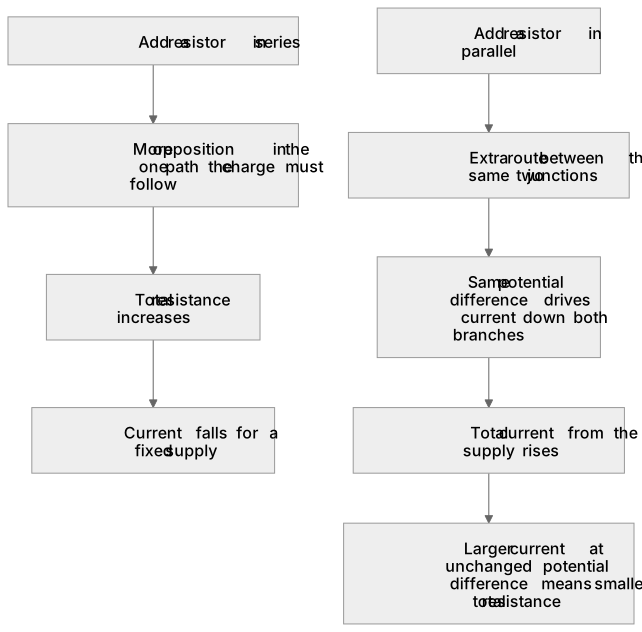
Adding a resistor in series puts more opposition into the one path the charge must follow, so the total resistance rises and, for a fixed supply, the current falls.
Checked against the AQA 8463 specification (opens in a new tab) on .
- Point 3 of 3
Study notes
From the checked teaching notes for this specification point.
The idea
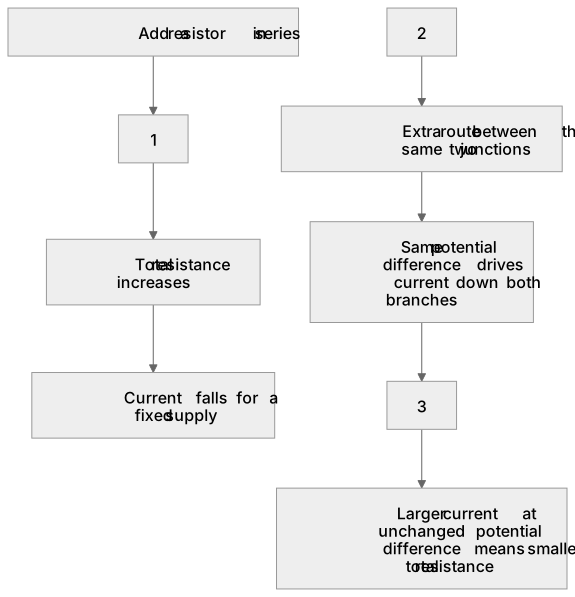
Adding a resistor in series puts more opposition into the one path the charge must follow, so the total resistance rises and, for a fixed supply, the current falls. Adding a resistor in parallel does the opposite: it opens an extra route between the same two junctions, so the same potential difference now drives current down both branches. The total current from the supply rises, and since R = V ÷ I a bigger current at an unchanged potential difference means a smaller total resistance, always smaller than the smallest single branch. That is why a hand warmer draws more power when a second heating element is switched in. Series circuits suit testing because one ammeter reading applies to the whole loop and a variable resistor placed in series controls the current everywhere at once.
What earns the marks
- Stating that a resistor added in parallel provides another path for the charge.
- The total resistance of the circuit decreasing when that branch is added.
- The current increasing because the potential difference across the battery is unchanged.
- Series resistances adding, so that the current falls when a resistor is added in series.
Common mistakes and how to put them right
Assuming more resistors must always mean more resistance, so predicting a smaller current when a parallel branch is added.
Giving a combined parallel resistance larger than one of the individual branch resistances.
Explaining the parallel case by saying the potential difference splits between the branches.
Allowing the supply potential difference to change during the explanation instead of holding it constant.
Exam tips
- For a qualitative explanation, write the chain: extra path, lower total resistance, larger current from the supply.
- 'Explain qualitatively' signals that no parallel resistance calculation is ever required here.
- Quote R = V ÷ I when arguing that a larger total current at the same potential difference means a smaller total resistance.
Try the lesson
The start of the Series and parallel circuits: Students should be able to: use circuit diagrams to construct and check series and parallel circuits that include a variety of common circuit components describe the difference between series and parallel circuits explain qualitatively why adding resistors in series increases the total resistance whilst adding resistors in parallel decreases the total resistance explain the design and use of dc series circuits for measurement and testing purposes calculate the currents, potential differences and resistances in dc series circuits solve problems for circuits which include resistors in series using the concept of equivalent resistance. lesson, made from checked teaching notes for this specification point.
Have a go first
Which statement describes a parallel circuit?
Listen
Adding a resistor in series puts more opposition into the one path the charge must follow, so the total resistance rises and, for a fixed supply, the current falls. Adding a resistor in parallel does the opposite: it opens an extra route between the same two junctions, so the same potential difference now drives current down both branches. The total current from the supply rises, and since R = V ÷ I a bigger current at an unchanged potential difference means a smaller total resistance, always smaller than the smallest single branch. That is why a hand warmer draws more power when a second heating element is switched in. Series circuits suit testing because one ammeter reading applies to the whole loop and a variable resistor placed in series controls the current everywhere at once. A strong answer earns marks for these points. stating that a resistor added in parallel provides another path for the charge. the total resistance of the circuit decreasing when that branch is added. the current increasing because the potential difference across the battery is unchanged. series resistances adding, so that the current falls when a resistor is added in series. Exam tip: For a qualitative explanation, write the chain: extra path, lower total resistance, larger current from the supply.
See it
Label the diagram
Some boxes have lost their names. Pick the right name for each number.
1Box 1
2Box 2
3Box 3
There is more to this lesson
The full lesson goes on to check your understanding and help you earn the marks. Create a free account to carry on, with your progress saved.
A week of Premium from your first lesson · Then the free plan continues · No card, no charge
Test your understanding of Series and parallel circuits: Students should be able to: use circuit diagrams to construct and check series and parallel circuits that include a variety of common circuit components describe the difference between series and parallel circuits explain qualitatively why adding resistors in series increases the total resistance whilst adding resistors in parallel decreases the total resistance explain the design and use of dc series circuits for measurement and testing purposes calculate the currents, potential differences and resistances in dc series circuits solve problems for circuits which include resistors in series using the concept of equivalent resistance.
Active recall beats re-reading. Take an instant quiz now to test what you’ve learned and lock it into long-term memory.
A week of Premium from your first lesson · Then the free plan continues · No card, no charge