AQA · GCSE · Physics
Course version: 8463 · Version from Sept 2016
Students should know that the range of normal human hearing is from 20 Hz…
Full specification wording
Sound waves (physics only) (HT only): Students should know that the range of normal human hearing is from 20 Hz to 20 kHz.
These two figures must be recalled.
Checked against the AQA 8463 specification (opens in a new tab) on .
- Point 6 of 6
- 3 key terms
Study notes
From the checked teaching notes for this specification point.
The idea
These two figures must be recalled. 20 Hz means twenty complete oscillations every second and is the lowest frequency a person with normal hearing can detect; 20 kHz is 20 000 Hz and is the highest. Keep the units straight, because kHz means a thousand hertz, so the audible range spans a factor of one thousand. The numbers matter because they define ultrasound, which is any sound above 20 kHz, and because the wave equation turns them into wavelengths: with the speed of sound in air about 330 m/s, 20 Hz gives a wavelength of about 16.5 m while 20 kHz gives about 1.65 cm. The range is for normal hearing; individuals vary, and the upper limit falls with age and with exposure to loud noise.
What earns the marks
- The lower limit given as 20 Hz.
- The upper limit given as 20 kHz, or as 20 000 Hz.
- A correct conversion from kHz to Hz before using the wave equation.
- Defining ultrasound as sound with a frequency above the upper limit of human hearing.
Common mistakes and how to put them right
Writing the upper limit as 20 kHz but then substituting 20 into a calculation that needs hertz.
Giving the range as 20 Hz to 20 MHz, confusing kilo with mega.
Treating the limits as exact for every person rather than as normal hearing.
Quoting the range in decibels, which measures sound level and not frequency.
Exam tips
- Convert kHz to Hz on the first line of any calculation and show the conversion so it can be credited.
- Recall questions on these values are worth one mark; write the number with its unit and move on.
- If asked whether a given frequency is ultrasound, compare it with 20 000 Hz explicitly.
Try the lesson
The start of the Sound waves (physics only) (HT only): Students should know that the range of normal human hearing is from 20 Hz to 20 kHz. lesson, made from checked teaching notes for this specification point.
Have a go first
A sound wave has a frequency of 15 Hz. Which statement about this sound wave is correct?
Listen
These two figures must be recalled. 20 Hz means twenty complete oscillations every second and is the lowest frequency a person with normal hearing can detect; 20 kHz is 20 000 Hz and is the highest. Keep the units straight, because kHz means a thousand hertz, so the audible range spans a factor of one thousand. The numbers matter because they define ultrasound, which is any sound above 20 kHz, and because the wave equation turns them into wavelengths: with the speed of sound in air about 330 m/s, 20 Hz gives a wavelength of about 16.5 m while 20 kHz gives about 1.65 cm. The range is for normal hearing; individuals vary, and the upper limit falls with age and with exposure to loud noise. A strong answer earns marks for these points. the lower limit given as 20 Hz. the upper limit given as 20 kHz, or as 20 000 Hz. a correct conversion from kHz to Hz before using the wave equation. defining ultrasound as sound with a frequency above the upper limit of human hearing. Exam tip: Convert kHz to Hz on the first line of any calculation and show the conversion so it can be credited.
See it
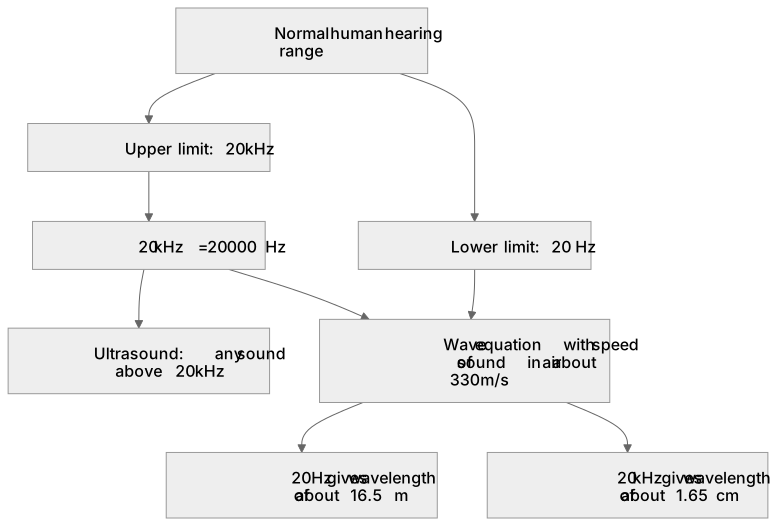
Key words
Say what each word means before you turn the card.
20 Hz
Try answering aloud or in your head before turning the card.
20 kHz
Try answering aloud or in your head before turning the card.
definition of ultrasound
Try answering aloud or in your head before turning the card.
See every definition
- 20 Hz
- Twenty complete oscillations every second, and the lowest frequency a person with normal hearing can detect.
- 20 kHz
- 20 000 Hz, and the highest frequency a person with normal hearing can detect.
- definition of ultrasound
- Any sound with a frequency above the upper limit of human hearing.
Label the diagram
Some boxes have lost their names. Pick the right name for each number.
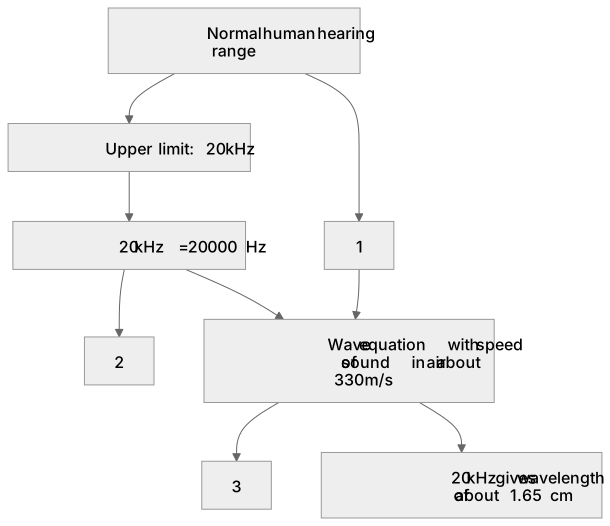
1Box 1
2Box 2
3Box 3
There is more to this lesson
The full lesson goes on to check your understanding and help you earn the marks. Create a free account to carry on, with your progress saved.
A week of Premium from your first lesson · Then the free plan continues · No card, no charge
Test your understanding of Sound waves (physics only) (HT only): Students should know that the range of normal human hearing is from 20 Hz to 20 kHz.
Active recall beats re-reading. Take an instant quiz now to test what you’ve learned and lock it into long-term memory.
A week of Premium from your first lesson · Then the free plan continues · No card, no charge