AQA · GCSE · Physics
Course version: 8463 · Version from Sept 2016
Negatively charged electrons are rubbed off one material and on to the…
Full specification wording
Static charge: Negatively charged electrons are rubbed off one material and on to the other.
Only electrons move.
Checked against the AQA 8463 specification (opens in a new tab) on .
- Point 2 of 9
- 4 key terms
Study notes
From the checked teaching notes for this specification point.
The idea
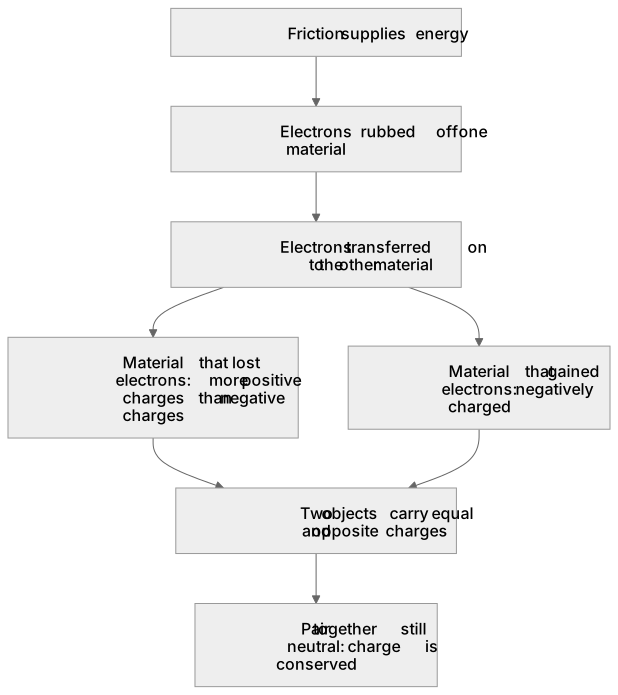
Only electrons move. They sit on the outside of the atom and are the only charged particles free enough to be scraped from one surface onto another, while the positive nuclei are locked in place in the solid. Friction supplies enough energy to strip some electrons from one material and deposit them on the other, so the two objects end up with equal and opposite charges: whatever one gains, the other has lost. Charge is conserved, so the pair together is still neutral. Mark schemes are strict here: any answer mentioning positive charge being transferred, or 'positive electrons', scores zero even when the rest is correct. Say that electrons move, name the direction, then say what that leaves behind.
What earns the marks
- Electrons being transferred from one named material to the other.
- Electrons being negatively charged.
- The material left with more positive charges than negative charges becoming positively charged.
- The two objects carrying equal and opposite amounts of charge.
Common mistakes and how to put them right
Writing that positive charge moves from the cloth to the rod, which scores zero.
Using the phrase 'positive electrons'.
Saying protons are rubbed off the surface.
Stating the final charges without ever naming the particle that moved.
Exam tips
- Open with 'electrons are transferred from ... to ...' so the first mark is secured immediately.
- Never let the word positive sit next to a moving particle in your answer.
- Explain the positive object by what it has lost, not by what it has gained.
Try the lesson
The start of the Static charge: Negatively charged electrons are rubbed off one material and on to the other. lesson, made from checked teaching notes for this specification point.
Have a go first
When a polythene rod is rubbed with a cloth, what is transferred between the two materials?
Listen
Only electrons move. They sit on the outside of the atom and are the only charged particles free enough to be scraped from one surface onto another, while the positive nuclei are locked in place in the solid. Friction supplies enough energy to strip some electrons from one material and deposit them on the other, so the two objects end up with equal and opposite charges: whatever one gains, the other has lost. Charge is conserved, so the pair together is still neutral. Mark schemes are strict here: any answer mentioning positive charge being transferred, or 'positive electrons', scores zero even when the rest is correct. Say that electrons move, name the direction, then say what that leaves behind. A strong answer earns marks for these points. electrons being transferred from one named material to the other. electrons being negatively charged. the material left with more positive charges than negative charges becoming positively charged. the two objects carrying equal and opposite amounts of charge. Exam tip: Open with 'electrons are transferred from ... to ... so the first mark is secured immediately.
See it
Key words
Say what each word means before you turn the card.
electron transfer
Try answering aloud or in your head before turning the card.
conservation of charge
Try answering aloud or in your head before turning the card.
equal and opposite charges
Try answering aloud or in your head before turning the card.
fixed nuclei
Try answering aloud or in your head before turning the card.
See every definition
- electron transfer
- Negatively charged electrons are rubbed off one material and on to the other, and only electrons move.
- conservation of charge
- Charge is conserved, so the pair together is still neutral.
- equal and opposite charges
- The two objects end up with equal and opposite charges: whatever one gains, the other has lost.
- fixed nuclei
- The positive nuclei are locked in place in the solid.
Label the diagram
Some boxes have lost their names. Pick the right name for each number.
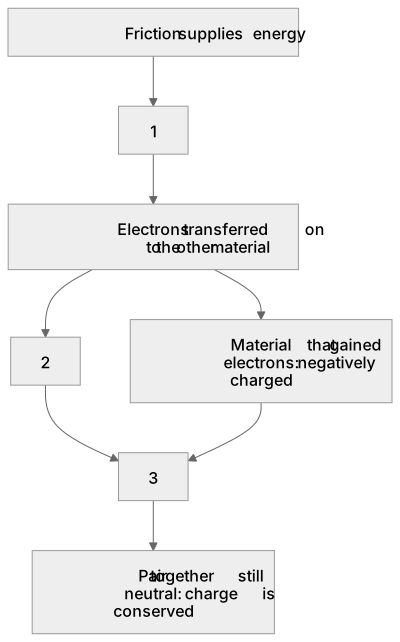
1Box 1
2Box 2
3Box 3
There is more to this lesson
The full lesson goes on to check your understanding and help you earn the marks. Create a free account to carry on, with your progress saved.
A week of Premium from your first lesson · Then the free plan continues · No card, no charge
Test your understanding of Static charge: Negatively charged electrons are rubbed off one material and on to the other.
Active recall beats re-reading. Take an instant quiz now to test what you’ve learned and lock it into long-term memory.
A week of Premium from your first lesson · Then the free plan continues · No card, no charge