AQA · GCSE · Physics
Course version: 8463 · Version from Sept 2016
If the temperature of the system increases, the increase in temperature…
Full specification wording
Temperature changes in a system and specific heat capacity: If the temperature of the system increases, the increase in temperature depends on the mass of the substance heated, the type of material and the energy input to the system.
Heating a system raises its internal energy, and how far the temperature climbs is set by three things.
Checked against the AQA 8463 specification (opens in a new tab) on .
- Point 1 of 3
- 4 key terms
Study notes
From the checked teaching notes for this specification point.
The idea
Heating a system raises its internal energy, and how far the temperature climbs is set by three things. More energy in gives a bigger rise. More mass gives a smaller rise, because the same energy is shared between more particles. The material matters through its specific heat capacity: 4200 J will raise 1 kg of water by 1 °C but will raise 1 kg of copper (c = 385 J/kg °C) by about 11 °C. Rearranging ΔE = m c Δθ makes this explicit, Δθ = ΔE ÷ (m c), so temperature rise is proportional to energy in and inversely proportional to both mass and specific heat capacity. This is why a reactor wall is built from a material with a very high specific heat capacity: a huge energy transfer then produces only a small temperature rise, keeping the wall below its melting point.
What earns the marks
- Stating that a larger energy input produces a larger temperature rise when mass and material are unchanged.
- Stating that a larger mass of the same substance gives a smaller temperature rise for the same energy input.
- Naming the property of the material as its specific heat capacity.
- Linking a high specific heat capacity to a small temperature increase for a large energy transfer, for example a reactor wall that does not reach its melting point.
Common mistakes and how to put them right
Claiming a larger mass reaches a higher temperature for the same energy supplied.
Using the words temperature and thermal energy as though they mean the same thing.
Assuming two equal masses given the same energy always end at the same temperature, whatever the material.
Treating specific heat capacity as a measure of how hot a substance can get rather than how much energy each degree costs.
Exam tips
- When a question says which factors affect the temperature rise, name all three: energy transferred, mass, and the material's specific heat capacity.
- If a question asks why a material was chosen, answer in terms of the size of the temperature change it produces, not just in terms of the value of c.
- Hold the other factors constant in your answer; examiners look for comparisons of the same mass or the same energy input.
Try the lesson
The start of the Temperature changes in a system and specific heat capacity: If the temperature of the system increases, the increase in temperature depends on the mass of the substance heated, the type of material and the energy input to the system. lesson, made from checked teaching notes for this specification point.
Have a go first
Two identical heaters supply the same amount of energy to two different liquids of equal mass. The liquids warm up by different amounts. Which factor explains the different temperature increases?
Listen
Heating a system raises its internal energy, and how far the temperature climbs is set by three things. More energy in gives a bigger rise. More mass gives a smaller rise, because the same energy is shared between more particles. The material matters through its specific heat capacity: 4200 J will raise 1 kg of water by 1 °C but will raise 1 kg of copper (c = 385 J/kg °C) by about 11 °C. Rearranging ΔE = m c Δθ makes this explicit, Δθ = ΔE ÷ (m c), so temperature rise is proportional to energy in and inversely proportional to both mass and specific heat capacity. This is why a reactor wall is built from a material with a very high specific heat capacity: a huge energy transfer then produces only a small temperature rise, keeping the wall below its melting point. A strong answer earns marks for these points. stating that a larger energy input produces a larger temperature rise when mass and material are unchanged. stating that a larger mass of the same substance gives a smaller temperature rise for the same energy input. naming the property of the material as its specific heat capacity. linking a high specific heat capacity to a small temperature increase for a large energy transfer, for example a reactor wall that does not reach its melting point. Exam tip: When a question says which factors affect the temperature rise, name all three: energy transferred, mass, and the material's specific heat capacity.
See it
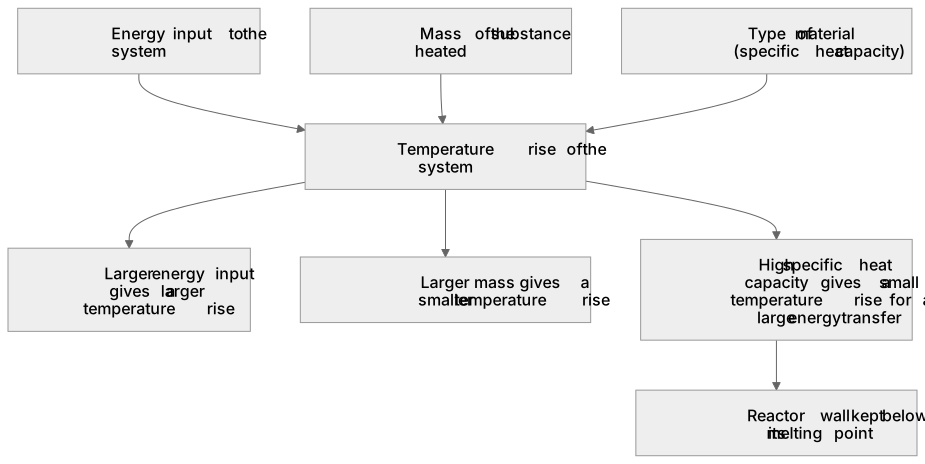
Key words
Say what each word means before you turn the card.
specific heat capacity
Try answering aloud or in your head before turning the card.
internal energy
Try answering aloud or in your head before turning the card.
mass and temperature rise
Try answering aloud or in your head before turning the card.
choosing materials
Try answering aloud or in your head before turning the card.
See every definition
- specific heat capacity
- The property of the material that, together with mass and energy input, sets how far the temperature of a heated system climbs.
- internal energy
- What is raised when a system is heated, with the temperature climb set by mass, material and energy input.
- mass and temperature rise
- For the same energy input, a larger mass of the same substance gives a smaller temperature rise.
- choosing materials
- A material with a very high specific heat capacity is chosen so a huge energy transfer produces only a small temperature rise.
Label the diagram
Some boxes have lost their names. Pick the right name for each number.
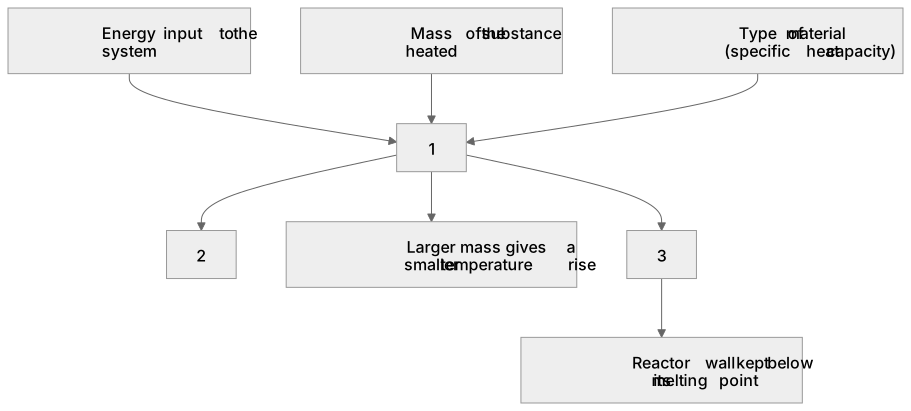
1Box 1
2Box 2
3Box 3
There is more to this lesson
The full lesson goes on to check your understanding and help you earn the marks. Create a free account to carry on, with your progress saved.
A week of Premium from your first lesson · Then the free plan continues · No card, no charge
Test your understanding of Temperature changes in a system and specific heat capacity: If the temperature of the system increases, the increase in temperature depends on the mass of the substance heated, the type of material and the energy input to the system.
Active recall beats re-reading. Take an instant quiz now to test what you’ve learned and lock it into long-term memory.
A week of Premium from your first lesson · Then the free plan continues · No card, no charge