AQA · GCSE · Physics
Course version: 8463 · Version from Sept 2016
The plum pudding model suggested that the atom is a ball of positive…
Full specification wording
The development of the model of the atom (common content with chemistry): The plum pudding model suggested that the atom is a ball of positive charge with negative electrons embedded in it.
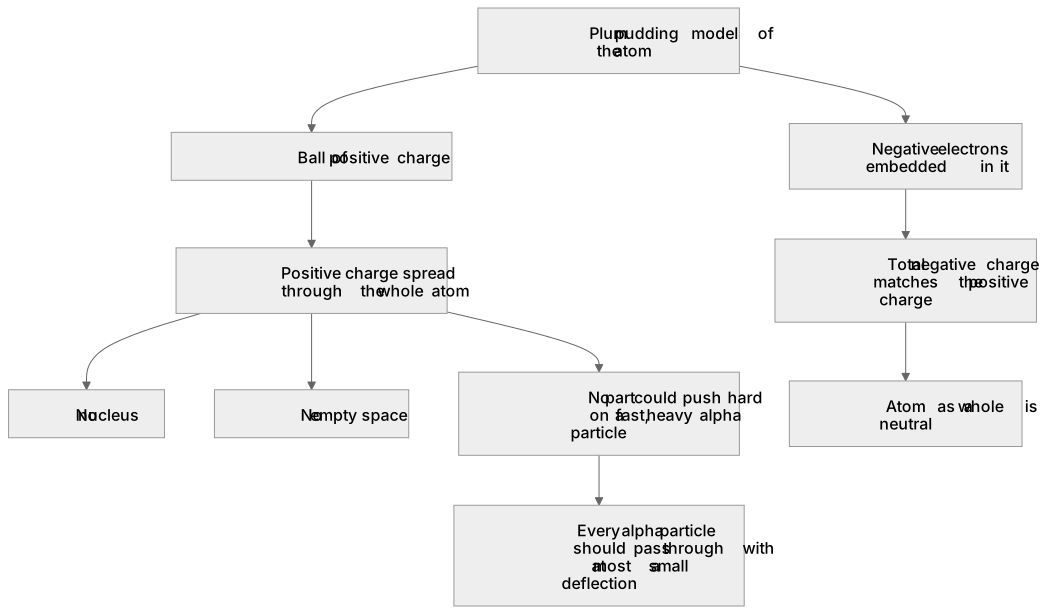
In the plum pudding model the whole atom is a sphere of positive charge, spread out evenly through its volume, with negatively charged electrons embedded in it like fruit in a pudding.
Checked against the AQA 8463 specification (opens in a new tab) on .
- Point 4 of 12
- 4 key terms
Study notes
From the checked teaching notes for this specification point.
The idea
In the plum pudding model the whole atom is a sphere of positive charge, spread out evenly through its volume, with negatively charged electrons embedded in it like fruit in a pudding. There is no nucleus and no empty space: matter and charge fill the atom uniformly. The amount of positive charge exactly matches the total negative charge of the electrons, so the atom as a whole is neutral. This picture makes a clear prediction about the alpha scattering experiment. Because the positive charge is thinly spread, no part of the atom could push hard on a fast, heavy alpha particle, so every alpha particle should pass through with at most a small deflection.
What earns the marks
- A ball or sphere of positive charge.
- Negatively charged electrons embedded within that positive charge.
- Stating that the positive charge is spread through the whole atom, with no nucleus.
- Stating that the overall charge of the atom is zero.
Common mistakes and how to put them right
Drawing a central positive nucleus with electrons around it and calling it the plum pudding model.
Reversing the parts, so the electrons become the pudding and the positive charge the plums.
Saying this model described the atom as mostly empty space.
Omitting the word positive when describing the ball.
Exam tips
- Describe the model in two halves, the positive ball and the embedded electrons, for two easy marks.
- Add that there is no nucleus, because comparison questions usually award that difference.
- Use the model's prediction about alpha particles as the bridge to the next part of the story.
Try the lesson
The start of the The development of the model of the atom (common content with chemistry): The plum pudding model suggested that the atom is a ball of positive charge with negative electrons embedded in it. lesson, made from checked teaching notes for this specification point.
Have a go first
Which of the following best describes the structure of the atom according to the plum pudding model?
Listen
In the plum pudding model the whole atom is a sphere of positive charge, spread out evenly through its volume, with negatively charged electrons embedded in it like fruit in a pudding. There is no nucleus and no empty space: matter and charge fill the atom uniformly. The amount of positive charge exactly matches the total negative charge of the electrons, so the atom as a whole is neutral. This picture makes a clear prediction about the alpha scattering experiment. Because the positive charge is thinly spread, no part of the atom could push hard on a fast, heavy alpha particle, so every alpha particle should pass through with at most a small deflection. A strong answer earns marks for these points. a ball or sphere of positive charge. negatively charged electrons embedded within that positive charge. stating that the positive charge is spread through the whole atom, with no nucleus. stating that the overall charge of the atom is zero. Exam tip: Describe the model in two halves, the positive ball and the embedded electrons, for two easy marks.
See it
Key words
Say what each word means before you turn the card.
plum pudding model
Try answering aloud or in your head before turning the card.
spread out positive charge
Try answering aloud or in your head before turning the card.
embedded electrons
Try answering aloud or in your head before turning the card.
no nucleus
Try answering aloud or in your head before turning the card.
See every definition
- plum pudding model
- A model suggesting that the atom is a ball of positive charge with negative electrons embedded in it.
- spread out positive charge
- The whole atom is a sphere of positive charge, spread out evenly through its volume.
- embedded electrons
- Negatively charged electrons sit within the positive charge like fruit in a pudding.
- no nucleus
- There is no nucleus and no empty space, as matter and charge fill the atom uniformly.
Label the diagram
Some boxes have lost their names. Pick the right name for each number.
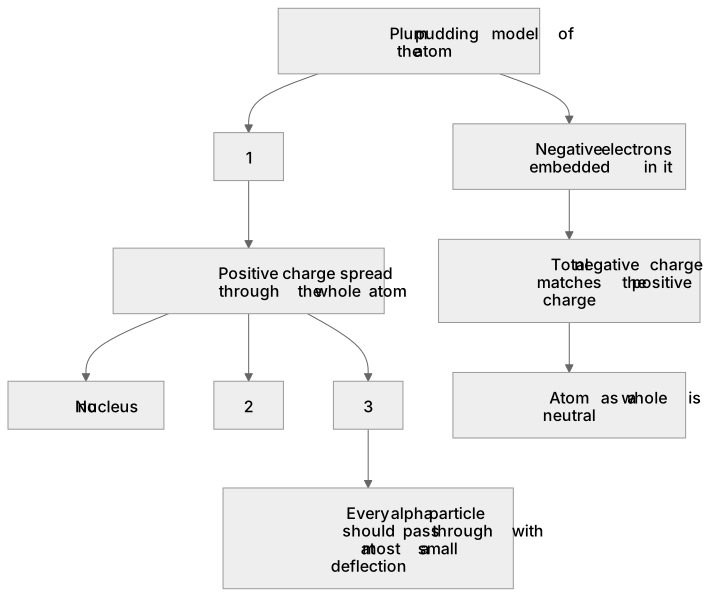
1Box 1
2Box 2
3Box 3
There is more to this lesson
The full lesson goes on to check your understanding and help you earn the marks. Create a free account to carry on, with your progress saved.
A week of Premium from your first lesson · Then the free plan continues · No card, no charge
Test your understanding of The development of the model of the atom (common content with chemistry): The plum pudding model suggested that the atom is a ball of positive charge with negative electrons embedded in it.
Active recall beats re-reading. Take an instant quiz now to test what you’ve learned and lock it into long-term memory.
A week of Premium from your first lesson · Then the free plan continues · No card, no charge