AQA · GCSE · Physics
Course version: 8463 · Version from Sept 2016
The theoretical calculations of Bohr agreed with experimental observations.
Full specification wording
The development of the model of the atom (common content with chemistry): The theoretical calculations of Bohr agreed with experimental observations.
A suggestion becomes an accepted model only when its predictions are tested against measurement.
Checked against the AQA 8463 specification (opens in a new tab) on .
- Point 8 of 12
- 4 key terms
Study notes
From the checked teaching notes for this specification point.
The idea
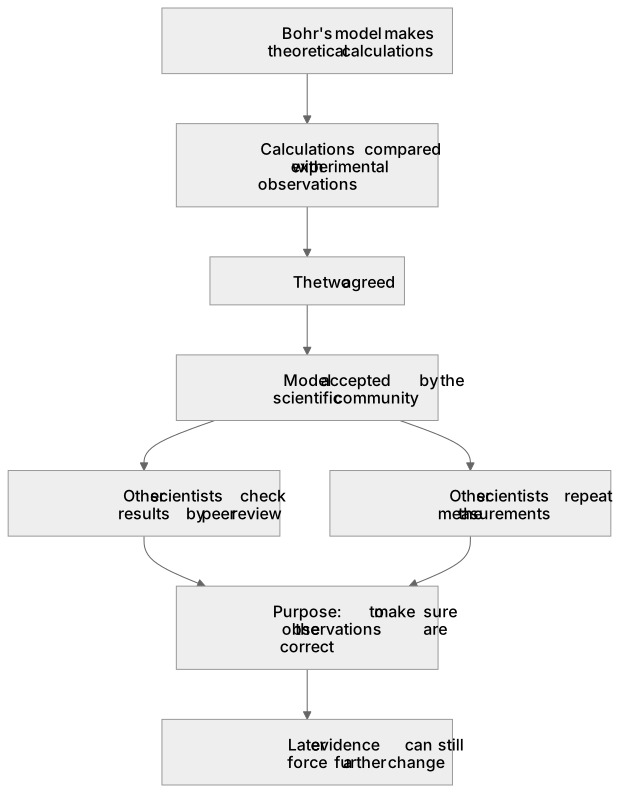
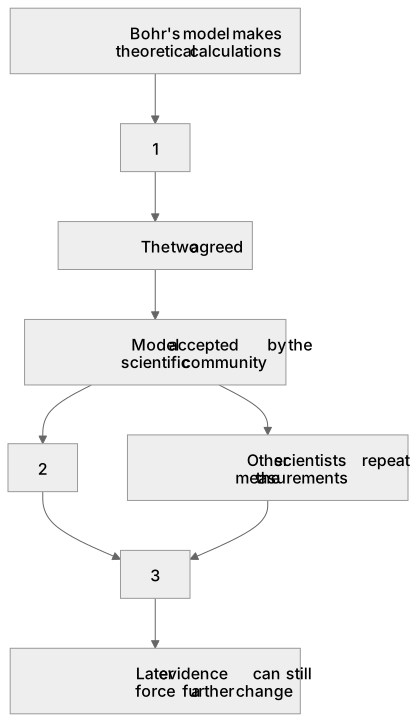
A suggestion becomes an accepted model only when its predictions are tested against measurement. Bohr's idea of fixed orbits allowed him to calculate values that could be compared directly with what experimenters had measured, and the two agreed. That agreement, not Bohr's reputation, is why the scientific community adopted his version of the atom. The process is general: a model makes a prediction, experiments test it, and other scientists check the work by peer review and by repeating the measurements themselves, which is done to make sure the observations are correct. Agreement never makes a model permanent, since later evidence can still force a further change.
What earns the marks
- Stating that Bohr's theoretical calculations were compared with experimental measurements.
- Stating that the two agreed, which is why the model was accepted.
- Stating that a model is accepted only when its predictions match observations.
- Stating that other scientists check results by peer review or by repeating the work.
Common mistakes and how to put them right
Saying the model was accepted because Bohr was a respected scientist.
Treating agreement with one set of results as proof that a model can never change.
Saying a theory is accepted before any evidence has been collected.
Confusing peer review with publicity in newspapers or on television.
Exam tips
- Answer acceptance questions with the phrase calculations agreed with experimental observations.
- If peer review is mentioned, state its purpose: to check that the observations are correct.
- Say models remain open to change; examiners reward that caution.
Try the lesson
The start of the The development of the model of the atom (common content with chemistry): The theoretical calculations of Bohr agreed with experimental observations. lesson, made from checked teaching notes for this specification point.
Have a go first
What provided support for Niels Bohr's theoretical calculations of the atom?
Listen
A suggestion becomes an accepted model only when its predictions are tested against measurement. Bohr's idea of fixed orbits allowed him to calculate values that could be compared directly with what experimenters had measured, and the two agreed. That agreement, not Bohr's reputation, is why the scientific community adopted his version of the atom. The process is general: a model makes a prediction, experiments test it, and other scientists check the work by peer review and by repeating the measurements themselves, which is done to make sure the observations are correct. Agreement never makes a model permanent, since later evidence can still force a further change. A strong answer earns marks for these points. stating that Bohr's theoretical calculations were compared with experimental measurements. stating that the two agreed, which is why the model was accepted. stating that a model is accepted only when its predictions match observations. stating that other scientists check results by peer review or by repeating the work. Exam tip: Answer acceptance questions with the phrase calculations agreed with experimental observations.
See it
Key words
Say what each word means before you turn the card.
agreement with observations
Try answering aloud or in your head before turning the card.
peer review
Try answering aloud or in your head before turning the card.
accepting a model
Try answering aloud or in your head before turning the card.
how science works
Try answering aloud or in your head before turning the card.
See every definition
- agreement with observations
- When a model's predictions are tested against measurement and the two agree, which is why the scientific community adopted Bohr's version of the atom.
- peer review
- Other scientists check the work, done to make sure the observations are correct.
- accepting a model
- A suggestion becomes an accepted model only when its predictions are tested against measurement.
- how science works
- A model makes a prediction, experiments test it, and other scientists check the work by peer review and by repeating the measurements themselves.
Label the diagram
Some boxes have lost their names. Pick the right name for each number.
1Box 1
2Box 2
3Box 3
There is more to this lesson
The full lesson goes on to check your understanding and help you earn the marks. Create a free account to carry on, with your progress saved.
A week of Premium from your first lesson · Then the free plan continues · No card, no charge
Test your understanding of The development of the model of the atom (common content with chemistry): The theoretical calculations of Bohr agreed with experimental observations.
Active recall beats re-reading. Take an instant quiz now to test what you’ve learned and lock it into long-term memory.
A week of Premium from your first lesson · Then the free plan continues · No card, no charge