AQA · GCSE · Physics
Course version: 8463 · Version from Sept 2016
A star goes through a life cycle. The life cycle is determined by the size…
Full specification wording
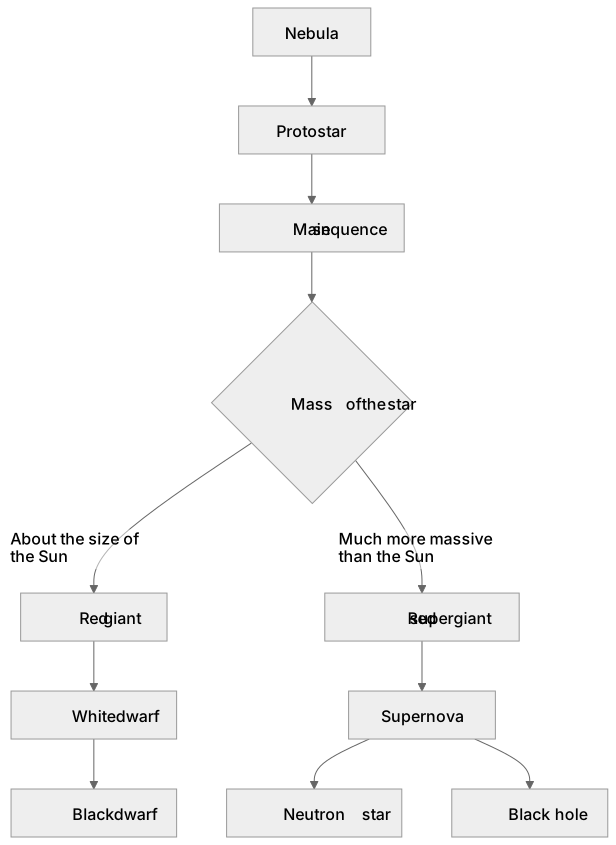
The life cycle of a star: A star goes through a life cycle. The life cycle is determined by the size of the star.
Every star follows the same opening: nebula, protostar, main sequence.
Checked against the AQA 8463 specification (opens in a new tab) on .
- Point 1 of 5
- 4 key terms
Study notes
From the checked teaching notes for this specification point.
The idea
Every star follows the same opening: nebula, protostar, main sequence. What happens afterwards is decided by the mass of the star, which is what the specification means by size. Stars about the size of the Sun swell into a red giant, then shed their outer layers and shrink into a white dwarf, which slowly cools into a black dwarf. Stars much more massive than the Sun swell into a red supergiant and then explode as a supernova, leaving behind either a neutron star or, for the most massive of all, a black hole. Mass also sets the pace, because a more massive star uses up its hydrogen faster and has a shorter main sequence life, so the biggest stars are also the shortest lived.
What earns the marks
- All stars starting as a nebula and passing through the protostar and main sequence stages.
- The mass of the star deciding which route it takes afterwards.
- A correct route for a star of about the mass of the Sun.
- A correct route for a star much more massive than the Sun.
Common mistakes and how to put them right
Thinking a bigger star lives longer, when a more massive star uses its hydrogen up faster.
Saying that the Sun will end its life as a supernova.
Putting red giant and white dwarf in the wrong order.
Writing that the life cycle depends on the star's temperature or brightness rather than on its mass.
Exam tips
- Sketch the two branches as a flow chart and learn them as a pair, not as one long list.
- Read the stem for the mass of the star before choosing which route to describe.
- Use the full names, red supergiant and white dwarf, because giant on its own is ambiguous.
Try the lesson
The start of the The life cycle of a star: A star goes through a life cycle. The life cycle is determined by the size of the star. lesson, made from checked teaching notes for this specification point.
Have a go first
Which property of a star determines the path its life cycle will take?
Listen
Every star follows the same opening: nebula, protostar, main sequence. What happens afterwards is decided by the mass of the star, which is what the specification means by size. Stars about the size of the Sun swell into a red giant, then shed their outer layers and shrink into a white dwarf, which slowly cools into a black dwarf. Stars much more massive than the Sun swell into a red supergiant and then explode as a supernova, leaving behind either a neutron star or, for the most massive of all, a black hole. Mass also sets the pace, because a more massive star uses up its hydrogen faster and has a shorter main sequence life, so the biggest stars are also the shortest lived. A strong answer earns marks for these points. all stars starting as a nebula and passing through the protostar and main sequence stages. the mass of the star deciding which route it takes afterwards. a correct route for a star of about the mass of the Sun. a correct route for a star much more massive than the Sun. Exam tip: Sketch the two branches as a flow chart and learn them as a pair, not as one long list.
See it
Key words
Say what each word means before you turn the card.
stellar life cycle
Try answering aloud or in your head before turning the card.
mass decides the route
Try answering aloud or in your head before turning the card.
main sequence
Try answering aloud or in your head before turning the card.
two branches
Try answering aloud or in your head before turning the card.
See every definition
- stellar life cycle
- The series of stages a star goes through, which is determined by the size of the star.
- mass decides the route
- The mass of the star decides which route it takes after the main sequence.
- main sequence
- One of the stages that every star passes through before the two routes separate.
- two branches
- The two routes that separate after the main sequence, which should be sketched as a flow chart and learned as a pair.
Label the diagram
Some boxes have lost their names. Pick the right name for each number.
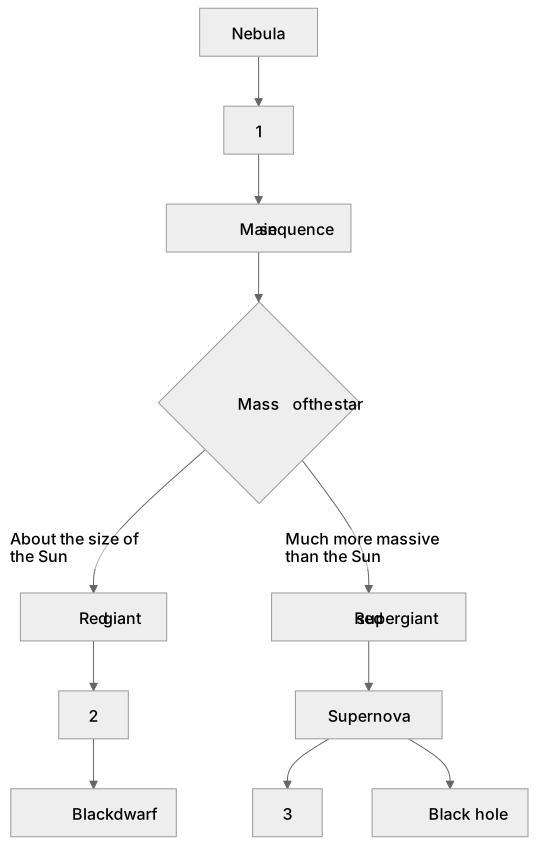
1Box 1
2Box 2
3Box 3
There is more to this lesson
The full lesson goes on to check your understanding and help you earn the marks. Create a free account to carry on, with your progress saved.
A week of Premium from your first lesson · Then the free plan continues · No card, no charge
Test your understanding of The life cycle of a star: A star goes through a life cycle. The life cycle is determined by the size of the star.
Active recall beats re-reading. Take an instant quiz now to test what you’ve learned and lock it into long-term memory.
A week of Premium from your first lesson · Then the free plan continues · No card, no charge